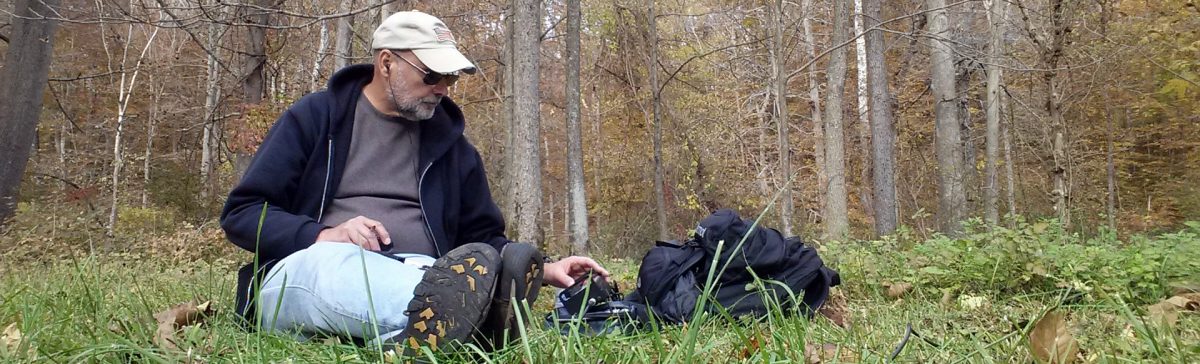
POTA Repeat Offender and SKCC WES

The monthly running of the Straight Key Century Club’s Weekend Sprintathon (WES) contest was this weekend. I needed two more activations at Marsh Creek State Park for a POTA “Repeat Offender” award, so I headed out both Saturday and Sunday for POTA/WWFF activations and to make a few WES contacts.

We had some outstanding weather here in southeastern Pennsylvania, so I knew Marsh Creek (US-1380, KFF-1380) was going to be pretty busy. Given that, I headed out early on Saturday morning. I found a parking spot in the boat launch area, but the parking lot was filling up fast. 

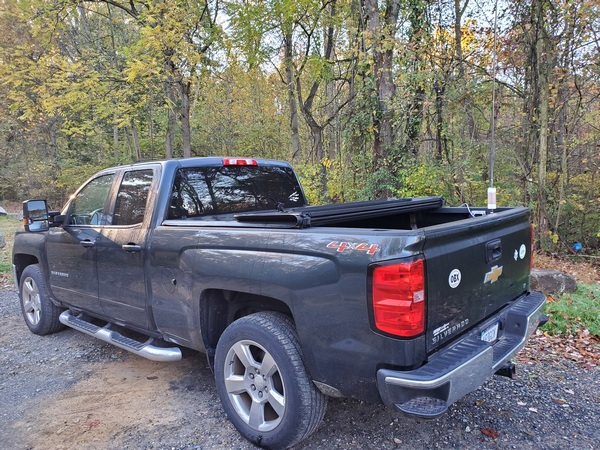
My location in Marsh Creek State Park (US-1380, KFF-1380) for a POTA activation and the SKCC WES
My location in Marsh Creek State Park (US-1380, KFF-1380) for a POTA/WWFF activation and the SKCC WES

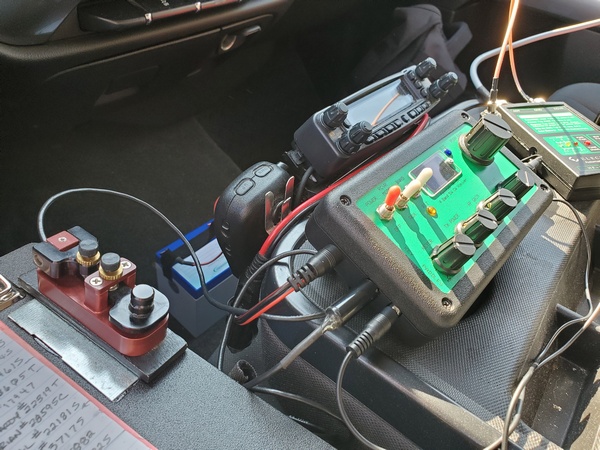
My trusty Penntek TR-35 was the perfect rig for this weekend. The TR-35’s separate straight key and paddle inputs let me instantly switch between the two without having to make configuration changes in the radio. I also went with my usual 12-foot whip and homebrew loading coil

The separate straight key and paddle inputs on the TR-35 lets me instantly switch between the two. (Note to Self: Clean out your truck!)

The 40M band was alive and well, so I spent most of my time there. I alternated between calling “CQ POTA” with the paddles and searching and pouncing SKCC WES stations with my little MS2 straight key. In about an hour of operating, I logged 26 contacts. Among those were three park-to-park QSOs and six SKCC WES QSOs. 

As great as the weather was on Saturday, it was even better on Sunday. I wanted to attend my grandson’s hockey game, so I went out even earlier this time and kept it even shorter. Even though I got an earlier start than the day before, the parking lot was even more crowded this time around. 

Once again, 40M was in excellent shape, and I ended up staying there for the duration. I logged 19 contacts in about 45 minutes, with three park-to-park and three more WES contacts. Then it was time to head home to take care of a few things before going to the soccer game.

In the end, I didn’t set any records in the WES contest, but I got in the two activations needed for my Repeat Offender award. 

72, Craig WB3GCK

Dusting Off My Z-Match

I was recently looking at some of my older gear gathering dust on the shelf, so I resolved to start putting it to use. So yesterday, before I headed out for Ridley Creek State Park (US-1414, KFF-1414), I grabbed my old homebrew z-match antenna tuner and gave my Elecraft T1 tuner the day off.

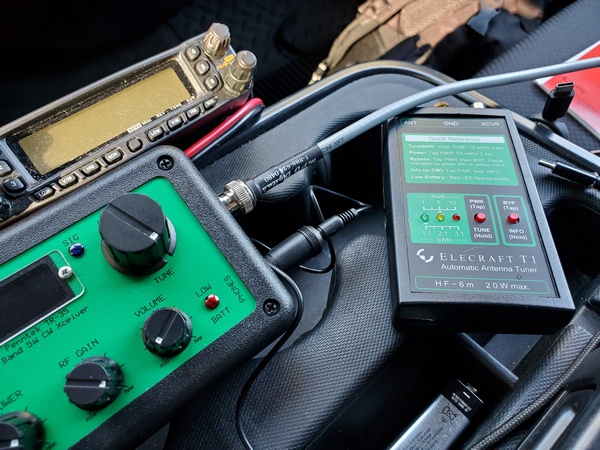
I built this tuner from scratch about 24 years ago, and it has always been one of my favorite projects. Based on a bunch of different designs, it gave me years of great service. For years, my go-to portable rig was my old FT-817 coupled with this tuner. Today, I paired the z-match with my Penntek TR-35 (5 watts, CW). I used my 12-foot whip and homebrew loading coil mounted on the truck. The loaded whip’s SWR on 40M and 30M is just slightly high, nothing the old z-match can’t handle. 

My old homebrew z-match ATU along with my TR-35

I’ve been spoiled using automatic antenna tuners lately, but tuning the z-match was a cinch. Just peak the received noise, switch in the resistive SWR bridge, key up the rig, and tweak the knobs to extinguish the LED. Then switch out the bridge and go. 

The z-match is a high-Q, narrow bandwidth device, so when changing frequencies on a band, I did a check with the SWR bridge before transmitting. It just took a minor tweak to extinquish the LED again.

It was a pretty good day on the bands. I split my time between 40M and 20M. I ended up with 28 QSOs. Among them was one park-to-park contact and one DX contact (IW2NXI). I forgot my water bottle, so my parched throat (and famously short attention span) prompted me to pull the plug after an hour on the air. Activation #20 from US-1414 was in the books.

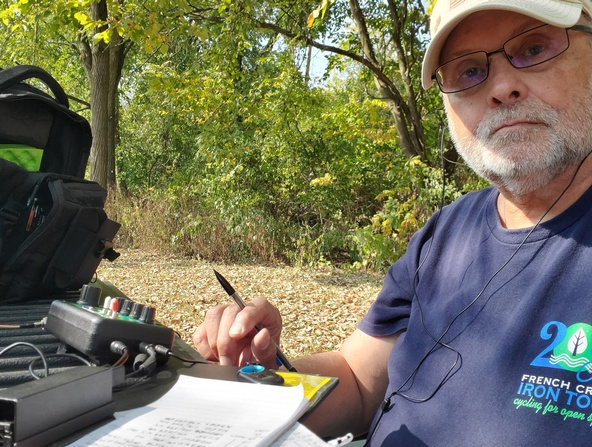
My homebrew z-match was an integral part of my portable setups back in the day. In this picture from 2001, I was using it with a doublet fed with TV twinlead.
My homebrew z-match was an integral part of my portable setups back in the day. In this picture from 2001, I was using it with a 40M doublet fed with TV twinlead.

My little Elecraft T1 tuner certainly has a size and weight advantage over my homebrew z-match. It’s certainly is easier to use, too. However the z-match can handle both balanced and unbalanced loads, and it doesn’t need a battery.

I have some other old gear in mind for future activations. A couple of rigs could make for some challenging activations.

Stay tuned.

72, Craig WB3GCK

Three in a Row at State Game Lands 246

Due to a medical emergency in the family, I unexpectedly spent the Labor Day weekend at my daughter’s house in central Pennsylvania. My (far) better half and I went out to help where we could. Thankfully, our family member’s medical situation was coming under control, so I was able to squeeze in three short activations over the weekend, while still being available to help out.

I’ve always been an early riser, and that worked to my advantage over the weekend. Pennsylvania State Game Lands 246 (US-8941, KFF-5862) is just a few minutes away, so my plan was to head over there early and keep my activations short. On all three days, I was onsite and set up at 0800 local time and back at the house around 0900. By the time I got back, everyone else was just getting up, so I was back in time for breakfast. 

Entrance to the trailhead in PA State Game Lands 246
Entrance to Roundtop Trail in PA State Game Lands 246

Unlike my last visit, I had my truck this time. On all three activations, I used my usual Penntek TR-35 (5 watts, CW) and a 12-foot whip with my homebrew loading coil

On Saturday morning, I gulped down a cup of coffee and headed out the door. Less than 15 minutes later, I was on location and ready to go. The bands seemed in pretty good shape. I stayed on 40M the whole time and logged 17 contacts in about 40 minutes.

On Sunday, things went downhill a bit. It was rainy and the geomagnetic conditions were unsettled. Signals were much weaker than the day before, and there was some constant noise on the bands. Despite the conditions, I still managed to squeak out 13 contacts in about 40 minutes, including two park-to-park contacts. The rain stopped by the time I started packing up, so I had a chance to dry off the whip and loading coil before packing them away in the truck. 

I went back out on Monday morning, and boy, what a difference a day makes. Conditions on 40M were great, and there were plenty of hunters out there. This time out, I logged 26 contacts in 40 minutes, with three park-to-park contacts. The activity was fast and furious at times.

How about that! My three activations put me in the Park Leaders list for US-8941.
How about that! My recent activations put me on the Park Leaders list for US-8941.

I really appreciate all the hunters who were out there during my early morning activations. There were even a few who worked me on all three days:

  • KQ4CW in VA
  • WA1HRH in NH
  • WX4TW in NC

Medically, my family member is doing much better, so I wrapped up my trip and headed home Monday evening.

I hope everyone had a fun and safe holiday weekend. 

72, Craig WB3GCK

Off to a Slow Start

The (far) better half and I made a trip out to central Pennsylvania to attend some activities our grand-kids are taking part in. I had some time on Saturday morning for a quick activation, so I drove a few miles down the road to nearby PA State Game Lands (US-8941, KFF-5862). 

We made the trip in the (far) better half’s little Chevy Traiblazer, so like a previous trip, I went with a simple setup. Along with my Penntek TR-35 (5W, CW), I used my Elecraft AX1 on a clip-on window mount. The diminutive AX1 has always gotten the job done in the past, so I hoped for similar results today.

My AX1 on the window mount

Today, I had a couple of things working against me: doing an early morning activation (0900 local time) on 20M coupled with some unsettled geomagnetic conditions. Not to mention running 5 watts into a 45-inch loaded whip. Still, I enjoy a challenge. Or maybe I’m just a glutton for punishment.  

With the AX1, it only took a few minutes to get set up and get on the air. After spotting myself, it took nine minutes of CQing to make my first contact. Then, 19 minutes after that, I made contact number two. Yikes! It was looking like I was headed for my first busted activation with the AX1. I also began wishing I had brought my Gabil GRA-7350TC and mag mount, so I could have made some contacts down on 40M. Undeterred, I pressed on.

The crowded operating position in my (far) better half's car
The crowded operating position in my (far) better half’s car

Not too long after that, things picked up a bit, and I started getting some more callers. Either the band conditions were improving or the hunters were waking up and getting out of bed. One of those callers was OH1MM. I had a weak copy on him, so I can only imagine what my QRP signal sounded like in Finland.  

An hour after arriving onsite, I had 14 contacts, including one park-to-park and one DX contact. I was happy with that, so I packed up and headed back to my daughter’s house for a late breakfast. 

So, despite getting off to a slow start, my little AX1’s undefeated streak remains intact. 

72, Craig WB3GCK

Outer Banks 2024

Well, the 2024 edition of our annual Outer Banks family vacation has come and gone. My (far) better half and I, along with our two daughters and their families, converged on a rental house in Duck, North Carolina. Of course, ham radio (for me, at least) was a part of that vacation. 

Our view of Currituck Sound

After an early morning start, our long drive from Pennsylvania to North Carolina on Sunday was relatively uneventful, and the traffic on the Outer Banks wasn’t too bad. We all arrived safely, albeit a little road weary. 

This year, we rented the same house overlooking Currituck Sound we were in last year. Being familiar with the layout of the rental house, I had an entire year to think about my antenna situation. The vertical I used the last time was somewhat noisy on 40M, and my 31-foot Jackite pole really took a beating in the wind. This year, I tried something a little different. 

My antenna layout. The wire wasn't visible in the picture, so I enhanced it. The coax dropped straight down from the unun and through the ground floor window.
My antenna layout. The wire wasn’t visible in the picture, so I enhanced it. The coax dropped straight down from the unun and through the ground floor window.

I wanted to avoid using a telescopic pole, so I strapped my homebrew weather-resistant 9:1 unun to the railing on the third floor deck. From there, I configured a 29.5-foot wire as a sloper, and tied it off to a fence post. I dropped 35 feet of RG-8x coax off the deck and fed it through a ground floor window, where I set up my KX3. I also used a 1:1 choke at the radio end. I’ve used this antenna configuration in the past with good results, so I was confident it would work here.

My homebrew 9:1 unun strapped to a 3rd story deck railing

Giving it a quick test, I found the noise on 40M was only S1-S2. That was an improvement from last year. There were no noise issues on 30M and up. I tuned around on 40M and made two quick Straight Key Century Club (SKCC) Weekend Sprintathon (WES) contacts. There were some storms in the area, so I declared victory, disconnected the antenna, and cracked open a cold adult beverage. 

My portable station next to a window in the game room on the ground floor. I re-used the foam pool noodle from last year to seal the window opening where my coax enters.

Although most of my time was devoted to other vacation activities, I squeezed in some radio time and made a few contacts from the house each day. I mostly hunted POTA activators and SKCC members. 

When I’m down here, I always like to check into the Outer Banks Area Wide Net on Thursday evening at 8pm (local time). They are always a friendly and welcoming group. The Outer Banks Repeater Association maintains a linked system of repeaters covering the entire area, so I easily hit a repeater across the sound with an HT while sitting out on the deck.

Jockey’s Ridge State Park (US-2737, KFF-2737)

I planned to do one or two POTA/WWFF activations during the week. On Tuesday, I took a 30-minute drive down to Jockey’s Ridge State Park. Since this is a family vacation, I went out early and kept it short, so I could get back and spend time with the grand-kids.  

It had been 25 years or more since my last visit to the park. So, when I rolled into the main parking lot, it was nothing at all like I remembered. Still, I found a shaded parking spot and set up my 12-foot whip and homebrew loading coil on the back of the truck. I used my trusty Penntek TR-35 (5 watts, CW) up front in the truck. 

Activating Jockey's Ridge State Park (US-2737, KFF-2737)
Activating Jockey’s Ridge State Park (US-2737, KFF-2737)

I was glad to see that the bands had started to bounce back after the severe geomagnetic storms of the previous couple of days. In less than an hour of air time, I logged 23 contacts with four park-to-park contacts. I didn’t work any DX, although I heard a French station calling. They were just too far down in the noise to copy their callsign. On the plus side, however, I worked a station in Nevada on 20M. 

This is the sandy trail in Jockey's Ridge State Park that leads back to the dunes.
This is the sandy trail in Jockey’s Ridge State Park that leads back to the dunes.

Jockey’s Ridge is known for having the tallest living sand dune system on the East Coast. It’s also a very popular spot for hang gliding. I didn’t have time to make the trek out to the dunes this time, but I have been there before. I didn’t take any pictures that do the park justice, but the Outer Banks Visitor’s Guide website has some great ones. 

Nags Head Woods Preserve (US-3862, KFF-3862)

I got in one more POTA/WWFF activation during the week. This time I drove down to Nags Head Woods Preserve, an interesting park that was not without some (radio) challenges.

I rolled into the parking lot and grabbed a spot near the entrance and away from the other cars. I was in a hurry to get set up. My friend, N3FLL, was activating a park back home in Pennsylvania and I wanted to snag a park-to-park QSO with him.  

I used my usual setup: Penntek TR-35 (5W CW) and 12-foot loaded whip. I powered up and found lots of electrical noise on 40M. Noise notwithstanding, I quickly found Frank, and after a few attempts to break the pile up, I finally got him.

My parking spot in Nags Head Woods Preserve.

I moved up the band a bit and started calling CQ. The cell service was poor, but I was able to use the Wi-Fi hotspot in my truck to put out a spot. It was slow going at first, and the noise was relentless. Eventually things picked up, and I worked 9 stations on 40M before things dried up.

I checked 30M to look for P2P contacts, and the noise was still there. Not hearing anyone, I moved on. The 20M band was no different, noise-wise, but at least there was more activity. I managed 11 more contacts before deciding to declare victory and pack up. Right before I turned off the rig, I heard a Straight Key Century Club (SKCC) member calling CQ, so I had a quick contact with him.

Entrance to the office at Nags Head Woods Preserve

As I was taking my antenna down, I saw the likely source of the noise I had been hearing. When I first pulled in, I didn’t notice the power lines that crossed the parking lot. On the other side of the parking lot from me, there was a utility pole with two transformers on it. As I started back down the gravel road to leave, I noticed a large transformer not far from the parking lot. No wonder it was noisy there. 

Wetlands in Nags Head Woods Preserve

After an hour of operating, I had 21 contacts in my log, including four park-to-park QSOs. Once again, I had no DX contacts, but I did work two California stations on 20M. 

One of the trails in Nags Head Woods Preserve

I took a short walk around the Preserve before leaving. It’s a fascinating place that definitely warrants further exploration in the future. There are wetlands and several beautiful trails with some really cool wooden bridges. Maybe next year, I can talk the grandkids into going on a nature hike there. 

And That’s a Wrap

After a few final QSOs on Saturday, it was time to take down the antenna and pack up the radios. Our week on the Outer Banks was over before we knew it. Time flies when you’re having fun, I guess.  

Sunset over Currituck Sound

The sloper antenna I used at the rental house did pretty well, even with the geomagnetic storms over the first day or two. I had room to accommodate a longer wire, so next year I’ll pack 36-foot and 44-foot wires and give those a try. This is our last year renting this house, but I’m sure I can make the sloper work wherever we end up next year. 

72, Craig WB3GCK

No Counterpoise Speaker Wire Antenna

It’s been a while since I’ve done a cheap speaker wire antenna, so here’s another one for you. Back in the early to mid-2000s, an antenna commonly referred to as the “No Counterpoise Antenna” was making the rounds on the Internet. I thought I might give it another look.

The No Counterpoise Antenna is either a 25-foot or 50-foot length of two conductor wire with half of one conductor removed. Essentially, it’s a radiator fed through a balanced line feeder. The 25-foot version is said to cover 20M through 10M, while the 50-foot version is supposed to cover 40M through 10M. It was usually connected to a balanced tuner of some sort or sometimes fed through a 4:1 balun. It was typically constructed from zip cord or speaker wire. So, this is perfect for another speaker wire project. (Actually, I built the 50-foot version years ago, but I don’t recall ever putting it on the air.)

A picture is worth a thousand words, so here goes:

No Counterpoise Antenna diagram

I’ve seen this antenna sometimes referred to as a Zepp. A true Zepp is basically a half wave radiator with a quarter wave balanced line matching section. Unlike a true Zepp, the No Counterpoise Antenna is non-resonant, so I guess it’s actually “Zepp-ish.” Because it’s non-resonant, a tuner is required for this antenna. 

I did some extensive research into the origins of this antenna. (OK… I just did a few Google searches.) Jeff Imel K9ESE came up with this design. I remember Jeff used to sell a high-quality version of the antenna on eBay. The reviews were generally positive.

Pete Millis, M3KXZ, is another name often associated with this antenna. I think that’s how I first came across it. Pete once made a phased array from two 25-foot versions

In the August 2020 edition of Ozark QRP Banner, the Four State QRP Group’s newsletter, Terry Fletcher, WAØITP, had a nice write-up about it. He discusses his experience with both the 25- and 50-foot versions. 

This antenna design has been around the block a time or two. So, there’s no innovation here on my part whatsoever. 

Construction

I happened to have a 25-foot roll of #18 awg speaker wire on hand, so this time around, I opted to build…you guessed it… the 25-foot version. 

Construction was about as easy as it gets:

  • I split the speaker wire halfway and cut off one side
  • Next, I twisted a loop at the end of the single wire and secured it with some Goop® adhesive. As an alternative, you could just tie a loop at the top or crimp a ring lug over the wire’s insulation. 
  • I stripped and tinned the wires at the feedpoint and installed spade lugs. You can just strip and tin the wires, if you like.
  • To keep the speaker wire from splitting further, I put some heat shrink tubing a couple of inches up from the lugs. I also added a dab of Goop® in the middle of the antenna where one side of the wire was removed. All of this is completely optional. 

Construction probably took me all of 15 minutes or so. That doesn’t include allowing the adhesive to cure overnight. However, the antenna was certainly usable without the adhesive and heat-shrink tubing I used. I’m just prone to overkill.

On the Air

To test the No Counterpoise Antenna, I drove down to Ridley Creek State Park (US-1414, KFF-1414). Using my drive-on mount, I supported the antenna from a 28-ft Jackite pole. I used a homebrew 4:1 unun at the feedpoint and ran 15 feet of coax into the cab of my truck to my KX3 (5 watts, CW). I used the long side of the antenna as the radiator.

I used my roll-on mount to support a 28-ft Jackite pole

Before I got started, I checked to see how the tuner in the KX3 would handle the antenna. The KX3 easily found a 1:1 match on all bands from 40M through 10M. Just for the heck of it, I tried 60M and 80M. The KX3 was able to find a good match on those bands, too. (That’s not too surprising, given that I once forgot to attach my coax to an antenna, and the KX3 still found a match.) I doubt this antenna would work well on 60M and 80M—but stranger things have happened. I wasn’t able to try it, but I’m sure the KX3 would be able to match it directly connected to the radio without the 4:1 and coax. 

I used a 4:1 unun at the feedpoint

Band conditions weren’t very good, so this wasn’t an ideal test. Despite the mediocre band conditions, I logged 13 contacts during my short activation. Most of my contacts were on 40M. There was considerable fading on 30M and 20M, but I made a contact on each of those bands.

This was hardly a rigorous evaluation, but the 25-foot No Counterpoise Antenna got the job done. I need to give it another try, when conditions are better.

Anyway, if you have some speaker wire and a few minutes to spare, give this one a try and see what you think. 

72, Craig WB3GCK

Carter Craigie N3AO (SK)

I recently learned of the passing of my old friend, Carter Craigie, N3AO. He was an avid QRPer, an excellent CW operator, and one of the nicest people I have ever met. 

I first met Carter sometime back in the 90s, when we were members of the now-defunct Eastern Pennsylvania QRP Club (EPA-QRP). Later on, Carter and I were members of Chester County (PA) ARES-RACES. Carter served a two-year stint leading the organization as the Emergency Coordinator (EC). 

Eventually, Carter and his wife, Kay N3KN (former ARRL President), moved to Blacksburg, Virginia. Although I rarely saw him in person after that, I had a bunch of QSOs with him over the years. He was a regular participant in QRP field contests, like the NJQRP Skeeter Hunt and Flight of the Bumblebees. He was also an active member of the Straight Key Century Club (SKCC). 

In 1999, Carter N3AO and Ed WA3WSJ stopped stopped by my campsite in French Creek State Park (PA) to check out my new camper. L-R: WA3WSJ, WB3GCK, and N3AO.

Looking back through my logs brought back some memories. Carter always tried to work me when I was out camping or traveling. He seemed to know my go-to frequencies and operating habits and would always seem to find me. I remember being on a camping trip to the Thousand Islands in New York back in 1999. I turned on the radio one morning, and without touching the tuning knob, the sound of Carter calling me greeted me. We had some nice rag chews on those trips. 

Phillies spring training in Clearwater, FL, in 2009. L-R: WB3GCK, my (far) better half, Kay N3KN, and Carter N3AO.
I had the pleasure of running into Carter and Kay during Phillies spring training in Clearwater, Florida, in 2009. L-R: WB3GCK, my (far) better half, Kay N3KN, and Carter N3AO.

During the year-long National Parks on the Air (NPOTA) event in 2016, I used to text Carter whenever I was out activating a park. Within minutes, I would hear Carter calling me for a contact. He would always make sure to spot me on the NPOTA Facebook page. 

While it’s sad to know that I won’t hear Carter on the air anymore, I feel truly blessed for having known him. Rest in peace, my friend.

72, Craig WB3GCK

Flight of the Bumblebees 2024

Yesterday was the annual Flight of the Bumblebees (FOBB) QRP contest, a four-hour sprint sponsored by The Adventure Radio Society. It’s been a couple of years since I last took part, so I was glad to get out for a couple of hours this afternoon. Prior to the contest, I signed up to be a bumblebee station and was assigned bumblebee number 82. 

I operated from a picnic area in nearby Valley Forge National Historical Park (US-0761, KFF-0761). There were several picnics in progress, so I headed to an area well away from them. I found a nice shady spot under the trees, where I set up my table and chair. Except for having to swat the occasional bug, it was a comfortable spot.

My operating position under some nice shady trees

My rig was an Elecraft KX3, running 5 watts. I dusted off my trusty homebrew 19-foot vertical and put it to use for this event.

In general, the bands weren’t all that great. Most of the signals I heard were weak, and there was considerable fading on the bands. A few contacts were a real struggle. 

The FOBB activity was surprisingly brisk when I first started, but slowed dramatically as the contest wore on. In about two hours and a half hours of operating, I ended up with 22 contest QSOs. Fourteen of those were with fellow bumblebees. Before I shut down, I came across a POTA station and had a quick park-to-park contact outside of the contest.

Although I was in a POTA entity, I didn’t spot myself or call “CQ POTA.” However, my FOBB contacts were more than enough to complete an activation.

Given the conditions, I did better than I expected. Thanks to those stations that hung in there to pull me out of the noise.

72, Craig WB3GCK

My AliExpress Whip on the Air

I had a chance to use the inexpensive whip I bought through AliExpress recently. While it performed well enough, I encountered a couple of minor quality issues. That’s certainly not surprising, given its $18 USD price tag. 

I made an early morning trip to Ridley Creek State Park (US-1414, KFF-1414). I coupled the AliExpress whip with my homebrew loading coil. My rig today was my Penntek TR-35 (5 watts, CW). 

Extending the whip, I noticed that two of the sections were pretty tight and took some effort to pull them out. Better tight than loose, I guess. Another issue is that the crimp that holds the mounting stud in the bottom section of the antenna was a little loose. When the antenna was fully seated in the mount, I could still rotate the antenna. 

My $18 (USD) whip from AliExpress mounted on my homebrew loading coil

Because this whip is longer than a quarter wave on 20M, I didn’t extend the first section from the bottom. Using an antenna analyzer, I was seeing SWR readings similar to my MFJ-1979 whip. The SWR readings seemed stable. So, I guess the suspect crimp is making a good enough connection. 

Band conditions seemed so-so this morning. Despite that, I logged 25 contacts on 40M and 20M in an hour, including three park-to-park contacts. I didn’t work any DX stations today, but I worked a station on the west coast in Washington on 20M. 

Even with its issues, the whip did a pretty decent job this morning. It won’t replace my MFJ whip, but it will have a place in my antenna arsenal.

72, Craig WB3GCK

My Wounded Whip

A while back, I ordered a 5.6M/18.4 foot. telescopic whip from a seller on AliExpress. I didn’t really need it, but having seen them on the Interwebs, I was curious to see what you get for $18 USD. Heck, at that price, why not take a chance? 

You can find these whips all over AliExpress. (I have also seen them on Amazon for about $10 more.) One nice thing about them is they are 7.5 inches shorter than an MFJ-1979 when fully collapsed. So, it might fit in backpacks easier. The shorter collapsed length is due to having 14 telescoping sections compared to the MFJ-1979’s 10 sections. Because of its thinner metal and lack of a reinforced base, the AliExpress whip weighs 4.4 ounces/125g less than the MFJ whip. Of course, the other obvious advantage is the incredibly low cost. 

There are some downsides though. The threads are metric (10mm), so you need an adapter to use it with a ⅜-24 mount. Fortunately, adapters are readily available as well. The other downside that I’ve noticed is that the metal they are made of is pretty thin. (More on that in a bit) The MFJ whip has a heavy stainless steel reinforcement at the bottom, while the AliExpress whip does not.

My antenna arrived from China about a week and a half later. It came wrapped in several layers of bubble wrap with a tough plastic outer wrap. I eagerly opened the package, but I was disappointed to see that the bottom section was damaged. It looked like either someone dropped something heavy on it or Big Foot stepped on it. As I mentioned previously, the metal is pretty thin.

While traveling half-way around the globe, this telescopic whip antenna encountered some rough handling.

When I finished uttering every expletive in my vocabulary, I contacted the seller through the AliExpress app and sent pictures of the damage. They promptly shipped out another antenna, and they didn’t want the old one back. So, I set the wounded whip aside, while I awaited its replacement.

The replacement whip arrived 6 days later, which is pretty impressive for a shipment from China. Happily, this shipment arrived intact. I would be remiss if I didn’t give props to the HUI BANG TE Store on AliExpress. Their customer support was top-notch.

When I get a chance, I’ll take the inexpensive whip out to a park to give it a go. I laid the AliExpress whip next to the MFJ-1979, and it looks like collapsing one section from the bottom on the AliExpress whip makes it about the same length as the MFJ.

I also have some ideas on how to straighten and reinforce the damaged whip to make it usable. That might be a winter project. 

72, Craig WB3GCK