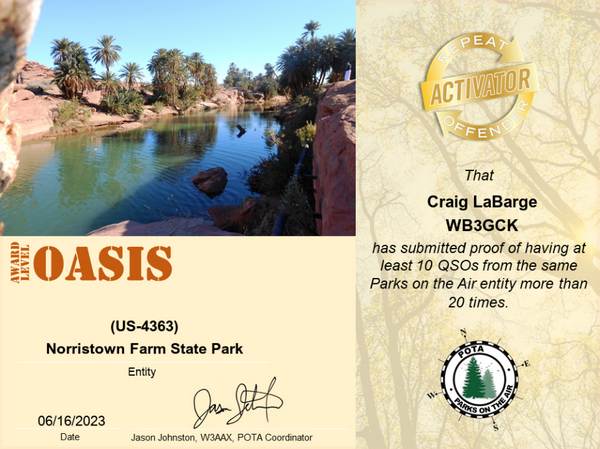
I was one activation away from the 20 needed for a POTA “Repeat Offender” award at Norristown Farm Park (US-4363, KFF-4363). After coming away empty-handed in my last attempt, I tried again this morning. This time I had a much better outcome.
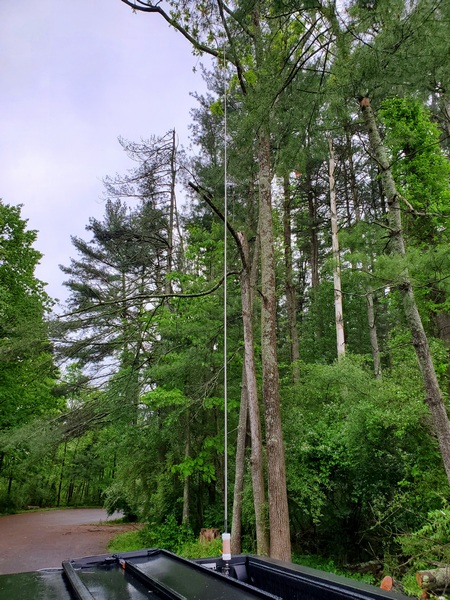
Given the dismal weather forecast, I left my bike at home and operated instead from the shelter of my truck. I went with my go-to setup: Penntek TR-35 (5 watts, CW) and 12-foot whip with my homebrew loading coil.
The bands weren’t great, but I have seen worse conditions. There was a fair amount of fading with some static crashes from storms in the area. Despite those challenges, I made my first 10 contacts in about 15 minutes on 40M.
While I was on 40M, I heard Greg WA3GM activating US-1351 about 5 miles away. Greg was operating with the Pottstown Area Amateur Radio Club’s annual PAARC in the Park POTA event. Our park-to-park contact this morning was a repeat of one we made last year.
After operating for an hour, it started to drizzle, so I called it quits. My time on 40M, 30M, and 20M, produced 26 contacts, with two park-to-park contacts.
My timing was excellent, as I ran into a heavy downpour on my way home. In any event, I was happy to close the books on activation #20 at US-4363.
“Mama said there’d be days like this.” — The Shirelles
My week got off to a good start. I activated parks three days in a row with good success. With some nice Spring weather today, I thought I’d get the bike out for an activation. I drove out to Norristown Farm Park (US-4363, KFF-4363), since I’m one activation away from a Repeat Offender award there. My plan was to get in a bike ride, while completing my 20th activation.
Things didn’t go as well as I had hoped.
I last rode my bike there about eight years ago. A friend and I were doing some communications testing to prepare for a March of Dimes event. I rode all over the park with an HT, while my friend listened for me at the proposed Net Control location. I remembered seeing a picnic table just off the road, so I headed out in that direction. About a mile out, I found a covered picnic table. It wasn’t the one I remembered, but it seemed to be a better location.
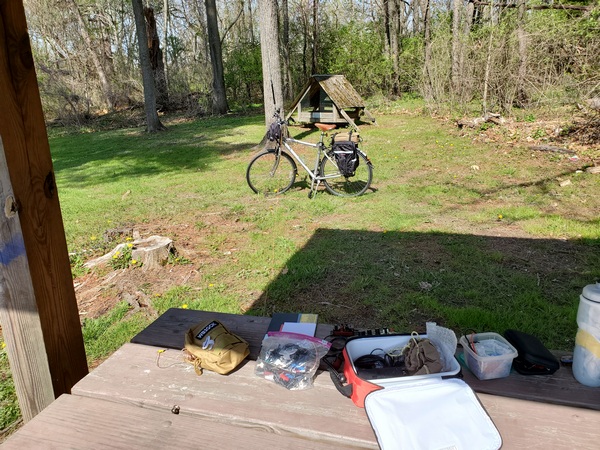
The view from the covered picnic table I was using.
My setup was similar to the last time I used the bike. I mounted a Gabil GRA-7350TC vertical on my handlebars and used a 33-ft elevated radial. I easily adjusted the antenna for a 1.3:1 SWR on 40M. Then, I ran 20-ft of RG-316 over to the picnic table where I set up my Penntek TR-35 (5 watts, CW) and Elecraft T1 tuner.
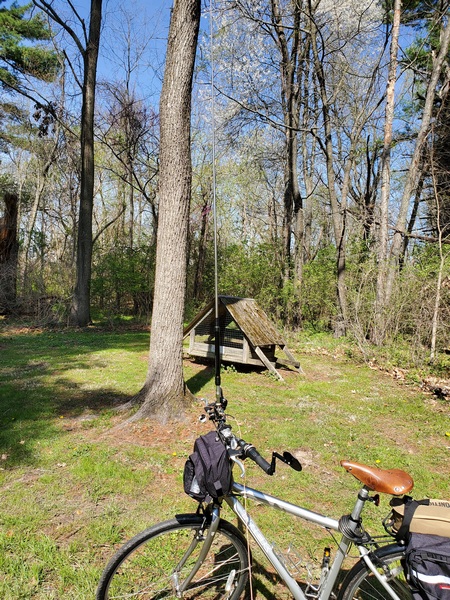
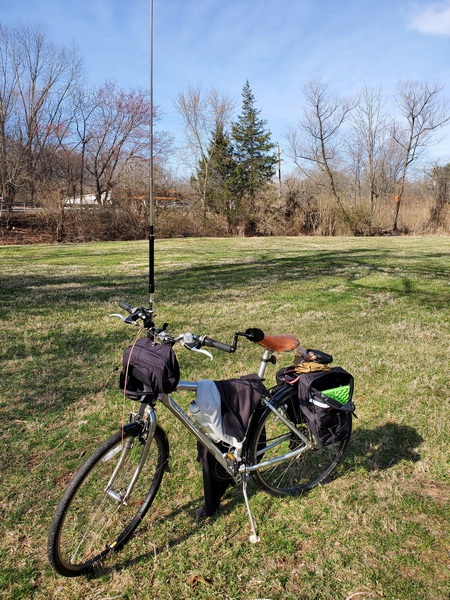
You have to look closely to see the Gabil GRA-7350TC on my handlebars.
The 40M band seemed a little weak. I heard very little activity, and my hits on the Reverse Beacon Network (RBN) weren’t all that strong. After 10 minutes or or so of futile CQing, I reconfigured the radials and tuned up the antenna for 20M. This time I used three 17-ft radials.
Despite getting double-digit Signal-to-Noise readings on RBN, 20M wasn’t producing any takers. I tried calling a couple of activators, but I wasn’t getting through the pile-ups. I didn’t have much time this morning, so I gave up after 30 minutes with an empty log. After packing up my gear, I rode back to the parking lot.
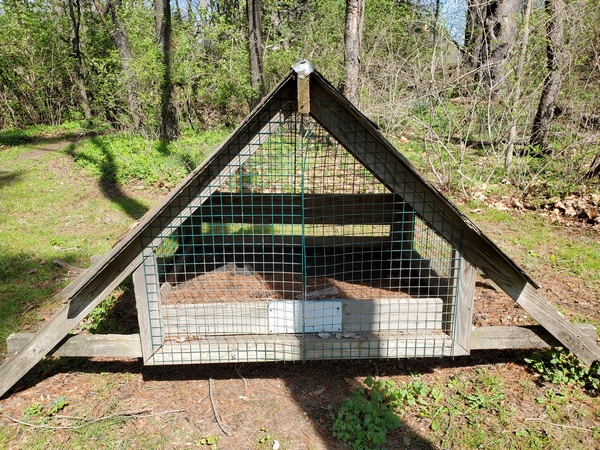
This empty cage was located in the back of the clearing I was in. I have no idea why it was there or what kind of critter it might have been used for.
On the ride back, I tried to figure out what the problem was today. Was it propagation, my location, or was it just one of those days? Who knows?
Radio-wise, today was a bust. I did, however, get in a pleasant bike ride and a little exercise.
My original plan was to do a bicycle-portable activation in Valley Forge National Historical Park (US-0761, KFF-0761). Lousy weather and another commitment put those plans on hold. Instead, I did a short stationary-mobile activation there instead.
The two main picnic areas in Valley Forge opened for the season on April 1st, so I rolled into one of my favorite spots. Not surprisingly, I was the only one there. I don’t think that too many folks want to have a picnic at 0830 (local time) in the rain.
I set up my usual Penntek TR-35 (5 watts, CW) and 12-foot loaded whip and started out on 40M. The bands were recovering from some geomagnetic storming yesterday, but were still a little flakey. Contrary to propagation predictions, 40M turned out to be the most productive band for me today. The 20M band only produced two contacts, while 17M was a total bust today.
One of my hunters on 40M sent me his SKCC number. I always keep a straight key connected to the TR-35, so I easily completed an SKCC contact with him.
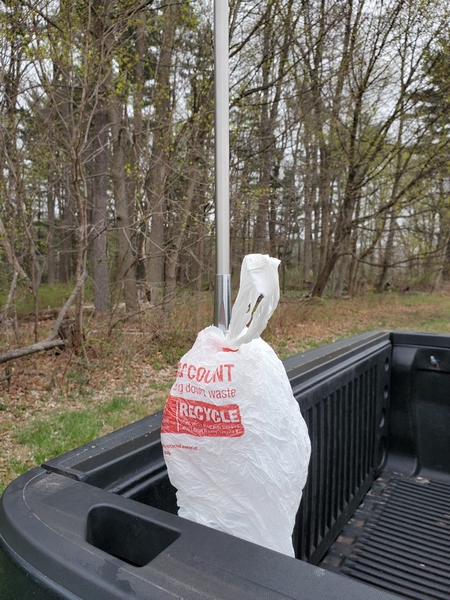
Part way through my activation, the rain started picking up. I headed around to the back of the truck to put a plastic bag on my homebrew loading coil.
I had to break out the foul weather gear for my loading coil.
After 20 minutes of futile CQing on 17M, I decided to call it quits. I ended up with 18 contacts. No DX today, but there were two known park-to-park contacts.
Hopefully, I’ll be able to get the bike out sometime next week.
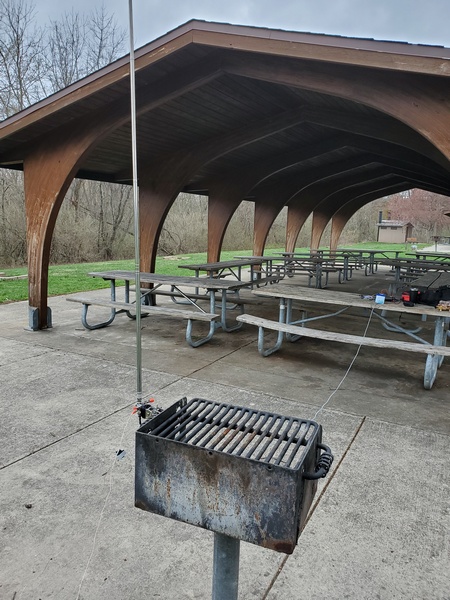
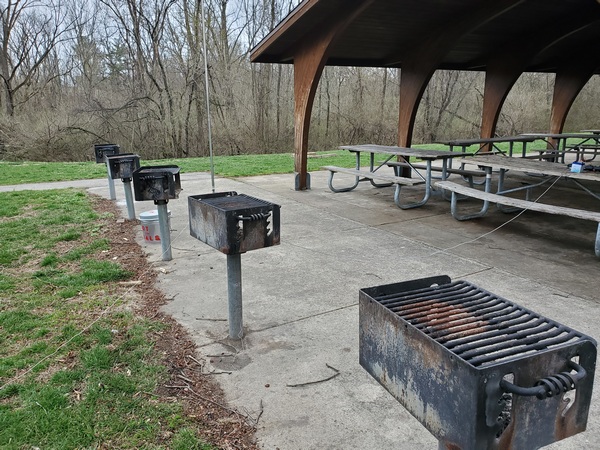
With rain in the forecast, I headed out to Norristown Farm Park (US-4363, KFF-4363) early on March 31st and conducted my activation under the shelter of a picnic pavilion. I used a jaw clamp to mount a 17-ft whip antenna to one of the picnic grills. So, I guess you could call this another “Grills on the Air” activation. With the lousy forecast and being a weekday to boot, I had the entire picnic area to myself.
My 17-foot whip clamped to a grill
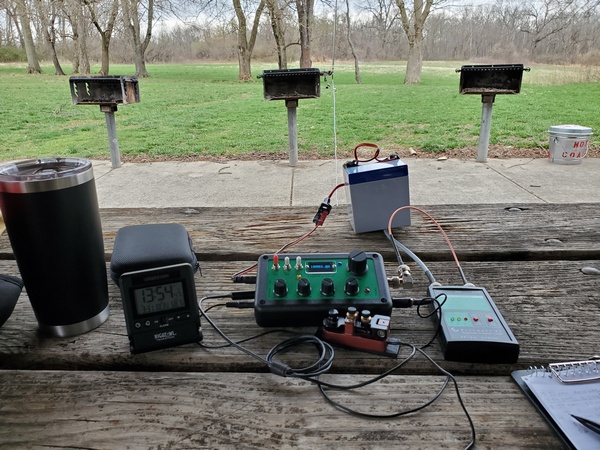
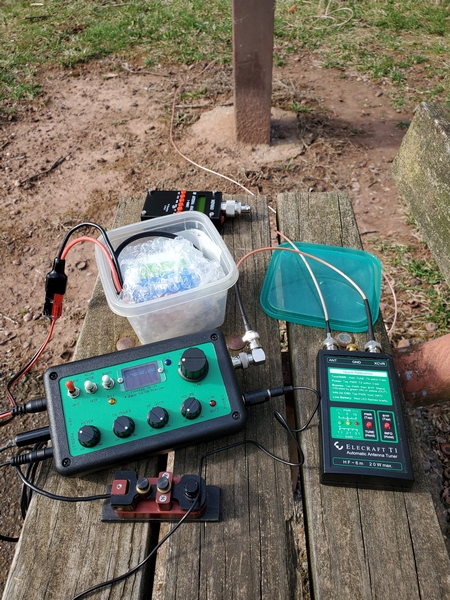
After installing the antenna on the grill, I laid out three 17-foot radials. With this setup, I easily obtained a 1.4:1 SWR. I set up my Penntek TR-35 (5 watts, CW) at the closest picnic table. The 18-foot length of RG-8x I brought along was a tad short, so I had to suspend it off the ground. I placed my LiFePO4 battery on top of the coax to prevent my little Elecraft T1 tuner from being dragged off the table.
My setup at Norristown Farm Park (US-4363, KFF-4363). My coax was a bit short, so I used my battery to keep my Elecraft T1 tuner from being dragged off the table.
There was a bit of static from the storm moving in, but the signals on 20M were strong enough to overcome it. Despite being early on a weekday, I made my first 10 contacts in about 13 minutes. I continued on 20M until the pool of hunters dried up.
After about 30 minutes, I shortened the whip for 17M. I only got the SWR down to about 1.9:1, so I let the T1 do the heavy lifting. The 17M band was less productive, but I made eight more contacts before calling it quits. My last QSO of the morning was with the Slovak Republic on 17M.
There were five grills next to the pavilion I was using. Hmmm… Maybe some sort of vertical array in the future?
After an hour on the air, I had logged 30 contacts with two park-to-park contacts. A few stations worked me on both bands. I also had three DX contacts: F1BLL, DL8NDG, and OM3CND.
It never rained during my activation, but that was fine with me. I had a nice dry outing to wrap up the month of March.
It has been quite a while since I’ve done any bike-portable operating. Over the past couple of years, I’ve dealt with medical issues of one sort or another. This year, I’ve avoided any serious issues, so I dusted off the bike and went out for a ride. While I was out, I tested some new gear for the bike. (I purchased all of the products mentioned with my own money.)
Antenna Mount
I make no claims of originality for this setup. I first saw this antenna mount in a YouTube video by VA7BIX. So, I found one on eBay and fired off an order to give it a try.
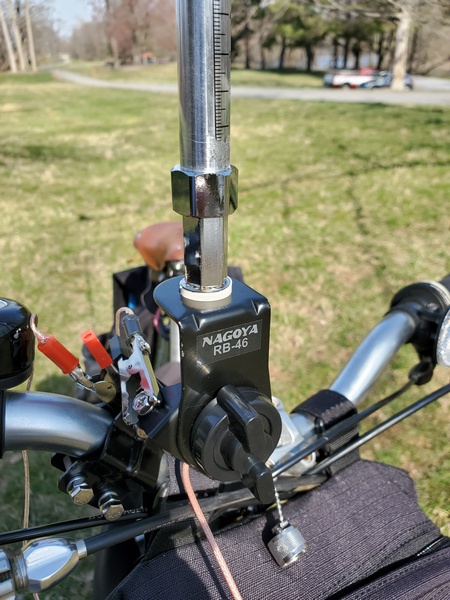
The antenna mount in question is a Nagoya RB-46. I had been looking for a way to mount my Gabil GRA-7350TC antenna (or any antenna with a ⅜-24 mount) on my bike. Originally intended for mounting on a car’s roof rack, the RB-46 can be clamped to the handlebars on bikes. With the kickstand down, my bike leans a bit. Fortunately, I can the adjust the RB-46 in two directions, so the antenna stays vertical. It accommodates a standard SO-239 to ⅜-24 antenna stud mount, which I had on hand.
Installing the RB-46 is quick and easy—for normal people. My installation, however, required extra time for searching the garage floor for dropped nuts and washers. Hardware mishandling aside, I installed the mount on my handlebars and adjusted it so the antenna would be vertical with the bike’s kickstand down.
Nagoya RB-46 antenna mount attached to my handlebars with my Gabil GRA-7350TC installed.
I also had a protective cap for the SO-239 in my junk box, so I put it to use here. Just in case it rains while I’m riding, I carry a ⅜-24 bolt in my handlebar bag. I figure I could put that in the antenna mount to keep the rain out. That’s probably overkill, but that’s how I roll. (No pun intended.)
New Panniers
I really like the cheap set of pannier bags I have been using for more than a decade. Sadly, they were really showing their age and were being held together with liberal applications of duct tape. Figuring I had gotten my money’s worth out of the old bags, I ordered a set of Bushwhacker Moab pannier bags.
The new bags are slightly larger than my old ones, so there’s more than enough room to carry my radio gear. My Bushwhacker handlebar bag has been going strong for about 12 years, so I’m hoping my new panniers also have a long life.
Schuylkill River Trail
I’m fortunate to live near the Schuylkill River Trail, a beautiful multi-use trail that runs along—you guessed it—the Schuylkill River. Since I haven’t been on the bike in a while, I chose a section of the trail for a three-mile ride that leads to a quiet local park.
Before loading up my bike, I always check the tire pressure. This morning, the front tire had gone flat, despite having fully inflating it a couple days earlier. After installing a new tube, I was finally on my way. Then, as I was driving to the trailhead, it started raining. Geez, what else!? Thankfully, the rain stopped by the time I reached the trailhead.
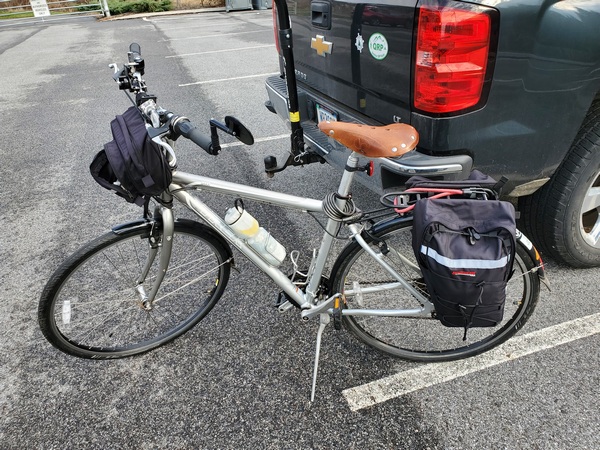
Bike loaded up and ready to roll
I rode about three miles to Towpath park, a ride I’ve done many times in recent years. The ride was uneventful, and I was soon setting up the GRA-7350TC on my new antenna mount. I used two 17-foot radials laid out on the ground and 25 feet of RG-316 coax. It was easy to get a 1.3:1 SWR on 20M.
Set up and on the air in the park
To see how it works, I set up my Penntek TR-35 on a nearby park bench. Tuning around I found some POTA activators to call. I ended up working three of them. It was fitting that one of my contacts was with Jim N4JAW. Jim is a bicycle/ham radio enthusiast I wrote about in a recent post. (Jim told me later that he was also bike-portable. You can read about his POTA activation operation and our QSO on his Ham on a Bike blog.)
My Penntek TR-35 set up on a park bench
Before tearing down, I checked the other bands with an antenna analyzer. I was able to get good matches on 30M through 12M. The 10M band was a little finicky. I didn’t use my longer radials, so I knew 40M would be tough.
Happy with the results, I loaded up the bike for the ride back to my truck.
Wrapping Up
I have a few takeaways from today’s ride:
The antenna mount worked great. However, using a PL-259 to BNC-F adapter on the antenna mount caused some clearance issues. It was a little tricky connecting the coax. I need to try using a right angle adapter next time.
The new panniers were easy to put on and take off the bike. Having a little extra room is a plus.
My short ride today was no Tour de France, but it reminded me how much I enjoy riding my bike. Yep. I definitely need to do more bike-portable outings this year.
I have been off the air for the past couple of weeks, so I set out to do something about that this morning. Taking advantage of some milder weather, I did some picnic-table-portable operating from Evansburg State Park (US-1351, KFF-1351).
I set up at a picnic table along one of the park’s trails. Using a jaw clamp antenna mount, I mounted my Gabil GRA-7350TC antenna to a picnic grill. I started with two radials, but I had some trouble getting an acceptable match on 20M. After I added two more, I got the SWR down to 1.3:1. Since I was next to a trail, I had to keep the radials on one side of the antenna to avoid being a trip hazard. I set up my Penntek TR-35 (5 watts, CW) and started calling CQ.
My Gabil GRA-7350TC antenna clamped to a grill
The band conditions were a little wonky, with an A Index of about 25 and an unsettled geomagnetic field. As a result, the contacts were coming in at a slower pace than usual. It took about 30 minutes to make my first 10 contacts.
Operating in Evansburg State Park (US-1351, KFF-1351)
I called it quits after about 40 minutes. Band conditions notwithstanding, I logged 12 contacts, including two DX contacts (F1BLL, IW2BNA) and three park-to-park contacts.
As I was packing up, I ran into a bit of an issue with the Gabil antenna. Despite my best efforts, I couldn’t unscrew the whip from the loading coil. As if that wasn’t enough, the sliding coil seemed to be stuck, too. I just put the whole antenna in the truck, so I could deal with it later.
When I got home, I took a closer look at the antenna. Using a pair of pliers I managed to remove the whip. I probably got carried away and over-tightened it when I put it together. I also got the sliding coil unstuck. My antenna is one of the early models where the adjustment scale is just a label that was stuck on. (On newer models, the scale is engraved.) The bottom of the label started peeling up and jammed the slider. A little surgery with a razor blade fixed that.
Even with my antenna issues, it was nice to get out for a little radio in the park.
I received an email from Jim N4JAW last week, letting me know he was planning to mention me in an upcoming blog post. Jim is an avid cyclist and is the owner of the Ham on a Bike blog. He’s doing a series of posts highlighting other hams who incorporate cycling into ham radio activities (or vice versa), titled “I Am Not Alone. There Are Many Of Us.”
Jim gave me a shout-out in Part 2 of his series. I’m honored to have my meager cycling activities included among such a distinguished group of hams on bikes. There is a really impressive collection of videos and pictures in Jim’s posts.
Operating bike-portable a couple of years back
All of this reminds me I’m long-overdue for some bike-portable operation. Now that the weather is warming up a bit, I need to get the bike out on the trails.
Be sure to check out Jim’s blog. He has some great stuff over there.
Last week I was using one of my Evolve III Maestro E-Books during our local ARES-RACES NBEMS digital net. I noticed the keyboard had developed a hump in the middle. Having seen this once before in another laptop, I immediately knew what was causing it: a bulging battery. As a precaution, I disabled the battery in the Windows Device Manager and continued running solely on AC power.
The next day I opened up the laptop to remove the battery. That was fairly simple to do. I just needed to remove nine tiny Phillips screws to open the case. Then I removed five more tiny screws holding the battery and unplugged the battery cable. It was a painless process.
Searching the Internet, I found some sources for replacement batteries. I ended up buying one on eBay from a seller that ships from New Jersey. Of course, that convenience came at a price. I ended up paying $40 for a battery to put in a $90 laptop. Yikes!
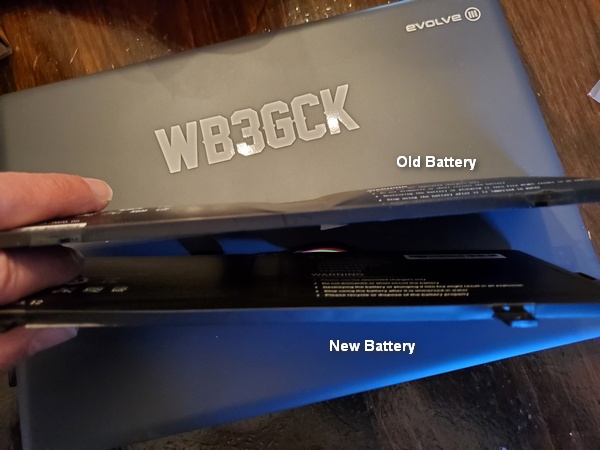
This isn’t a great a picture, but you can see how bloated the old battery was. It’s hard to tell with the lousy lighting, but the new battery is perfectly flat.
A week after I first noticed the problem, I had a brand new battery in my mailbox. It took about 15 minutes to open the laptop, install the new battery, and put it all back together again. Happily, it survived the “smoke test” and charged up normally. Back in business!
Yeah, $40 is steep investment for such a cheap laptop, but I really like this little thing. Hopefully, it’s got a couple more years left in it.
Whenever I go operate portable, I usually take my old YouKits HB-1B transceiver along as a backup. One thing I learned from back in my working days, is you need to test your backup equipment periodically to make sure it will actually work when you need it. It had been quite a while since I last used the HB-1B, so I put it to use today.
My destination today was Ridley Creek State Park (US-1414, KFF-1414). I rolled into one of my favorite spots and set up my homebrew loading coil paired with a 17-foot telescopic whip. This combination covers the 40M, 30M, and 20M bands, perfect for the HB-1B. Along with the HB-1B, I used my Elecraft T1 tuner and my old NorCal keyer.
My YouKits HB-1B in use at Ridley Creek State Park (US-1414, KFF-1414)
The A Index was 32 when I started out on 40M. Despite the active geomagnetic field, my four-watt HB-1B still managed 10 contacts in about 16 minutes. The 30M band was a little better, but I made most of my contacts on 20M. The HB-1B only puts out a little over 3 watts on 20M, so I was pleased with that.
The (far) better half and I are puppy sitting one of our grand-dogs this weekend, and I received a text message that he was at the house waiting for me. He knows I’m the designated dog walker at our house, so I packed up to go spend some quality time with a furry buddy.
After operating for an hour, I logged 34 contacts. I didn’t have any DX contacts today, but four of my contacts were park-to-park.
I bought the HB-1B from Ten-Tec almost twelve years ago, and it has seen a lot of use in the field. Although it doesn’t see as much action as it used to, it proved once again it’s a capable little rig.
I had a weekend with no competing obligations, so I was able to get my POTA/WWFF fix and get in a couple of activations.
Norristown Farm Park (US-4363, KFF-4363)
I made an early morning trip to Norristown Farm Park on Saturday, since I haven’t been there since back in December. Although my activation was plagued by some local electrical noise, it turned out to be an interesting one.
I started out on 40M, using my Penntek TR-35 (5 watts, CW only) and 12-foot loaded whip. There was noise across the entire band, something I first noticed in December. My guess is power lines along the road are the likely culprit. Anyway, the noise didn’t keep me from making contacts.
Norristown Farm State Park (US-4363, KFF-4363) taken during an activation last year
Noise notwithstanding, the 40M band was very productive for me. I had my first contact within a minute of my first spot, and I had my requisite 10 contacts in about 11 minutes. There were some deep pile-ups at times. After about 40 minutes, the hunters thinned out, and it was time to change bands.
I switched to 20M, hoping to pick up some WWFF hunters in Europe. As bad as the noise was on 40M, it was twice as bad on 20M. I didn’t even try.
The 17M band was much better, noise-wise. I could hear it, but the noise floor was much lower. After a slow start, I finally started getting a few contacts here and there. Eventually, the band improved, and I was able to work a few European stations. I also worked two California stations.
After a little over an hour, I had 38 contacts in the log, including four DX stations (DL8NDG, DL3HXX, OM2JU, and SQ2WKQ).
My last contact of the day was with NI6BB, the Battleship IOWA Amateur Radio Association out in California. The BIARA was on the air celebrating the USS Iowa’s (BB-61) first commissioning on this day in 1943. Thanks to NI6BB for giving me a call!
Also, I noted on my calendar that this happened to be the 48th anniversary of my current callsign. I’m glad I could observe this anniversary by putting WB3GCK on the air.
Evansburg State Park (US-1351, KFF-1351)
I visited Evansburg State Park on Sunday morning. Although I used the same setup as the day before and I was only five miles down the road, this activation started off differently.
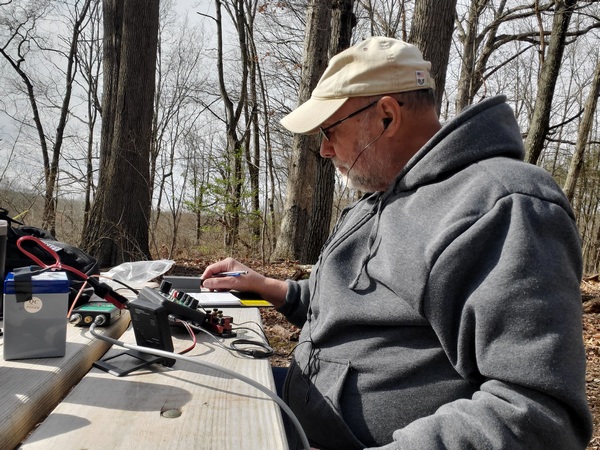
My location in Evansburg State Park from a 2024 activation
My usual practice is to start off on 40M, as a quick way to make my first 10 contacts. Not today, however. Things got off to a very slow start, and it took me over 20 minutes for those first 10 contacts. In fact, I started thinking I might not get there at all. On my way to the park, I got on the local repeater to let some folks know where I was going. So, my friends Frank, N3FLL, and Barry, K3EUI, came to my rescue and gave me a couple of contacts.
I noticed on the POTA spotting page that a bunch of activators were up on 30M. Once I moved up there, the pace picked up significantly. The 20M band was also productive for me. When things dried up on those bands, I shifted my attention to 17M and picked up a few more.
After an hour and 15 minutes, I managed 35 contacts with two known park-to-park contacts. Seventeen meters yielded three DX contacts: DL8NDG, ON4BB, and DK9HN. Thanks also to N3FLL for working me on three bands.
I was so focused on making contacts during these activations that I neglected to take pictures. No problem; I’ve included some from prior activations at these parks.




 WB3GCK QRP Amateur Radio