Late to the (KX3) Party

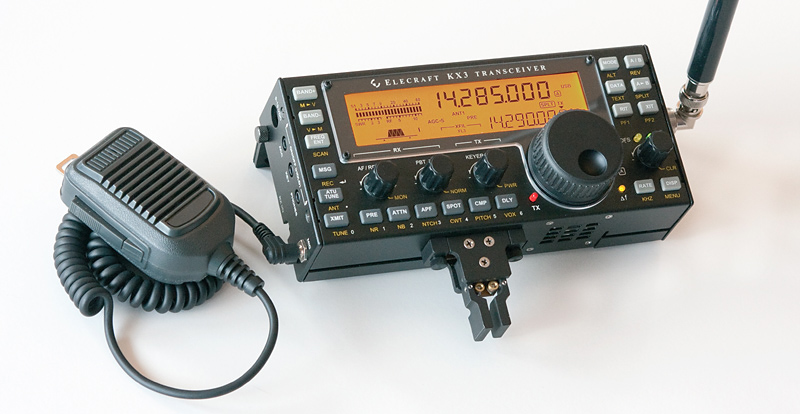
I’ve toyed with the idea of picking up an Elecraft KX3 for the past year or so.  I came close to buying one a few times but always talked myself out of it.  I know there are many satisfied KX3 owners out there and I’ve used the KX3 several times myself so I was familiar with its excellent capabilities.  It was just that my current stable of rigs was working fine and I felt no urgent need to replace them.

That all changed last week.  I decided that a rig that has everything built-in (ATU, keyer with memories, etc.) was more suited to the kind of portable operating I typically do.  Since ham radio has been my main pastime since I retired, I figured I was deserving of a new toy.  So, I fired off an order to Elecraft and two days later it arrived.

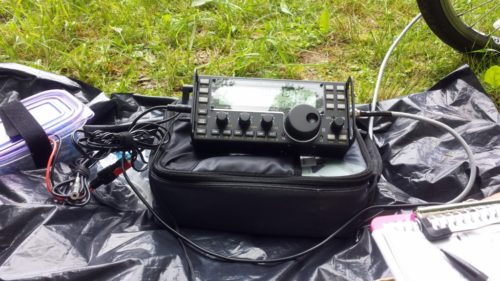
KX3

While I was waiting for the radio to arrive, I spent some time reading through the user’s manual.  I wanted to gain some familiarity with the KX3’s mind-boggling array of features before I got my hands on it.  The basic operations were fairly intuitive but it will be a while until I feel like I have mastered this thing.

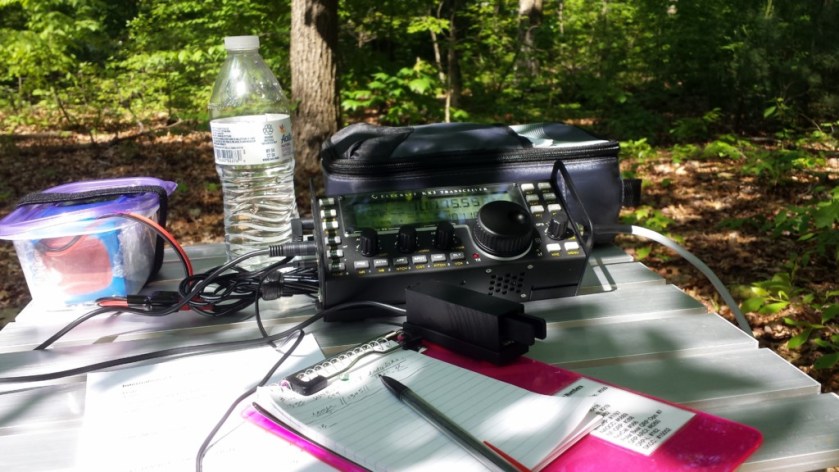
Barely out of the box, I had the KX3 set up and connected to my infamous rain gutter antenna.  The KX3 tuned it up nicely on all bands.  The filtering and noise reduction really did a nice job with my local noise problems on 40 and 80 meters.  While I was tuning around on 20 meters, I had an SKCC QSO with Andy, EA5IIK.  A DX QSO while running 5 watts into my rain gutter?  For the rig’s first QSO, that’s some good mojo!

It took me a while to join the ranks of KX3 users but I’m finally here and looking forward to many QRP outings with this great rig.

UPDATE (5/19/2016):

It figures…  A week after I get my KX3, Elecraft announces the smaller and less-expensive KX2.  I guess I’ll need to start saving my pennies again!

72, Craig WB3GCK

New AlexLoop Tripod

As mentioned in a earlier post, I have been using the Vivitar VPT-1250 tripod with my AlexLoop, as suggested by the vendor, Alex PY1AHD.  The Vivitar tripod has a few advantages.  It’s very light, fits in the AlexLoop carrying case and it’s inexpensive.  On the downside, it’s not particularly rugged.  It’s a great solution for casual operating but I wanted something a bit more robust for operating in the field.

UltraMaxx Model# UM-TR60BK tripod. The camera mount and carrying handle have been removed.

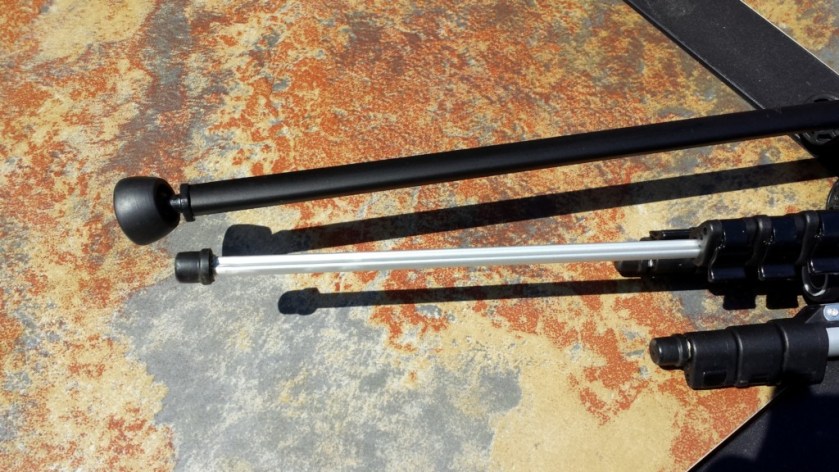
After doing some searching, I came across the UltraMaxx UM-TR60BK.  It’s 60-inch tripod that is much sturdier than the Vivitar tripod.  In particular, the very bottom sections of the legs are thicker than those of the Vivitar tripod.  The bottom sections of the UltraMaxx are about 19/32″ (13.7mm) compared to 5/16″ (7.85mm) for the Vivitar.  It also wasn’t very expensive.  I found a source on eBay for less than $20 shipped.

Comparing the diameter of the bottom leg sections of the UltraMaxx Model# UM-TR60BK tripod (top) and the Vivitar VPT-1250 (bottom).

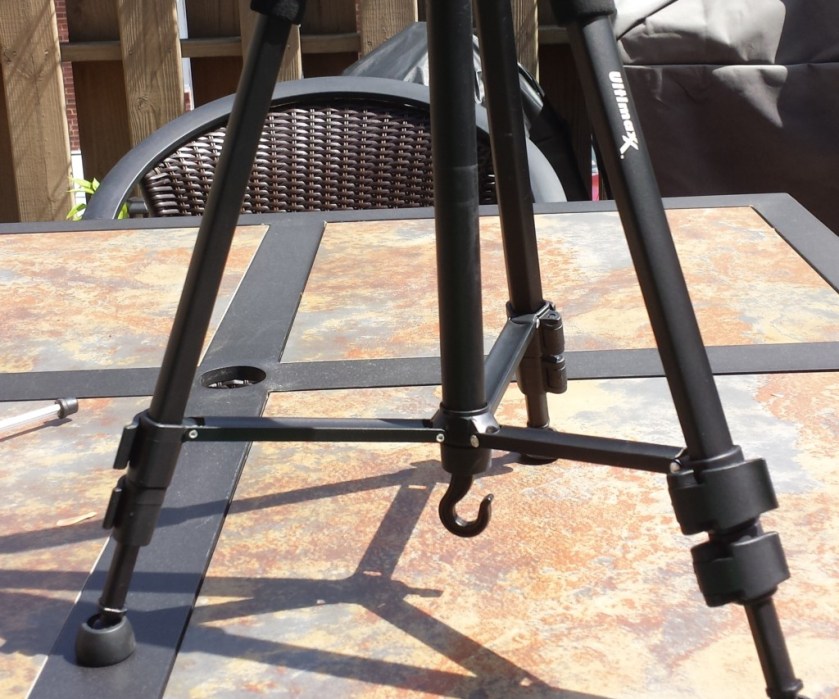
One nice feature of the UltraMaxx is the accessory hook at the bottom of the center post.  This can be used to suspend some weight to help stabilize the tripod in windy conditions.  I envision using a bungee cord between the accessory hook and my backpack on the ground beneath the tripod.

UltraMaxx UM-TR60BK accessory hook on the bottom of the center post.

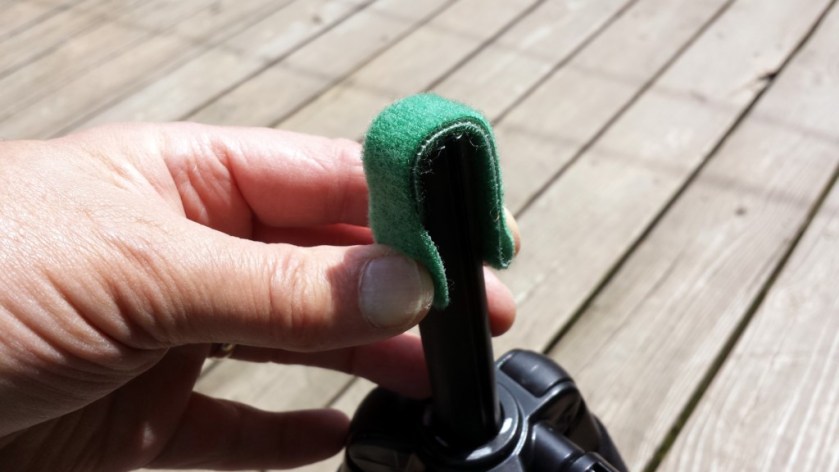
Adapting the UltraMaxx tripod for use with the AlexLoop was a snap.  I easily removed the pan head/camera mount, leaving just the bare center post.  The center post is just slightly smaller than the opening of the AlexLoop tubing.  So, I took a velcro cable tie, doubled it over and placed it on the center post as I placed the AlexLoop over the post.  This gave a nice, snug fit.  I also removed the handle attached to the underside of the tripod; I don’t envision a scenario where I would use it.

This is how I arrange the Velcro strap before placing the AlexLoop on the tripod. This gives a nice, snug fit.

The sturdiness of the UltraMaxx tripod does come at a price.  With the head removed, it only collapses down to 19 inches (48cm) compared to 14.5 inches (37cm) for the Vivitar.  The UltraMaxx doesn’t fit inside the AlexLoop bag but it does attach neatly to the outside of my backpack.  Also, the UltraMaxx weighs in at 1.3 lbs (584g) compared to 12 ounces (341g) for the Vivitar.  For my purposes, this isn’t a huge trade-off.

I don’t plan to retire the Vivitar tripod anytime soon.  It will keep its permanent spot inside the AlexLoop bag.  It’s still a good solution for quick excursions to the local park.  But when I’m out in more rugged conditions, I think the new UltraMaxx tripod will suit my needs a little better.

Now, all I need is some spare time to do some field testing the with the new tripod.

72, Craig WB3GCK


More SKCC Fun

Straight Key Century Club (SKCC) logoThe past few weeks have been interesting for me.  Despite poor band conditions, I managed to qualify for some more Straight Key Century Club (SKCC) awards.
Two weeks ago I received my Prefix x2 (Px2) award and a 40 meter endorsement on my Px1 award.  The SKCC Prefix awards are awarded on a point system for working a unique set of prefixes and summing up the membership numbers of the stations you work.  The PX1 award requires 500,00 points and the Px2 award requires 1,000,000 points.  So, I had 1,000,000 points on all bands and more than 500,00 on 40 meters alone.  It’s a lot easier to reach these numbers than you would think.

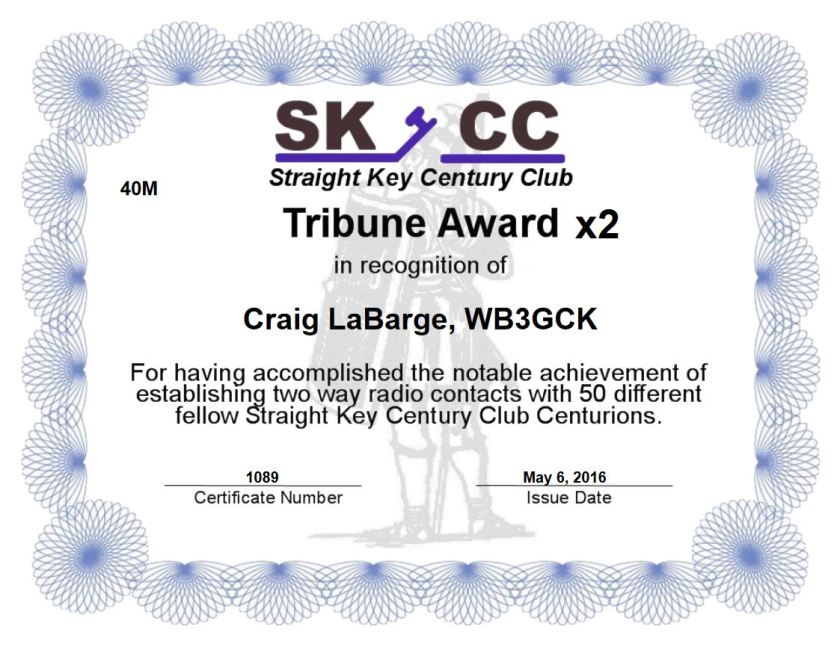
Yesterday afternoon, I got on 40 meters for a bit to see if I could find two more Centurion or higher contacts to reach the Tribune x2 level.  After working Tom N2TRJ in New Jersey, I heard him working Conrad W3ZMN.  Conrad is about 45 miles north of me in my hometown of Bethlehem, PA.  After they finished, I gave Conrad a quick call.  We were 339 both ways but managed to complete the exchange.  My thanks to these two folks for getting me to the Tx2 level!

My SKCC Tribune x2 certificate for working 100 unique Centurion, Tribune and Senator level members. I still need about 500 more to reach the Senator level.

Today, along with my Tx2 award, I also received my 1xQRP award.  This award is a point-based award for working a sufficient number of stations while running 5 watts or less.  The points for each QSO vary according to the band used.  There is also a 2xQRP award for making 2-way contacts but that is going to be much harder to achieve.

While I was in my SKCC logging program, I noticed that I was also qualified for 40 meter endorsements on my Centurion X1 and Tribune X1 awards.  I also received those endorsements today.

The SKCC awards certainly become more challenging as you move up the ranks.  I think that one of the things I enjoy most about the SKCC is that even someone like me with a QRP rig and a crappy antenna (more on that in another post) can earn some wallpaper.  Being able to pick up an award now and then gives me a sense of accomplishment that has kept my interest peaked.  Plus, you get to interact with some really friendly hams in the process.

73/72, Craig WB3GCK

Save

More Jackite Pole Hacks

Here are a few more things I have learned, based on my experience using Jackite telescopic poles.  Although some of this might be fairly obvious stuff, hopefully, this will be helpful to some.

Dealing with Stuck Sections

About four months ago, I had the top two sections of my 31-foot pole become hopelessly stuck.  After trying several things, I stumbled across a solution (at least for me).

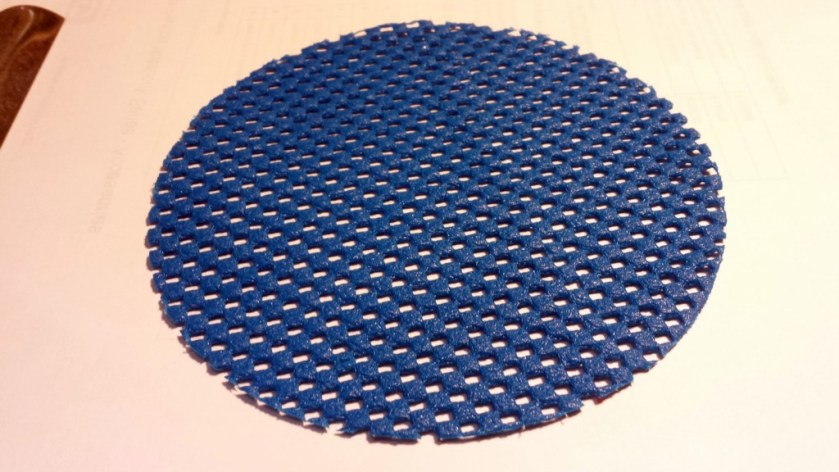
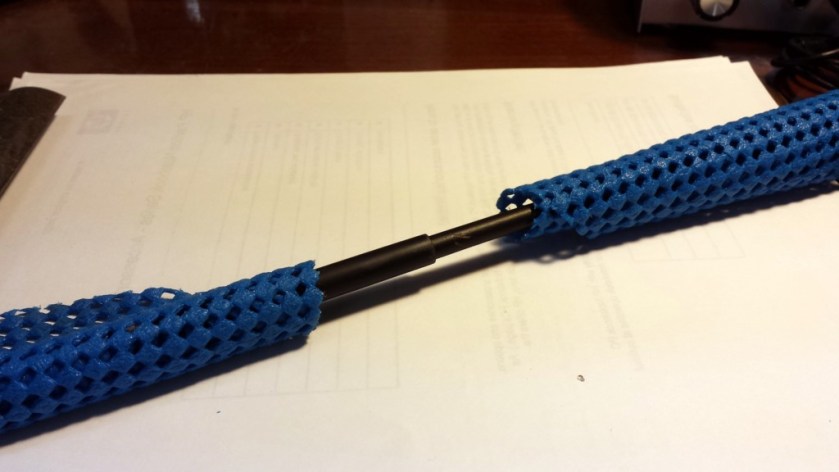
My wife came home from the store one day with one of those rubber pads that are intended to help you grip and remove the lids from stubborn jars.  A light went off in my head.  I bought a couple of them at the local dollar store and by using them to help me get a grip on each of the two stuck sections, I was able to twist them enough to get them unstuck.  A few months later, I again had two sections that became stuck.  I went right for the grip pads and was able to instantly get them unstuck.  I now keep a pair of these pads in my backpack for when I run into this problem again in the field.  As a bonus, these pads work great under your paddles or straight keys to keep them from sliding around on the table.

This is one of the jar lid grippers my XYL found at our local dollar store.

Just a piece of advice.  Don’t try to use pliers to get fiberglass mast sections unstuck.  You’ll create a bigger problem for yourself.  Don’t ask me how I know this.  Just trust me on this one.

When wrapped around the two stuck sections of a pole as shown, these jar lid grippers help you twist the sections to get them apart.

Maintenance

This is sort of related to the stuck section problem.  I use my Jackite poles quite a bit and they can sometimes take a beating when camping or at the beach in a salty environment.  Dirt and debris might be contributing factors in getting sections stuck together.  Just a theory on my part.  I found that regular cleaning of the pole sections seems to minimize sticking problems.

Every other month or so (if I’m being diligent), I completely disassemble the poles.  Then, I spray a little WD-40 on a clean rag and wipe down each piece of tubing.  I wipe off any excess WD-40 with another clean rag and re-assemble the pole.  It seems to work for me.  After spending a week at the beach, this procedure is mandatory for me.

Bottom Cap Shock Absorber

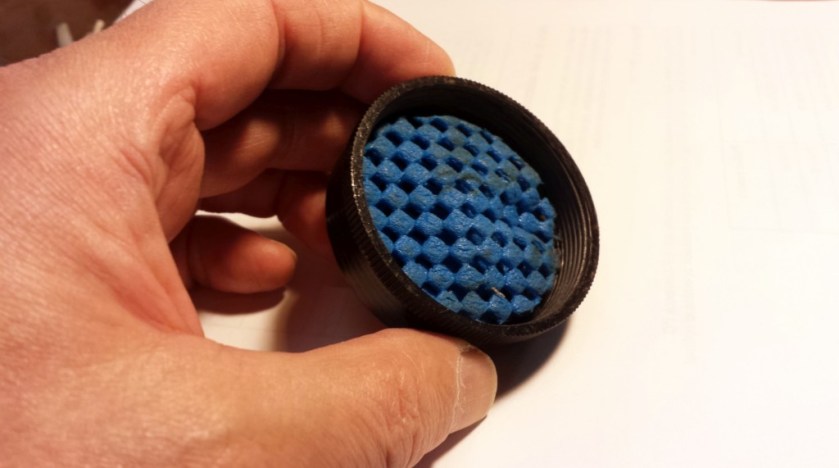
When collapsing a 28-foot or 31-foot pole, the lower sections can sometimes come down so hard that they knock the bottom cap loose.  To counter this, you can cut a thin piece of sponge and place it inside the bottom cap.  I actually used two layers of that dollar store jar lid gripper material in mine.  Just make sure whatever you use doesn’t interfere with the threads in the cap.  This should help absorb some of the impact if you collapse the pole too quickly or if it comes down by itself in a strong wind.

This is two layers of material cut from the dollar store lid gripping pads placed inside the bottom cap of a Jackite 31-foot pole. The intent is to absorb some of the impact when collapsing the pole.

I hope some of this is useful to someone out there.

72, Craig WB3GCK

Portable for a Good Cause

The QRP to the Field (QTTF) contest is one that I look forward to every year.  This year, however, it coincided with a long-standing commitment to take part in a public service event.

For many years, I’ve been coordinating my local ARES-RACES group’s support for the March of Dimes’ annual March for Babies event in Valley Forge, Pennsylvania.  In addition to enhancing the safety of the participants, events like this also provide a low-stress environment to hone our emergency communications skills.

The event got off to an unpleasant start.  Paul, KB3ZOH, and I arrived early to set up a crossband repeater at the Net Control location.  We wound up having to set things up in a steady downpour.  Fortunately, the rain let up by the time the walkers set out on the course.

Paul KB3ZOH assuming the Net Control duties

From an ARES-RACES standpoint, it was an uneventful event.  We had solid communications around the course and there were no incidents or issues to handle.  In addition to KB3ZOH and me, The Chester County ARES-RACES team included Leslie KC3EOR, Joe W3JY, Will K3WIL, and Rob W3OWM.

Walkers passing by my position. The weather was dreary but, at least, it was raining.

Since the March for Babies course was located about 100 yards from Valley Forge National Historical Park, my original plan was to head over there after the event for some QTTF action.  With another obligation later in the day, however, QTTF was clearly not in the cards for me.

So, I look forward to next year’s contest.  At least I was able to do some portable operating for a good cause this morning.

72, Craig WB3GCK

Three Birds, One Stone

I was on a mission today and there were three things I wanted to accomplish.  With one trip to a local park, I was able to check them all off of my list.

First, I submitted a write-up on my homebrew, drive-on antenna mount for the Ideas Exchange column in the QRP Quarterly publication.  Mike WA8MCQ, the column’s editor, asked for some more pictures.  So, I needed to get out and set up somewhere to take a few shots.

Next, I wanted to field test my little American Morse MS2 straight key and the homebrew magnetic mount I built for it.  I had used it at home but I was anxious to see how it works out in a portable setting.

Finally, I wanted to get out and make some Straight Key Century Club (SKCC) QSOs using a real antenna (as opposed to using my downspout at home).  I only had an hour, so I needed to move quick.

I headed out for Black Rock Sanctuary, which is just outside Phoenixville, PA.  On arrival, I set up the drive-on mount and took some pictures before and after deploying my 31-foot Jackite pole.  I used a 29.5-foot vertical wire with one counterpoise wire fed through a 4:1 unun.  My rig today was my trusty YouKits HB-1B powered from a small gel cell battery.

Drive-on antenna support

I started on 40M and posted my frequency on the SKCC Sked Page.  Almost immediately, I got a call from KB1WOD in Vermont.  He gave me a decent signal report, despite some less-than-optimal band conditions.  A few minutes later, I had a 2-way QRP QSO with KD3CA here in Pennsylvania.  I finished out my brief session with a 2-way QRP QSO on 20 meters with AA4MX in Florida.

As for the MS2 straight key, I have to say it worked pretty well.  My homebrew magnetic mount held the key firmly to my clipboard.   I was pleased with that.  Using a straight key in the confines of my pickup truck’s cab was a little challenging, though.  I also found the feel of the key a little loose, so I’ll need to tighten up the spring tension a bit.

MS2 miniature straight key and magnetic mount in use.

So, in about an hour, I accomplished my mission.  I got the pictures I needed, tested my little straight key/clipboard setup, and made a few SKCC QSOs to boot.

72, Craig WB3GCK

Good Week for SKCC Activity

Straight Key Century Club (SKCC) logoLife-in-general made this a somewhat slow ham radio week for me.  It did, however, get off to a great start for my Straight Key Century Club (SKCC) activities.

Having reached the Centurion level (100 SKCC member QSOs) back in mid-March, I set my sights on reaching the Tribune level (50 QSOs with Centurion or higher members).  Thanks to the many SKCC members who were eager to add me to their logs with my new “C” designation, I made great progress over the following 2 weeks.

So, by last Monday (March 28th), I needed just 3 more QSOs to reach the Tribune level.  Despite some rough band conditions, it only took about 30 minutes to reach my goal.  The QSO that put me over the top was a nice chat on 20 meters with Pablo KP4SJ in Puerto Rico.  Pablo’s QSO helped me reach Tribune on the 2-month anniversary of my SKCC membership.  It was especially gratifying doing it with 5 watts into my rainspout antenna.  SKCC members, apparently, have very good ears!

Now begins the long climb towards the Senator level.  That entails 350 more contacts with Centurion or higher members and 200 more contacts with Tribune or Senator level members.  That, for sure, is going to take quite a while.

I made a number of 2-way QRP SKCC QSOs during the week, as well.  I worked K8FAC in Ohio, NC4RT in North Carolina, N0HYD (portable) in Kansas, AH6AX in Maryland, and NF1U in Connecticut.

I’m hoping that “Life-in-General” settles down a bit next week and lets me get out for some portable operating.

72, Craig WB3GCK

Hopewell Furnace NPOTA Activation

ARRL National Parks on the Air logoOn Good Friday, I found myself with a free afternoon.  I decided to take advantage of the great Spring weather and make a spur-of-the-moment trip to activate the Hopewell Furnace National Historic Site (NS37).  I hastily threw some equipment into my truck and headed out.

About 45 minutes later, I was on site and ready to get started.  But first, I  had to resolve some antenna issues.  For some reason, my SWR was higher than normal and not very stable.  I found a loose BNC connector on my 4:1 unun that I think was the culprit.  I eventually managed to get things stabilized enough to operate.  I was using my FT-817 at 5 watts into a 29.5-foot vertical wire antenna with two counterpoise wires.  I operated all CW.

The somewhat cramped operating position in my truck.

I couldn’t spot myself due to lack of a cell signal, so I just started calling, “CQ NPOTA.”  After about 35 minutes with no takers, I was pretty close to packing up and heading home.  Finally, I worked a Wisconsin station on 20 meters.  I tuned down the band a bit and heard N4CD activating a park in Texas.  I got him on the first call.  So, at least, I was getting out to somewhere.

I moved down to 40 meters and worked stations in New York and Michigan.  One of them must have spotted me because things picked up quickly after that.  I spent the rest of my time on 40 meters and wound up with 30 contacts in the log (including 2 park-to-park QSOs) after an hour and forty-five minutes.

My 31-ft Jackite pole supported with a drive-on mount

After I packed up, I stopped by the visitor center and chatted a bit with the park rangers.  They were very welcoming and happy to have their park activated again.  They were curious about how many contacts I made and how far I was able to get out.  As I was leaving they thanked me for putting their park on the air.

Hopewell Furnace visitor's center
Hopewell Furnace visitor’s center

I have some repair work to do on my antenna but it was a nice afternoon for an NPOTA activation.

72, Craig WB3GCK

Rediscovering the Straight Key

Back in January, I decided I wanted to add a new facet to this hobby that I’ve enjoyed for more than 42 years now.  I have always heard a lot of Straight Key Century Club (SKCC) activity on the bands and it sounded like fun.  So, I signed up for an SKCC number, dusted off my trusty J-38 key and jumped into the fray.

More than 20 years had passed since I made the switch to paddles and Iambic Mode B keying.  Needless to say, my straight key fist was very rusty.  After some off-air practice, I heard NN9K near Chicago calling, “CQ SKCC,” on 30 meters one day.  I grabbed the J-38 and a few minutes later, Peter had given me my first official SKCC contact.

I bought this J-38 from a military surplus store around 1975. Nothing special but I love the feel of it. It reminds me of my Navy days, I guess.

A few days later, it was time for the February SKCC Weekend Sprintathon (WES).  The monthly, weekend-long WES contests are like most other CW contests except they are friendlier and run at a slower pace.  After a fun weekend operating on and off, I ended up with 38 more SKCC contacts in the log.  One particular highlight was working Bert F6HKA on two bands with my meager 5 watts and rainspout antenna.  (Full disclosure:  Bert’s awesome station gets most of the credit for these contacts.  He was louder than most stateside stations.) After my first WES, I was hooked.

Even though SKCC promotes the use of manual keying methods, i.e., straight key, bug, cootie key; they have some pretty sophisticated, computer-based tools that can help you reach the various award levels.  There are a few SKCC-specific logging programs.  I use AC2C’s SKCC Logger for logging during WES contests and keeping track of all of my SKCC contacts.   The K3UK SKCC Sked Page is an online gathering place for members looking for contacts.  Another slick tool is the SKCC Skimmer.  This software tells me who is online on the Sked Page and which SKCC members have been spotted on the Reverse Beacon Network (RBN).  Most importantly, it lets me know if they have SKCC numbers I need for award levels I’m pursuing.

The thing I like most about SKCC is the friendly attitude of the members.  They are particularly helpful to newbies and will always slow down to match the sending speeds of slower operators.  Many times, operators would recognize my new SKCC number and take the time to welcome me to the club — even during contest exchanges.

This is my first key as a ham. I bought this at a Radio Shack store in 1974. It still sees occasional use.

After a month and a half of general operating and two WES contests, I found myself with 99 SKCC contacts.  I needed just one more to reach the SKCC Centurion level.  With some sort of geomagnetic disturbance going on, I resorted to the SKCC Sked Page for help.  Within minutes, there were several stations trying to work me to put me over the top.  Werner, N8BB in Michigan, was finally able to get me there.  I applied for my Centurion award and received it later that day.  I’m now in the process of trying to work 50 Centurion, Tribune, or Senator level members for the Tribune level.

I’m pleased to report that my old straight key fist is back in shape and I have rediscovered the elegant simplicity of the straight key.  Many thanks for the good folks who run the SKCC organization.  It’s easy to see why the SKCC is one of the fastest growing clubs in ham radio.

72, Craig WB3GCK

Measuring Audio Frequencies with a Guitar Tuner

Here’s a little hack that serves no real purpose.  I’ll tell you about it anyway.

I recently built the T-Tone Code Practice Oscillator (CPO) kit from Morse Express.   It’s a handy little addition to the shack for adjusting straight keys or testing keyers.  After building it, I just adjusted the audio frequency for a pleasing tone.  Most people would have just left it alone at that point.  I’m not most people.

I started to do some thinking, which is a dangerous practice that can sometimes lead to unexpected consequences.  I wondered how the frequency of CPO compared to the sidetone of my FT-817.  There was no particular point to this mental exercise other than idle curiosity.

Now, I certainly could have keyed both the CPO and the FT-817 and done a comparison by ear.  I could have just adjusted the CPO by ear to match the FT-817.  But what fun would that be?  I was curious about the exact audio frequency of the FT-817’s sidetone, so I opted to do some experimenting.

Having been playing guitar for more than 50 years, I have acquired a gadget or two over the years.  One of those gadgets is a clip-on guitar tuner.  I can clip this clever device on the headstock of my guitar and, by sensing vibrations, it will tell me what note I’m playing and whether the pitch is sharp or flat.  I figured I could use this thing as an audio frequency meter of sorts.

First, I laid the guitar tuner on top of the FT-817’s speaker and keyed up.  That indicated that the pitch of the sidetone was an F note.  Consulting a conversion chart I found on the Internet, that equates to 699Hz.  I seemed to recall that the FT-817’s sidetone was somewhere around 700Hz, so that seemed about right.  I was sure I was in the right octave.

Guitar tuner on top of the FT-817

Next I took the lid off of the CPO and clipped the guitar tuner on it.  It initially indicated that the CPO was tuned to F#.  That equates to a frequency of 740Hz.  I tweaked the CPO’s frequency adjustment pot to F, matching the FT-817.  A side-by-side comparison of the CPO and the FT-817 showed that I was successful.

Guitar tuner clamped onto the lid of the code practice oscillator

So, what’s the point of all this?  None really.  Is there a practical use for this?  Probably not.  Does it really matter that my CPO matches the sidetone of my radio?  Nope.  I just had one of those “I wonder what would happen if…” moments.  Now I know.

72, Craig WB3GCK