After enduring the fourth nor’easter this month, I needed a little QRP-portable fix. Unfortunately, my bike is in the shop for repairs and the ground is saturated from melting snow, so I opted for quick trip to a local park and operated from the truck.
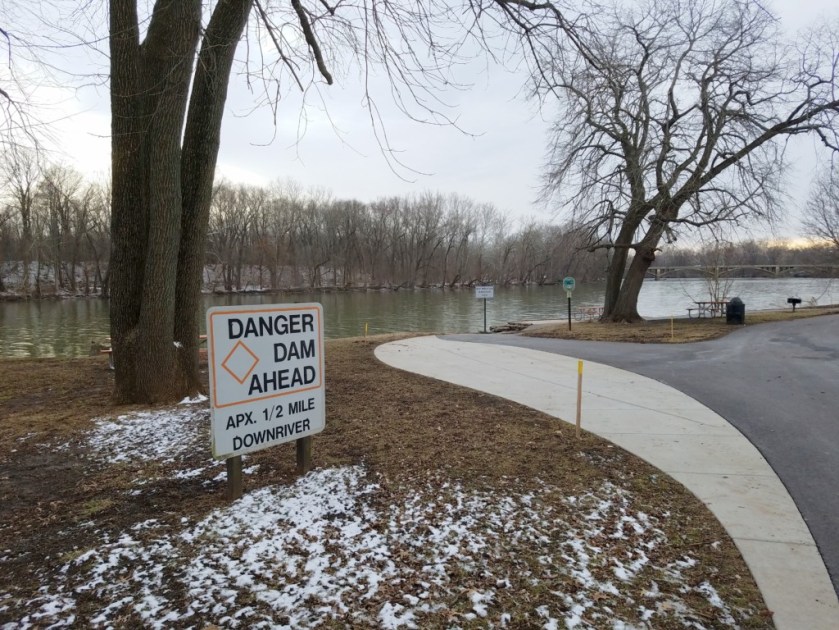
Charlestown Park is a beautiful community park just down the road from my home. I hadn’t operated from there in a while, so it was an ideal spot for a quick outing.
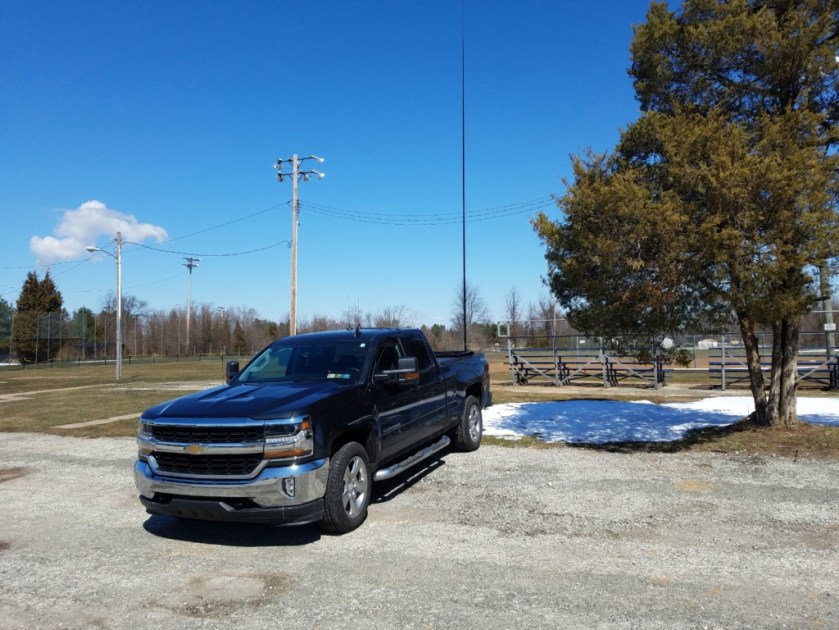
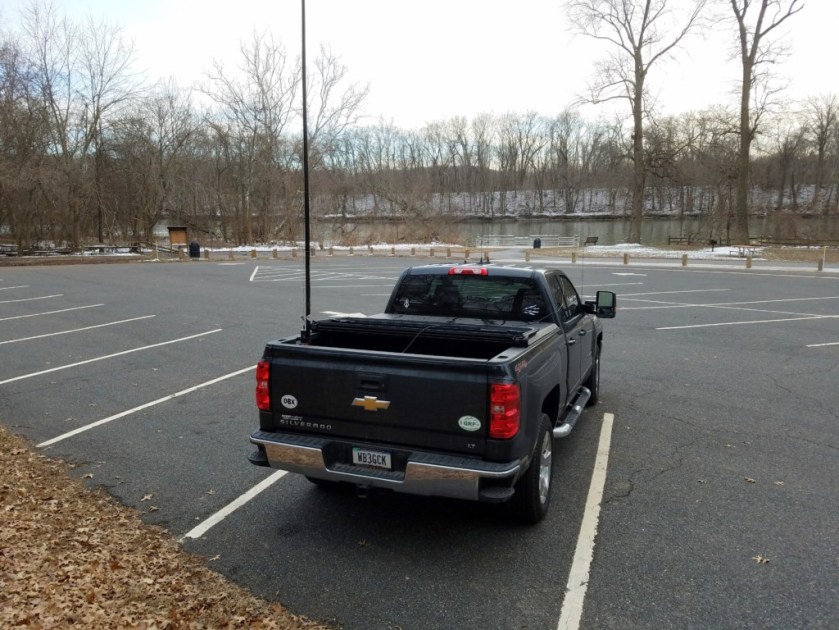
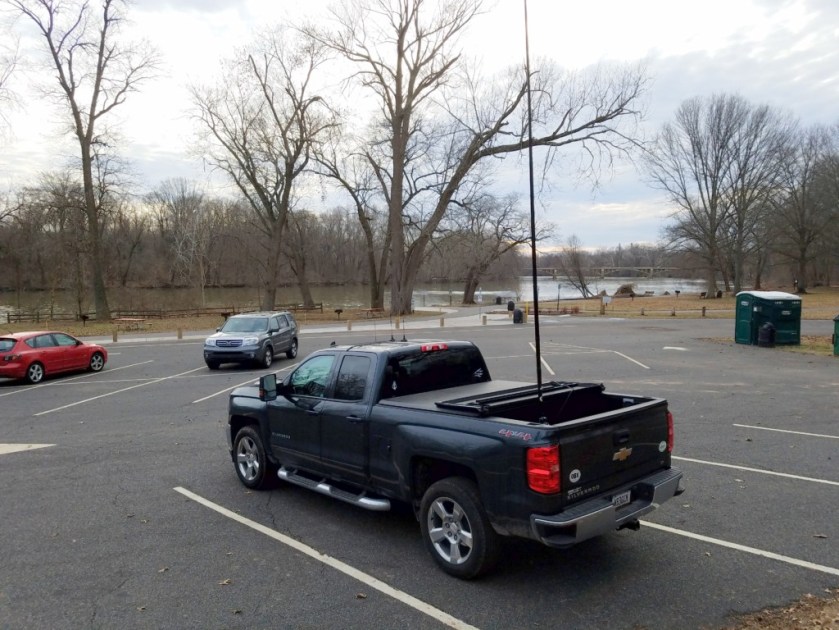
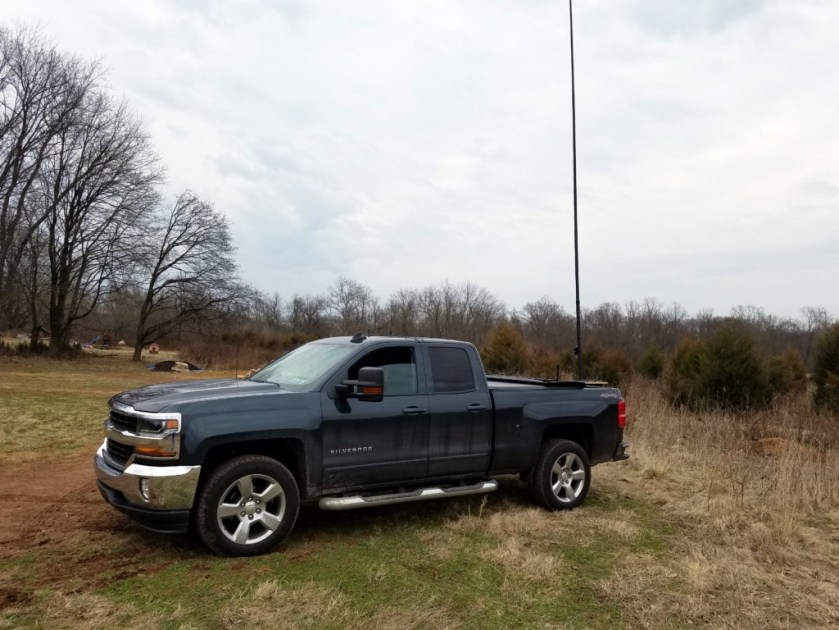
As I was setting up, a curious passerby walked up and asked about the 20-foot Black Widow pole I was getting ready install on the truck. I explained that it was a ham radio antenna. He watched to see how I mounted the pole then resumed his walk.
My location in Charlestown Park.
Once again, I focused my efforts on making SKCC contacts. I started off on 40M and added a few new members to my log. On 30M I had two 2xQRP contacts. One with W9ILF in Indiana and one with KI4KGK in Georgia who was running 1 watt.
As I was operating, a security officer cruised by looking at my antenna. He drove down the road a bit and turned around. He slowed down in front of me, probably getting ready to approach me. I waved to him and he waved back and drove off. I guess he was satisfied that I wasn’t doing anything nefarious.
On 20M, I received a nice signal report from VE4MG in Manitoba. He was very strong into Pennsylvania. I made one more contact on 40M before packing up.
Today was a nice break from the snow we had this week but I’m looking forward to some warmer weather. Hopefully, it’s not too far off.
Despite all the bad weather lately, we managed to get a weekend’s worth of half-decent weather. So, I brushed the cobwebs off my bike (literally) and went out for a spin on one of my favorite trails.
I rode the Schuylkill River Trail from the Oaks Trailhead up to the Perkiomen Trail and stopped in the Lower Perkiomen Valley Park for some bicycle-portable QRP. I parked next to a convenient bench and set up my KX3.
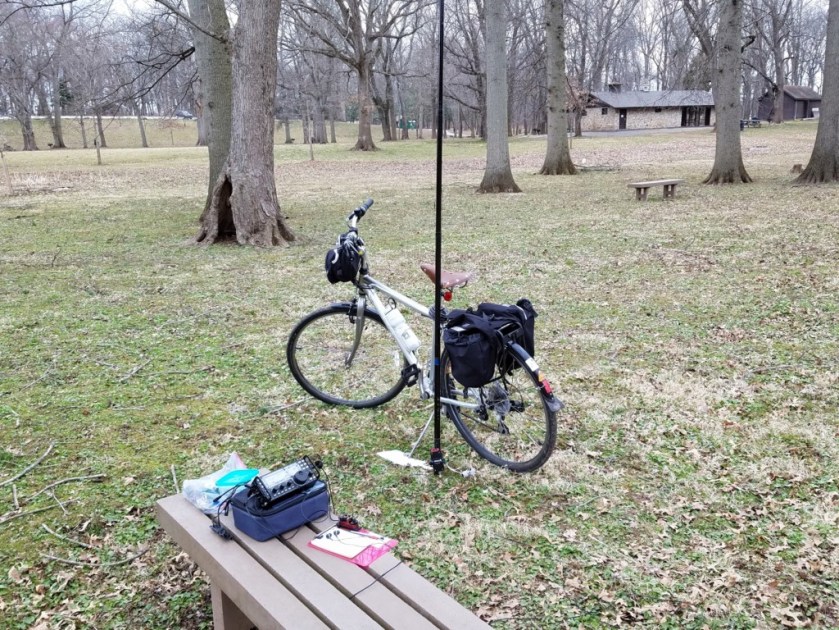
I did some experimenting with a mount I made to use my bike as a support for my portable vertical. That didn’t work out as planned so I ground-mounted my 19-foot vertical next to my bike, using a screwdriver shoved in the ground.
My setup in Lower Perkiomen Valley Park. The white object on the ground is a Dollar Store cutting board. The ground was soft so I used the cutting board under the kick stand to stabilize the bike.
I started off looking for some SKCC QSOs on 40M but there wasn’t much activity there. I moved up to 30M and KO5Q in Georgia answered my CQ. After I finished chatting with Roger, I moved up to 20M and found W0RT in Kansas. Immediately after I signed with Rick, I got a call from a very loud NA3AR. Tony was just a few miles away in nearby Collegeville. That accounts for his very loud signal.
By the time I finished up with Tony, the wind had picked up and it was starting to get cold. So, I packed up the bike for the ride back to the trailhead.
It sure felt good to get out on the bike today. I’m a member of the Rails to Trails Conservancy, so I’m making it a point this year to explore more local trails with the bike. There will definitely be more bike-portable operations in my future.
They were forecasting some rain and snow for the late afternoon today, so I decided to squeeze in a trip to Valley Forge Park before it started. I have already met my WWFF-KFF quota from this park, so I concentrated my efforts on making SKCC contacts.
It was chilly but sunny when I rolled into the Park. I quickly set up my 19-foot Vertical on the back of the truck and fired up the KX3. I spotted my 40M frequency on the SKCC Sked Page and I was soon met with some callers. I had seven contacts in the log before things thinned out. I moved up to 30M and worked two more stations there. The clouds were starting to roll in (and the restrooms were closed for some reason), so I decided to pack up and head home.
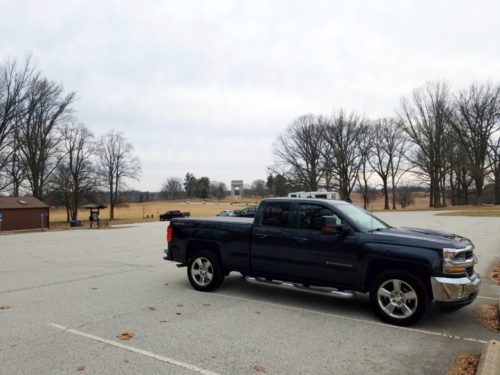
My location at Valley Forge. The National Memorial Arch is in the background. I took this right before I left for home.
I ended up with 9 SKCC contacts. Four of those are new numbers I need for the Tribune x5 level. As a bonus, I also made 3 two-way QRP SKCC contacts. It was a brief outing today but I had fun.
As I write this, the snow has started. Hopefully, I won’t have too much shoveling to do tomorrow.
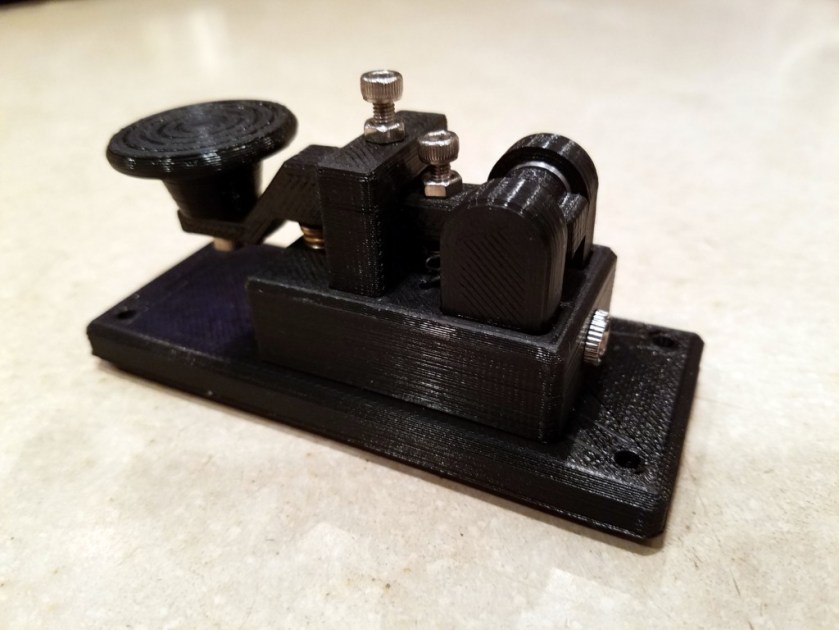
I recently bought another key from KC5ILR & Sons over eBay. This inexpensive little straight key could become one of my favorites.
Last year, I came across these straight keys that KC5ILR and his sons produce on a 3-D printer. They sell a variety of key styles in various colors. I bought a camelback style key and wrote about my initial impressions. While it is a nice key, the aluminum contacts didn’t always close cleanly and I detected some slight noise in the keyed signal.
I noticed that KC5ILR’s keys are now using solid brass contacts, so I bought one of their new lightweight Micro keys to give it a try. I received it a few days after ordering it and boy am I impressed.
Micro Key by KC5ILR & Sons
Here are the specifications from the eBay listing:
Width: 1-7/16"
Length: 4-1/8"
Height: 1-3/8"
Weight : <2 oz.
Action: Single Max .100" gap.
Spring: Coil Chrome
Style: Camel Back Arm
Wiring: Stranded Copper
Contacts: Solid Brass
Resin: Biodegradable PLA Polymer
Construction: 3D Thermal Printed
Screws: 18-8 Stainless Steel 3MM Socket Head Cap Screws
Nuts: 3MM Stainless Steel Jam Nuts
Screw Holes To Mechanically Fasten.
Standard 3.5MM Receptacle (Use Tip & Sleeve Mono Or Stereo)
Solid Brass Contacts For The Ultimate QSO.
It took no time at all to adjust the contact spacing and tension to my liking. The base has countersunk holes for permanent mounting but I applied the four stick-on, rubber feet that came with the key.
The key has a 1/8-inch audio jack for connection to the rig. A cable is not provided so you’ll need to provide a stereo or mono patch cable. When using a stereo cable, the key is wired to use only the tip and sleeve. So, using a regular stereo patch cord, I can connect the key directly to my KX3. I connected it to my code practice oscillator for my initial tests.
The solid brass contacts are a huge improvement over the earlier aluminum contacts; the keying was absolutely clean. Even though the key weighs less than 2 ounces, I found that the design of the base makes it very stable when keying. The overall feel of the key is impressive.
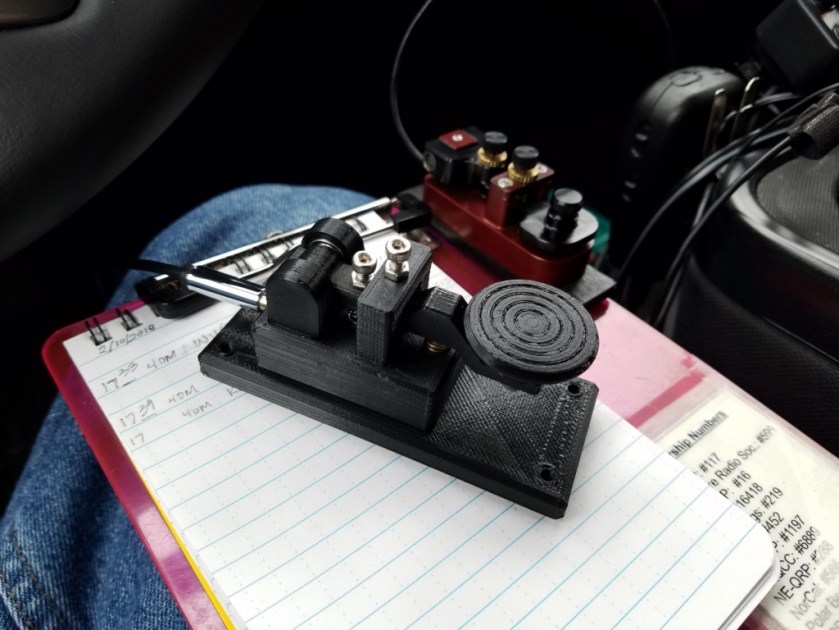
I recently took my new key out for some portable operating. I used it to make a few SKCC contacts during a Weekend Sprintathon (WES) contest. As expected, this little key performed well and keyed cleanly. This will be a nice little key to take along when weight is a major concern.
KC5ILR’s Micro Key being used for portable operations. My American Morse MS-2 key is in the background.
If you’re looking for a small straight key for portable operation, look no further. For $19.95 USD, you really can’t go wrong. You can also buy these keys directly from the C. W. Morse website.
73, Craig WB3GCK
[Disclaimer: I have no financial interest in this company. I’m just a satisfied customer.]
I braved the chilly temperatures yesterday to operate in the annual Freeze Your B— Off (FYBO) contest. It’s always fun to get out for some QRP-portable but the contest itself left me cold (pun intended).
I went back to the same spot I used for my impromptu outing a few days ago. (Truth be told, I like this spot in the Winter primarily because it’s one of the few local parks that has a year-round Porta-Pottie.) I used my usual setup with the KX3 at 5 watts into my 19-foot vertical on the back of the truck. It was about 30° F outside with a steady breeze. Inside the truck, it was a balmy 35° F or so.
The WB3GCK QRP cockpit. (This picture was actually taken during Winter Field Day.)
There was a lot of contest activity going on but no specific FYBO activity that I could find. I worked several QSO party stations from Minnesota and Vermont. I was pleased with how well I was getting into Minnesota on 40M. I also received a very nice signal report on 20M from K5C, a Space Shuttle Columbia special event station in Texas. I ended up with 10 contacts in the log before my toes started going numb.
But where were the FYBO stations?
Ever since 2016, the FYBO rules include a “Work Anyone” rule. Since you can work other contests or participate in activities such as POTA and SOTA and submit those contacts as FYBO contacts, there’s no real incentive for anyone to actually call “CQ FYBO.” As a result, I didn’t hear a single FYBO station yesterday. For me, this rule takes the fun out of operating in a QRP contest.
Don’t get me wrong; I appreciate that the Arizona ScQRPions take the time and effort to run the contest. It’s just that, for me, part of the fun of a QRP field contest is working other QRPers. In this contest, that’s less likely to happen. In any event, it still gives you a reason to shake off that cabin fever and get out for some portable operating.
I had some free time today so I made a quick trip to a local park for some mid-week QRP-portable operating. My plan for today was to make some Straight Key Century Club (SKCC) contacts.
I started on 40M near the SKCC calling frequency. My first “CQ SKCC” call was met with an immediate response. I like when that happens. I worked four more SKCC members (including special event station, K3Y/1) and had a nice rag chew with a non-member in Georgia before moving to 20M.
My 19-foot vertical has worked like gangbusters for me on 40M but I haven’t spent much time on 20M with it. While on 20M today, I worked SKCC special event stations in Nebraska (K3Y/0), California (K3Y/6) and Oregon (K3Y/7). Not too bad for QRP from eastern Pennsylvania. I guess the vertical gets out reasonably well on 20M.
Upper Schuylkill Valley Park
After an hour and a half or so, I packed up and headed home to warm up (it was only 27° F today).
This was fun. I need to get out during the week more often.
I had every intention of doing something special for Winter Field Day (WFD) this year but Life-in-General got in the way. I hadn’t made any particular plans, so I decided to do a little operating from some local parks.
Day One
I drove out to nearby Upper Schuylkill Valley Park for a few hours on Saturday afternoon and parked in a spot with a nice view of the Schuylkill River. We were experiencing some above average temperatures this weekend (it was 55° F today), so I actually had my window rolled down.
My location at Upper Schuylkill Valley Park for Winter Field Day 2018
I set up my 19-foot vertical in the back of the truck and my KX3 in the cab of the truck just in time for the start of the contest. I operated in the Outdoor category (1O), running QRP CW only.
In just under 2 hours, I logged 21 stations on 40 and 20 meters. Part of that time was spent chatting with a curious passerby. I spent about 10 minutes talking about ham radio with him. After he left, I made a few more contacts before heading home for the evening.
Day Two
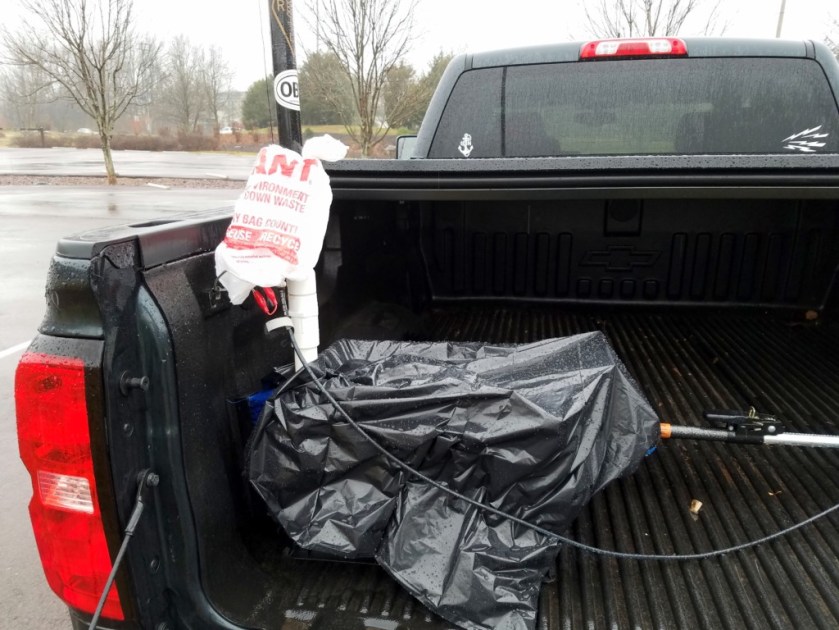
What a difference a day makes. On Sunday morning, I operated from Black Rock Sanctuary, just outside Phoenixville. While the temperature was still fairly moderate (47° F), it rained steadily all morning. I had to cover up my antenna components with plastic to keep everything dry.
My vertical antenna wearing its raincoat
The 40M band was in pretty good shape, so I spent most of my time there. I checked 20M once or twice but there was another contest going on and I didn’t hear any Winter Field Day CW activity.
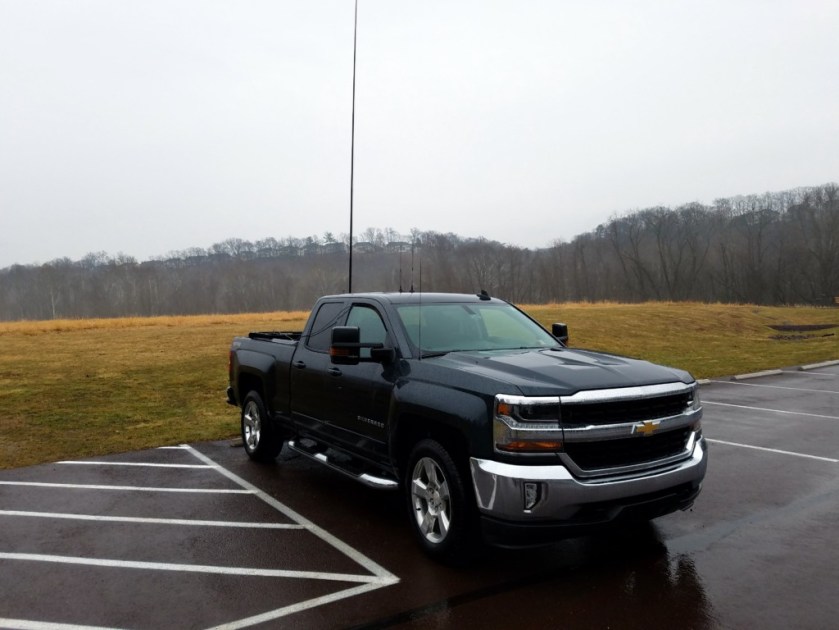
Winter Field Day at Black Rock Sanctuary
After about 1.5 hours, I matched yesterday’s effort with another 21 contacts. I even dragged out the microphone (gasp!) and made 4 SSB contacts. One of the SSB contacts was with WW1USA from the World War I museum in Missouri. He was also giving out WFD exchanges.
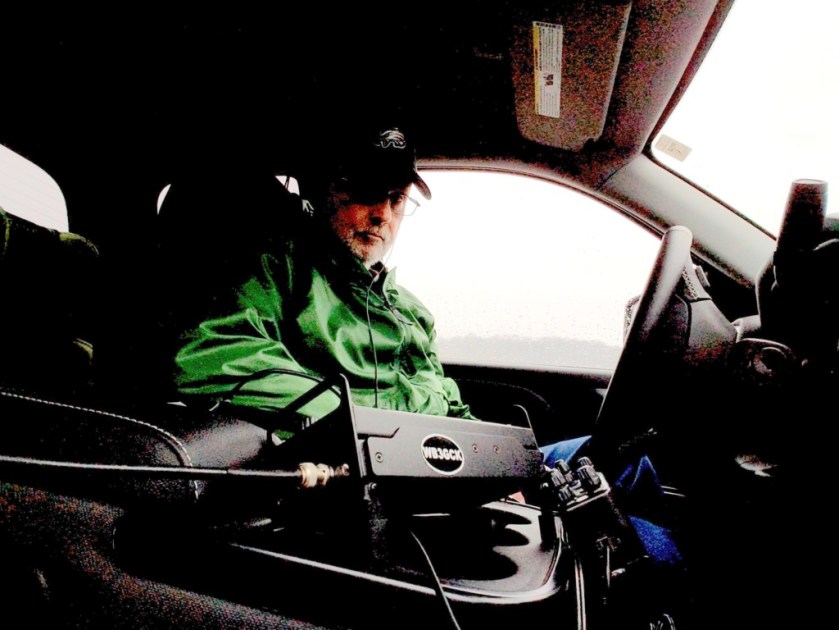
WB3GCK hunkered down for Winter Field Day on a rainy Sunday morning
Overall, I worked 42 stations in 24 sections and 21 states. I’m certainly not a threat to win but I’m happy with the results of my meager effort. It was great to hear all the CW activity this year.
I didn’t spend a lot of time on WFD this year but it certainly was fun. Maybe next year I’ll do something more adventurous like Winter camping. We’ll see.
The loosely organized group of QRPers known as the Boschveldt QRP Club made their annual pilgrimage to the Mohican Outdoor Center (MOC) for a weekend of radios and tall stories. Each year we rent a cabin and use that as a home base for hiking and QRP-portable operating. This year’s participants included Ed WA3WSJ, Ed K3YTR, Ron WA8IYH, John NU3E, Glen NK1N, Walt KB3SBC, Bill KA3RMM and me.
We all arrived Friday afternoon and it wasn’t long before a couple of stations were set up in the cabin. Friday evening’s activities included lots of socializing and a great dinner prepared by Ed K3YTR. KB3SBC set up a small projector and we looked at some pictures from the many WA3WSJ/KB3SBC NPOTA activations. We also saw a preview of WA3WSJ’s upcoming NPOTA presentation at the Four Days in May (FDIM) gathering.
The Boschveldt QRP crew. Seated (L-R): K3YTR, WA8YIH and WA3WSJ. Standing (L-R): KB3SBC, WB3GCK, NK1N, NU3E and KA3RMM. (Photo by WA3WSJ)
The Club also had some door prizes, courtesy of Ed WA3WSJ. WA8IYH won a neat little QRPver 20M QRP rig. Other prizes included a QRPver antenna tuner, a set of Palm Mini paddles and a few other goodies. I was surprised when Ed presented me with a uBITX rig for making the most QSOs at past Field Days. (I later traded it to NU3E for the Palm Mini paddles.)
During the evening, we lost power to the cabin, including heat and running water. The Team channeled their inner MacGyver and collected rainwater for flushing toilets, firewood for the fireplace and battery-operated lights. Despite the sub-freezing temperatures outside, the cabin stayed remarkably warm through the night.
Ron WA8YIH inspecting the QRPver transceiver he won as a door prize.
On Saturday morning, KB3SBC and KA3RMM made a much-needed coffee and donut run. A few folks stayed behind at the cabin, while the rest of us drove up to High Point State Park. At 1803 feet above sea level, this is the highest point in the state of New Jersey. Since the rain from the night before was now ice, we opted to forego hiking on this trip.
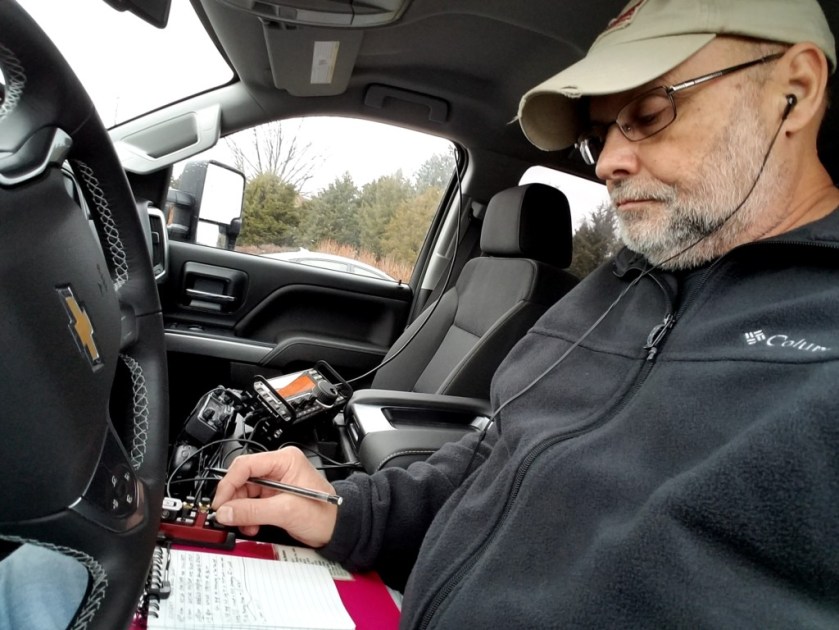
WB3GCK operating from the cab of the truck.
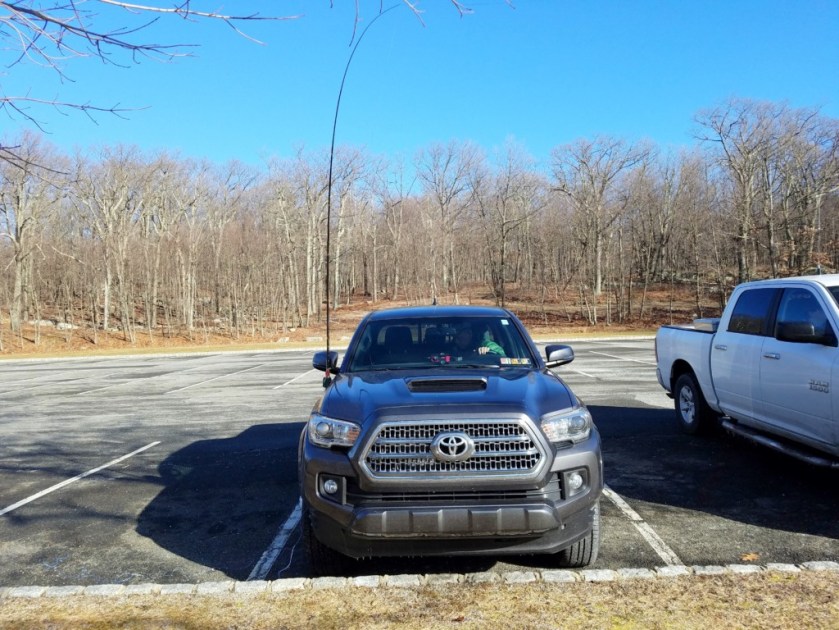
The road up to the High Point Monument was closed and it was too cold and windy for hiking, so we stayed in the parking lots and operated from our vehicles. WA3WSJ did a Parks on the Air (POTA) activation. NK1N set up his portable satellite equipment to work the “birds.” I put my 19-foot vertical on my truck and operated in the SKCC Weekend Sprintathon (WES) contest. By this time, the temperature was in the teens with a wind chill in the single digits. Needless to say, putting up antennas was a real challenge. Despite the challenges, everyone had a successful day. After a few hours of operating, we packed up and made the hour-long drive back to the cabin.
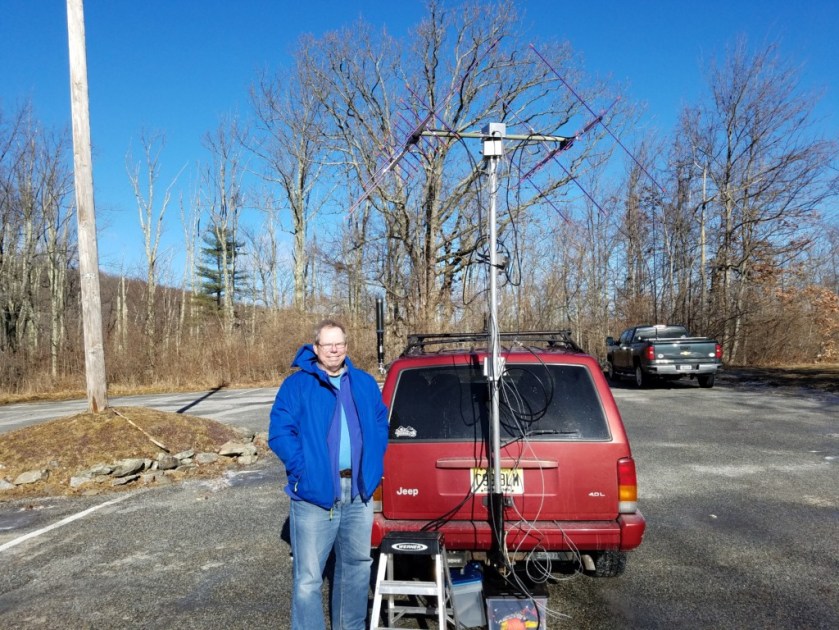
Glen NK1N ready to work the “birds” at High Point State Park. My truck with my vertical is in the background.
On Saturday evening, power was restored to the camp and we all headed into town for a great dinner. The evening concluded with more tall stories and some more radio operating.
Ed WA3WSJ operating from High Point State Park.
On Sunday morning, we had a huge breakfast before packing up and heading out. John NU3E made his famous Belgian waffles, while Ron WA8YIH made some incredible omelets. Needless to say, our little group includes some amazing culinary talent.
After packing up and saying our goodbyes, we closed the book on another fun Camp Run-a-MOC weekend. We’re all looking forward to coming back again next year.
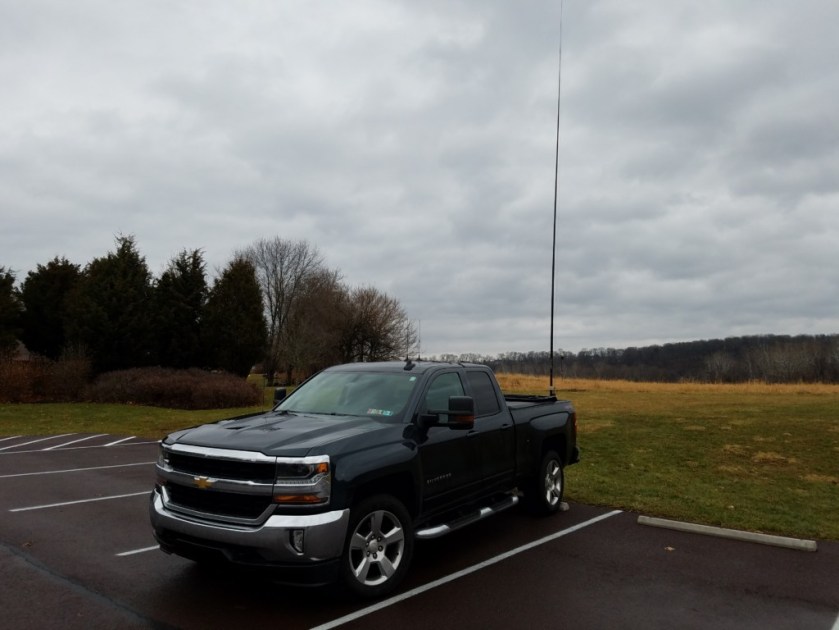
I wanted to get out and do a little QRP-portable before all the holiday festivities get started. I hadn’t operated from Black Rock Sanctuary in a while, so I headed over there. It was dreary and drizzly today, so it was a good day to operate from the truck and give my homebrew 19-foot vertical another workout.
The vertical antenna in use at Black Rock Sanctuary
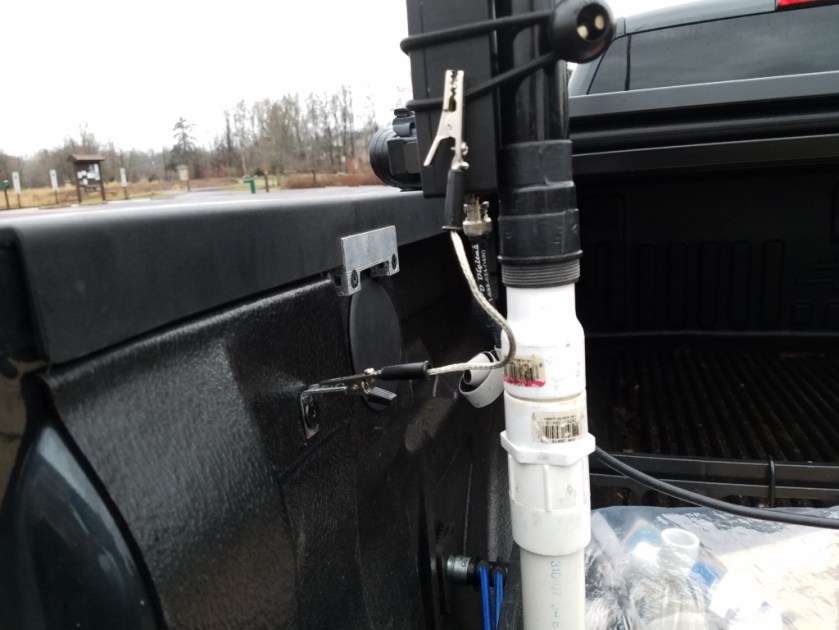
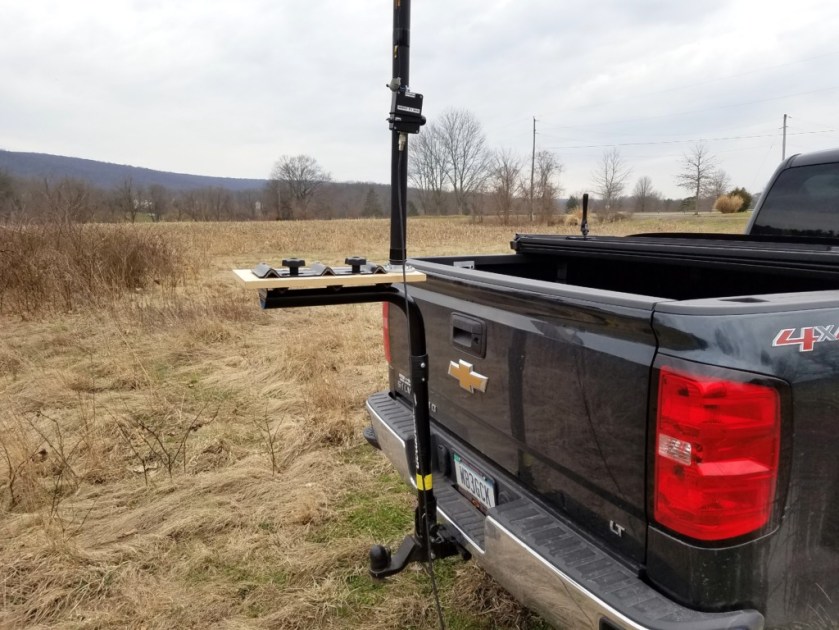
Since the last time I used the 19-foot vertical in the truck, I found a way to ground the antenna to the body of the truck. It was a simple matter of backing out one of the screws that hold the bed liner in place and using it to attach a small L bracket. This now provides a convenient spot to attach my ground lead.
Ground connection for the vertical antenna.
I was using my little MS2 straight key with the KX3 today. The bands were in pretty decent shape and the antenna seemed to be working great. I made a half-dozen SKCC contacts on 40 and 20 meters with some respectable signal reports. One SKCC’er in California called me on 20 meters but the frequency was taken over by other stations. I wasn’t able to complete the QSO but at least I was being heard on the West Coast.
Operating position in the truck
I also had some nice two-way QRP QSOs. W4UV in North Carolina had a great signal on 40M with his Ten Tec QRP rig. Jim N0UR was really pounding in from Minnesota on 20 meters. My favorite QSO of the day was with Dirk W8IQX. Dirk was running 2 watts from his FT-817 to an AlexLoop on 20 meters. If I copied correctly, he was in Florida. QRP never ceases to amaze me!
[This is an updated version of a post that appears on my old website. – WB3GCK]
I do quite a bit of my QRP operating from portable locations. I like to use simple wire antennas but, truth be told, I really dislike spending my limited operating time trying to get antenna wires up into trees. Also, when activating parks for Parks on the Air (POTA), I often operate from the cab of my truck and need an antenna that is self-contained and quick to deploy. This set up fits the bill.
What I did was modify my homebrew roll-on mast support so I could use my hitch-mounted bicycle rack to support it. This only required the drilling of two holes in the roll-on mount. Figure 1 shows the roll-on mount clamped into the bike rack. In this case, I was supporting a 31-foot Jackite pole. After extending the pole and removing the bottom cap, I just lower the pole onto the 1-1/4 inch pipe. That’s all there is to it.
Bike Rack Antenna Mount. A 9:1 unun is attached to the Jackite pole with a bungee cord.
By selecting the right size of pipe, I can use this technique to support a variety of masts. For example, I’ve used this type of mount to support two 5-foot sections of TV antenna mast. I used this configuration to support a 1.2 GHz yagi for DStar digital communications during an ARES-RACES drill years back.
The Bike Rack Vertical in use
When operating QRP-portable, I often use a vertical antenna made from a 30-foot piece of hook-up wire and fed through a homebrew 9:1 unun with an 18-foot length of RG-8x coax. The unun is just attached to the 31-foot Jackite pole using some small bungee cords. No radials are used, which gives this set-up virtually a zero footprint. You can find more information on this configuration on the EARCHI website. I’ve successfully used this antenna in the field over the past few years. It’s a bit of a compromise, as antennas go, but it has always served me well. The extra height using the bike rack mount seems to help performance a bit. (Although I can’t quantify that, I’m sure the extra height doesn’t hurt.) With the internal antenna tuner in my KX3, I can work all bands from 40 through 10 meters. Heck, I’ve even used it on 80 meters a bunch of times.
I used this particular antenna configuration countless times in recent years. It was my “go to” antenna for NPOTA activations. Within 5 minutes of arrival, I can be on the air. When it’s time to leave, tear down is just as fast. Now, that’s what I’m talkin’ about!

 The loosely organized group of QRPers known as the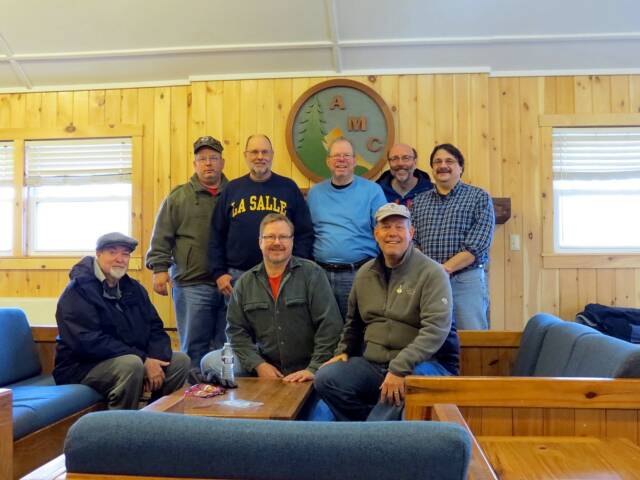

 WB3GCK QRP Amateur Radio