I haven’t activated a park recently, so I made a point to get out today. This weekend is the Parks on the Air Fall Support Your Parks weekend. What better time to activate?
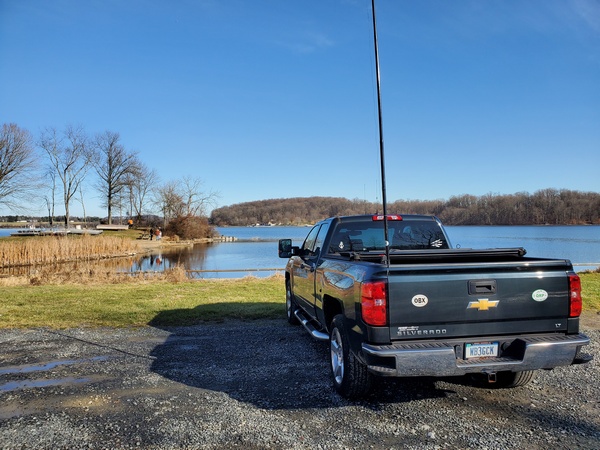
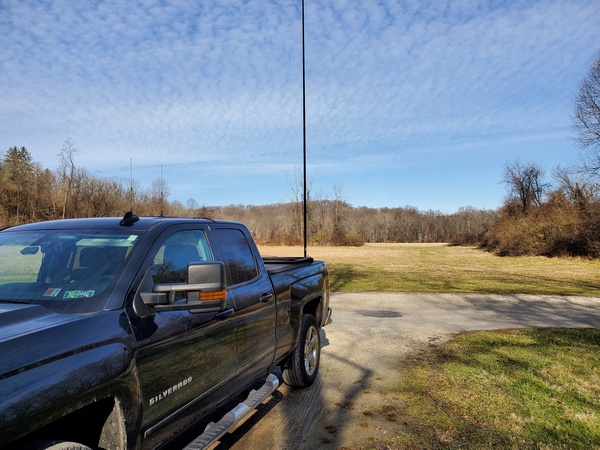
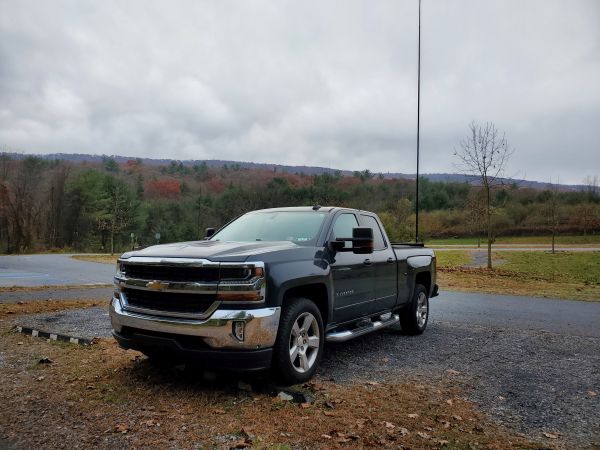
I made a last-minute decision to head back to the western boat launch area in Marsh Creek State Park (K-1380, KFF-1380), a site I’ve been to a few times in the past year. Looking at the surrounding terrain, you would think this is a terrible location. It’s down at water level near the lake, and you have to descend a large hill to get down there. Despite the terrain, I’ve always had good luck from there. Today was no exception. Not to mention there’s a beautiful view of the lake.
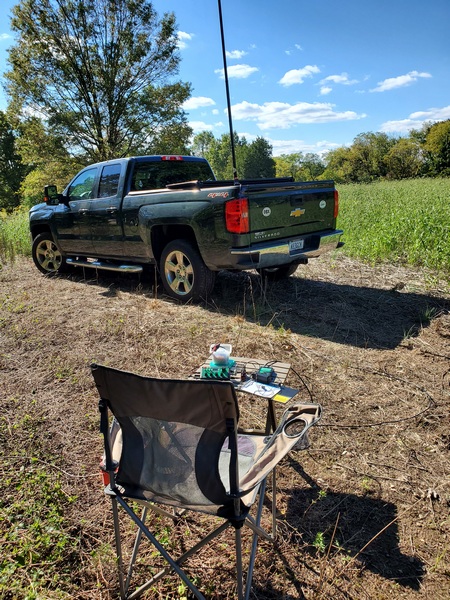
WB3GCK at Marsh Creek State Park (K-1380)
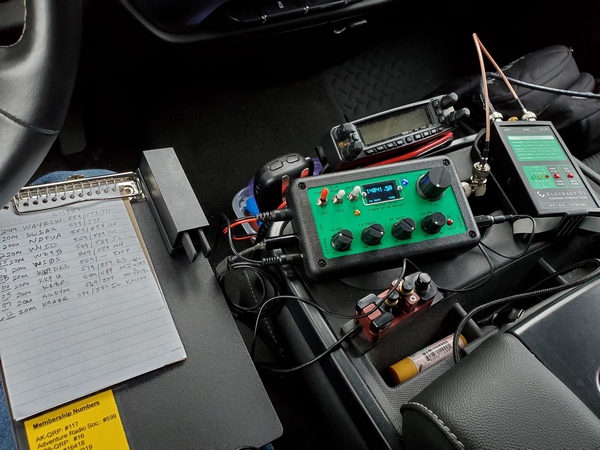
Using my TR-35 and my 19-foot vertical, I started out on 40M. Initially, I had a little trouble spotting myself. Even before I was spotted, a station in New York stumbled upon me and got things started. Eventually, my spot went through, and things really picked up. I made 28 contacts on 40M in the first 45 minutes. Up on 30M, I picked up 11 more contacts.
Before I left, I checked 17M, and I’m glad I did. I was getting some very strong Reverse Beacon Network (RBN) spots from Europe. In short order; I had three contacts, with the last two being SP6GNJ and CU3AA. Happily, my puny five-watt signal was making the trip across the pond.
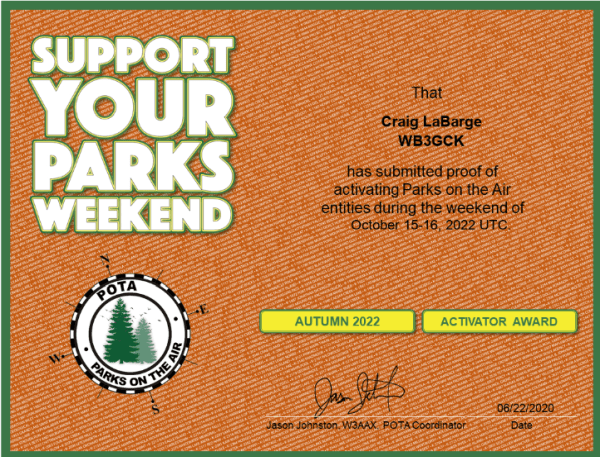
Support Your Parks Weekend Activator Award
I ended up with 42 contacts, including two park-to-park QSOs, and the two DX contacts. Right after I uploaded my log, I received a certificate for activating a park during Support Your Parks weekend. I made a few contacts as a hunter yesterday, so I also received a hunter certificate.
I was long overdue for some portable QRP, so I went out twice over the weekend. As a bonus, we had some beautiful Fall weather here in southeastern Pennsylvania.
The bands, especially 20M, were in good shape, and I made a half-dozen SKCC contacts. There were a lot of Parks on the Air (POTA) activators, so I spent most of my time hunting them. The Pennsylvania QSO Party was also going on, and I logged a few of them, too.
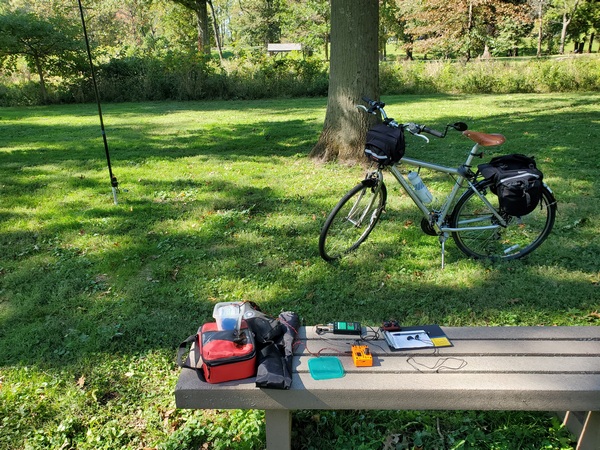
On Sunday, I went for a bike ride on the Schuylkill River Trail and stopped in a park for a little radio time. This time I used my newly acquired (tr)uSDX with my ground-mounted 19-foot vertical.
My bike-portable setup on Sunday
The bench I was sitting on was getting full sun from time to time, which made reading the radio’s display a challenge. There were some loud signals on 20M that seemed to overload the radio’s front end. I could have used some attenuation, but, not being able to read the display clearly, I didn’t attempt to navigate the menus. (Note to self: Stay in the shade next time.) Despite these challenges, I logged three SKCC stations receiving good signal reports from each of them.
Nothing really exciting this weekend, but it was great to get back out portable again.
I keep saying that I need another rig like I need a hold in the head. I guess I have a hole in my head, because I recently bought another QRP rig.
The rig I purchased was a (tr)uSDX transceiver. I had been thinking about getting one of these little rigs for several months before finally giving in and buying one. I placed an order with roWaves in Romania, and, to my surprise, I had it in my hands five days later.
My new (tr)uSDX transceiver on the air for the first time
This rig is only about the size of a pack of cigarettes, but it sure packs a lot of functionality in there. I won’t go through all the specs and functions, but it puts out about 5 watts (give or take) and covers 80/60/40/30/20m. It supports CW/LSB/USB/FM/AM, and you can set it up for digital modes, too.
There are three controls (two push-buttons and a rotary encoder), and they each have multiple functions. So, it’ll take some practice getting this old dog used to the menus and functions.
I set it up on the bench to fire it up for the first time. I connected it to my Elecraft T1 tuner, which was connected to my rainspout antenna. During this initial session, I logged contacts on 40, 30, and 20M. One of those was a very nice chat on 30M with a fellow SKCC member up in Massachusetts. This little rig held up well in my noisy environment.
Hopefully, I’ll be able to take the (tr)uSDX out in the field over the weekend and give it a whirl.
I haven’t been very active on the HF bands lately. Family functions and other obligations have been keeping me busy. This weekend, however, I was able to take part in two different ARES–RACES events.
On Saturday morning, our local ARES-RACES group conducted a Simulated Emergency Test (SET). Because of the heavy rains forecasted, most operators participated from home. During the brief exercise, I sent an NBEMS message and a Winlink peer-to-peer message to the county Emergency Operations Center over local 2M simplex frequencies. I used my little Evolve laptop, and it performed great.
On Sunday, our ARES-RACES group provided emergency communications for the Marshalton Triathlon. This annual, family-friendly event combines cycling, canoeing, and speed walking. This year I was once again stationed at “Canoe Out,” which is the terminus of the 2.3 mile canoe run on the Brandywine River.
A water-logged WB3GCK at the Marshalton Triathlon
A crew was on hand to help participants disembark safely
The boat handlers did a great job in some very muddy conditions
This year’s triathlon was a wet one. It rained steadily for most of the five hours I was onsite. Despite the lousy weather, the participants seemed to have a good time. After the last canoe arrived, I was able to head home and dry out.
Hopefully, I’ll get back to doing some QRP-portable operating this week.
You’ve most likely heard hams talking about the Evolve III laptop over the past few months. I had been hearing about these little laptops being snapped up at prices as low as $60. Several ARES-RACES colleagues have been happy with them, and there’s even one running 24 x 7 as a VARA FM digipeater in our Emergency Operations Center. So, I had to buy one and judge for myself.
So, what is attracting hams to this laptop? Of course the low price is attractive to frugal hams. It’s also small (11.6-inch display) and light, making it useful for portable operation. Speaking of portable operations, you can charge the Evolve III from a 12-volt DC source. Out in the field, you can charge this laptop from the same type of 12-volt battery used to power your rig.
Evolve III Maestro E-Book
Despite its low cost and small size, it’s a capable little machine. It runs the Windows 10 Pro Education operating system, and has two USB ports and a micro SD memory card slot. A 1.1 GHz Celeron processor runs the laptop, and it has 4 GB of RAM and 64 GB of data storage.
Micro Center stores have been selling them for $59.99 with a limit of five per customer. When I checked my local store, they were out of stock, so I bought one on Amazon for about $89. (Still a bargain, I think.) These laptops are obviously clearance items, since the Evolve website shows newer models running Window 11.
My plan for this little laptop is to use it for logging during QRP-portable operations, especially Field Day and Winter Field Day. I also want to use it for digital communications during ARES-RACES exercises and deployments.
Getting started with the Evolve III was the same as any other Windows 10 device I’ve owned. The initial Windows setup didn’t take long, and I was ready to install some software. I started by installing the software I use for logging, e.g., N3FJP ACLog, SKCC logger, HamRS, N3FJP Field Day Logger, etc. Everything ran without issues.
Next I installed the software I need for ARES-RACES. First up was Winlink Express, along with VaraFM and SoundModem. Then, I installed the Narrowband Emergency Messaging System (NBEMS) software, i.e., fldigi, flmsg, and flamp. Over the past two weeks, I’ve been making solid connections to a local Winlink node on 2M using VARA FM. The NBEMS software has also been working great during our local ARES-RACES digital nets.
After using the Evolve III daily for the past few weeks, I really like it. The keyboard has a good feel to it, and the display looks good. I used it outdoors in the shade and the display was still readable. You might need to crank up the brightness, though.
Is it the fastest laptop? No way. Is it fast enough? Absolutely. I’ve heard of hams running FT8 on these things with no issues. You would think the 64GB of storage would be a limitation. However, after installing the ham radio applications I use, I still had about 24GB left. Just in case, I took advantage of the Micro SD card slot and added an extra 128 GB of storage.
I’m really impressed with the battery life. Depending on what I’m doing, I get more than eight hours of operation on a charge.
Lately, it seems like my house is where computers go to die. I’ve had a laptop and a desktop go belly-up in recent months. Given what I paid for the Evolve III, if it dies, I won’t feel a tremendous loss.
I took advantage of the decent weather yesterday and went for a bike ride along the Schuylkill River Trail and the Perkiomen Trail. Along the way, I stopped in a local park to make a few contacts in the Straight Key Century Club’s Weekend Sprintathon (WES) contest.
When I arrived at the trailhead, it was nearly full. Fortunately, I grabbed one of the last remaining parking spaces. After loading up my radio gear, I hopped on the bike and took off down the trail. As the trailhead parking situation would suggest, the trail was getting lots of use from walkers and cyclists.
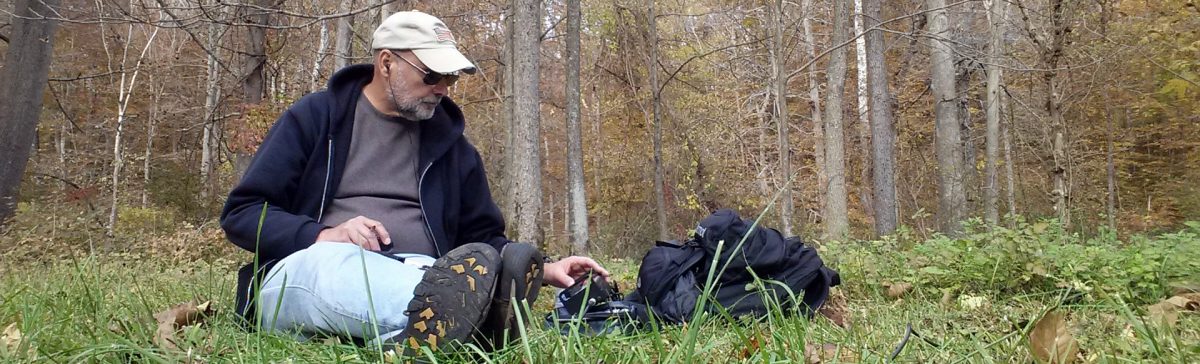
WB3GCK taking a radio break along the Perkiomen Trail
I didn’t hear much contest activity, but I seemed to have a pipeline to Prince Edward Island in Canada. I made SKCC contacts with the special event station, VC3Y/VY2, on both 40M and 20M. I also worked VA3DXQ/VY2 who was doing a POTA activation. KS9KCC was booming in from Indiana, but they didn’t seem to hear my five-watt signal. (Later in the day, I logged KS9KCC from home on 40M.) After making seven contacts, I packed up and continued on my ride.
My homebrew 19-foot vertical and ground mount
It’s a good thing I went for my ride yesterday. The weather today is raining and dismal.
Also, on the 21st anniversary of the 9/11, please take time to remember those lost in that tragedy.
Over the years I have accumulated a stash of the bags that Crown Royal whiskey comes in. I don’t drink much hard liquor myself, but I have a relative who enjoys a nip now and then. She knows I have a thing for bags and containers, so she passes them along to me. I graciously accept them, figuring someday I’ll find a good use for them.
When I take my Penntek TR-35 on the road, I use a repurposed insulated lunch box to carry the radio, an Elecraft T1 tuner, along with a variety of accessories. Pending a better solution to protect the TR-35 from bouncing around, I wrap some bubble wrap around it before placing it in the box. Decidedly low-tech, but effective.
The Crown Royal bag, along with my TR-35 transceiver
The lunch box works great, but it’s a little bulky for my sling pack. So, for hiking, I usually pack the TR-35 loose in the pack, with a rubber band around the bubble wrap.
The bubble-wrapped TR-35 going in the bag
I found that a Crown Royal bag provides a more elegant solution for packing the TR-35 (or other small QRP rig). I just wrap the bubble wrap around the radio and place it in the bag. There’s no longer a need for the rubber band. Plus, there’s enough room in the bag to accommodate the T1 tuner.
The Crown Royal bag with my TR-35 tucked away inside
These bags don’t offer any real protection from the weather, but they look cool. My collection of bags includes a variety of colors, so I can change them to match my mood (just kidding—let’s not get carried away here).
So, there’s a crazy little hack for you to ponder. If you’re a Crown Royal drinker, save the bags. Your radio just might fit in there.
After a long drive home from North Carolina yesterday, we were still unpacking from our vacation and getting caught up on things today. I couldn’t pass up the annual Skeeter Hunt QRP contest, so I snuck out to make a few contacts. Besides, I was issued a single-digit skeeter number (#7) this year, so I couldn’t let that go to waste.
I drove a few miles over to Valley Forge National Historical Park, hoping to catch enough skeeters for a valid POTA activation (K-0761). The area I was in was busy with folks enjoying their picnics, so I parked my truck well away from them.
I didn’t plan to stay long, so I operated from the truck. I used my Penntek TR-35 and my trusty homebrew vertical. That turned out to be a wise move, since the truck provided some shade and an occasional cross-breeze through the windows.
Yours truly operating in the 2022 Skeeter Hunt QRP contest
When I turned on the rig, the 40M band was buzzing with QRP skeeters, and I made most of my contacts there. Conditions, at times, seemed pretty good; I worked stations in WI, MO, and GA on 40M from here in southeastern PA. After running out of new ones on 40M, I moved up to 20M and picked up a few there.
At the end of my 1.5 hour session, I had worked 16 skeeters, one non-skeeter QRPer. There were other skeeters operating from POTA entities; I had at least four park-to-park contacts I know of.
The Skeeter Hunt is always a good time. I’m glad I could take part, even if just for a part of the contest. A big shout-out to Larry W2LJ for organizing this fun event.
We arrived on Saturday, after a long drive from southeastern Pennsylvania. After unloading and getting organized in the house we rented in Corolla for the week, I went outside and set up an antenna.
Currituck Sound, as seen from my antenna.
For the past two years at this house, I used a 29-foot vertical fed through a 9:1 unun. During both trips, I struggled with noise issues. I had a couple of antenna options I wanted to try this year.
This time around, I went with a Rybakov-type antenna. I strapped a 28-foot Jackite pole to the railing of the 3rd floor deck. I used a 26-foot vertical wire fed through my recently built weather-resistant 4:1 unun. My 26-foot counterpoise wire ran out to the side of the antenna and down the side of the deck stairs. It was a weird configuration, for sure. I ran 25 feet of RG-8X coax down to the second floor, where I could operate in the shade—in the morning, at least.
My Rybakov vertical configuration. The red line shows how I ran the counterpoise wire. Despite this weird-looking setup, it worked pretty well.
I didn’t test the antenna until early Sunday morning, and my KX3’s tuner matched it on every band from 40M through 10M. The noise levels on 40M and 20M were down around S2, a dramatic improvement over previous years and completely workable. The higher bands were dead quiet.
My antenna feedpoint. I used my weather-resistant 4:1 to create a Rybakov-type vertical.
My first contact was an interesting one. Fellow Boschveldt members, Glen NK1N and Rob KE3TI, were on an overnight backpacking trip on the Appalachian Trail in Pennsylvania. I sent Glen NK1N a text message to let him know I was on the air, and we connected on 40M. We chatted for a bit and exchanged SKCC numbers. Conditions were rough in the beginning but, towards the end of our contact, our signals improved.
Before quitting, I logged 10 SKCC Weekend Sprintathon (WES) contacts. There were bonus points for using a homebrew key, so I used a straight key I cobbled together a few years ago. I also worked Greg WA3GM, who was doing a POTA activation at a park near to my home in Pennsylvania. So, my jury-rigged Rybakov seemed to get out OK.
The homebrew straight key I used during the SKCC Weekend Sprintathon (WES).
Monday morning, I got set up on the deck to make a few contacts. I noticed the antenna was acting up a bit on the 40M band. The KX3’s tuner showed it found a 1:1 match, but the SWR went up when I transmitted. I had no issues with the other bands, just 40M. It seemed like I was getting some RF on the coax shield, so I added a common mode choke at the transceiver and changed to a shorter length of coax. That cleared up the issue. I’m guessing there was some interaction between the antenna’s counterpoise and the coax on 40M. Even before I resolved the antenna issue, I logged a half-dozen contacts.
My radio setup on the 2nd story deck of the rental house.
With six adults, four grand-kids, and two grand-dogs, there was always something going on in the house. However, I managed to get on the air for about an hour each morning after breakfast to make a few contacts.
Thursday evening was busy. I kept track of Winlink check-ins for an ARES-RACES net back home. Using DMR, I checked into another ARES-RACES net in Pennsylvania. When I’m down here, I always like to check into the Outer Banks Area Wide Net. Then, it was out to the dock to join my grand-kids for some crabbing.
As I was finishing up breakfast on Friday, I got a text message from my friend, Frank N3FLL, asking if I was on the air. I quickly moved my radio out to the deck and had a nice QSO with him. I also worked a few POTA activators including Greg WA3GM. I worked Greg on the first day, so it was only fitting that I work him on the last day, too. After that, it was time to take down the antenna and pack up the radios.
I didn’t spend as much time on the air as in previous years, but I worked some fellow SKCC members, chased a few POTA activators, and had a couple of nice ragchews. All in all, it was a great vacation with excellent weather. I’m already looking forward to next year.
I recently came across a product on Etsy that caught my eye. It’s a 3D printed project box with an integrated antenna wire winder. I couldn’t resist, so I ordered one.
The box will accommodate a T-130 toroid, and the snap-on lid comes with a gasket. There is a pre-drilled hole for a BNC-F panel mount connector, and there are marks to guide drilling for the output and ground connectors of your choice. You can choose from two colors: orange or green. The vendor states that it is “UV and weather resistant.”
I like the idea of having a box to enclose the balun or transformer. My preference for portable antennas is to avoid exposed components or circuit boards.
I used mine to build a 4:1 unun for portable use in a Rybakov configuration. The unun consists of 19 bifilar turns of #24 solid hookup wire on a T130-2 toroid. You can find plans for winding the unun here and other places on the Internet. For the output and ground connections, I used #10-24×3/4″ stainless steel machine screws, along with some nuts, flat washers, and lock washers.
Inside view of the 4:1 unun. I used double-sided foam mounting tape to secure the toroid. I also use a small piece of packing foam (not shown) between the lid and the toroid for added stability.
To go along with the completed unun, I prepared two 26-foot wires; one for the radiator and one for a counterpoise. I finished up by attaching a length of 2.5mm bungee cord. This cord keeps everything together for travel. I have also used it to secure the box to a vertical support, e.g., fiberglass mast, fence post, etc.
The 4:1 unun deployed in a Rybakov vertical configuration with a 26-foot radiator and a 26-foot counterpoise
In the field, this Rybakov antenna worked as well as others I have built over the years. I tested it using my Penntek TR-35 and Elecraft T1 tuner with 18 feet of coax. It tuned up easily on 40, 30, 20, and 17 meters, and I made a couple of QSOs while testing. The integrated winder made it easy to deploy and take down.
The 4:1 unun packed up for travel
I have a feeling another one of these boxes is in my future. Maybe a 9:1 unun next time?