Micro Straight Key by KC5ILR

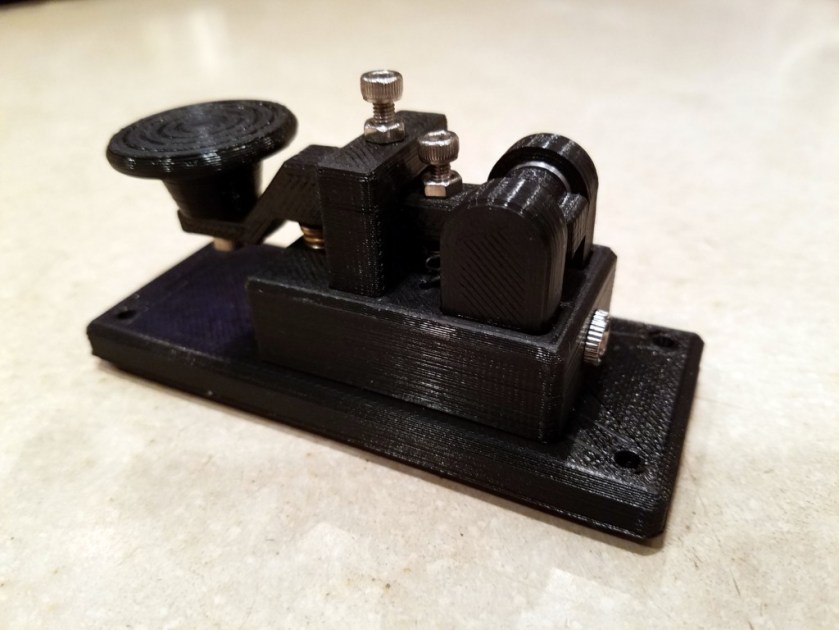
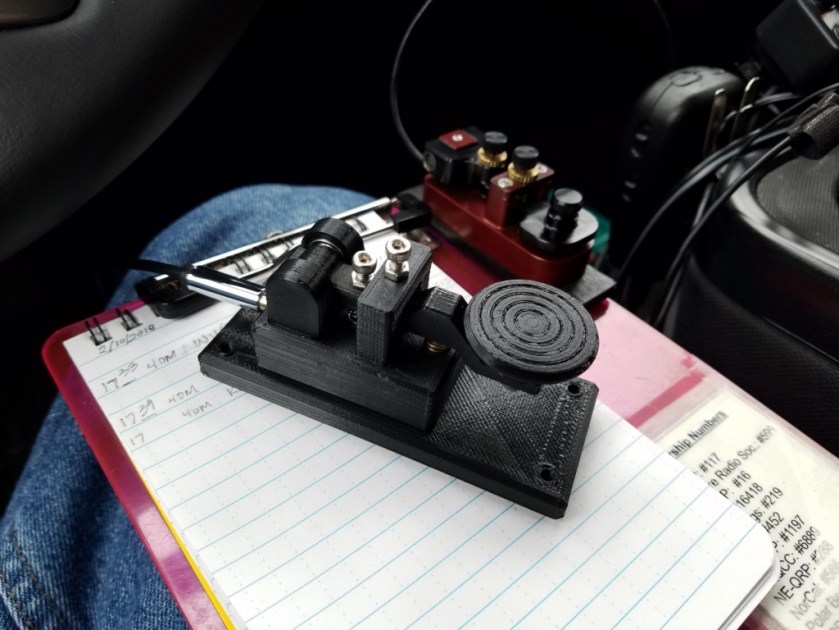
I recently bought another key from KC5ILR & Sons over eBay. This inexpensive little straight key could become one of my favorites.

Last year, I came across these straight keys that KC5ILR and his sons produce on a 3-D printer. They sell a variety of key styles in various colors. I bought a camelback style key and wrote about my initial impressions. While it is a nice key, the aluminum contacts didn’t always close cleanly and I detected some slight noise in the keyed signal.

I noticed that KC5ILR’s keys are now using solid brass contacts, so I bought one of their new lightweight Micro keys to give it a try. I received it a few days after ordering it and boy am I impressed.

Micro Key by KC5ILR & Sons

Here are the specifications from the eBay listing:

Width: 1-7/16"
Length: 4-1/8"
Height: 1-3/8"
Weight : <2 oz.
Action: Single Max .100" gap.
Spring: Coil Chrome
Style: Camel Back Arm
Wiring: Stranded Copper
Contacts: Solid Brass
Resin: Biodegradable PLA Polymer
Construction: 3D Thermal Printed
Screws: 18-8 Stainless Steel 3MM Socket Head Cap Screws
Nuts: 3MM Stainless Steel Jam Nuts
Screw Holes To Mechanically Fasten.
Standard 3.5MM Receptacle (Use Tip & Sleeve Mono Or Stereo)
Solid Brass Contacts For The Ultimate QSO.

It took no time at all to adjust the contact spacing and tension to my liking. The base has countersunk holes for permanent mounting but I applied the four stick-on, rubber feet that came with the key.

The key has a 1/8-inch audio jack for connection to the rig. A cable is not provided so you’ll need to provide a stereo or mono patch cable. When using a stereo cable, the key is wired to use only the tip and sleeve. So, using a regular stereo patch cord, I can connect the key directly to my KX3. I connected it to my code practice oscillator for my initial tests.

The solid brass contacts are a huge improvement over the earlier aluminum contacts; the keying was absolutely clean. Even though the key weighs less than 2 ounces, I found that the design of the base makes it very stable when keying. The overall feel of the key is impressive.

I recently took my new key out for some portable operating. I used it to make a few SKCC contacts during a Weekend Sprintathon (WES) contest. As expected, this little key performed well and keyed cleanly. This will be a nice little key to take along when weight is a major concern.

KC5ILR's Micro Key being used for portable operations. My American Morse MS-2 key is in the background.
KC5ILR’s Micro Key being used for portable operations. My American Morse MS-2 key is in the background.

If you’re looking for a small straight key for portable operation, look no further. For $19.95 USD, you really can’t go wrong.  You can also buy these keys directly from the C. W. Morse website.

73, Craig WB3GCK

[Disclaimer:  I have no financial interest in this company.  I’m just a satisfied customer.]

Pre-Holiday QRP Portable

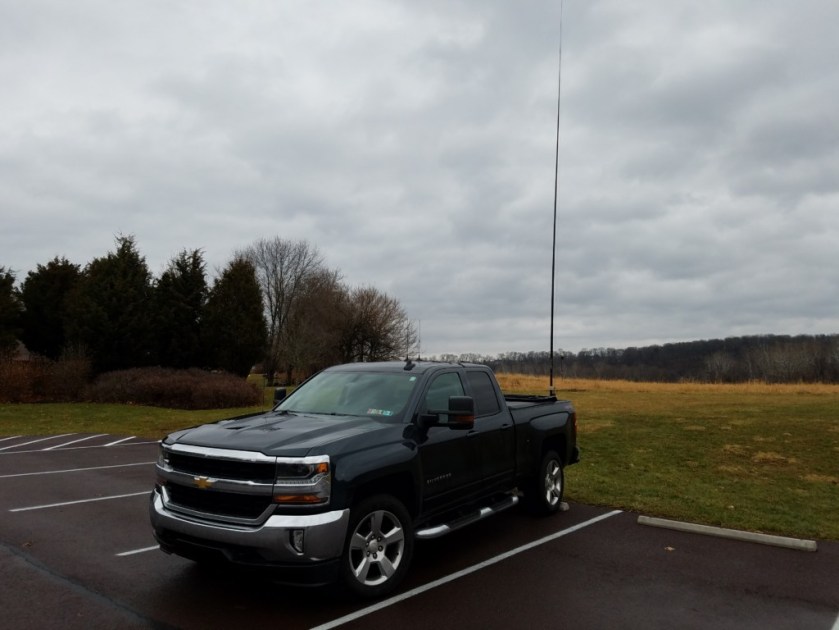
I wanted to get out and do a little QRP-portable before all the holiday festivities get started. I hadn’t operated from Black Rock Sanctuary in a while, so I headed over there. It was dreary and drizzly today, so it was a good day to operate from the truck and give my homebrew 19-foot vertical another workout.

The vertical antenna in use at Black Rock Sanctuary

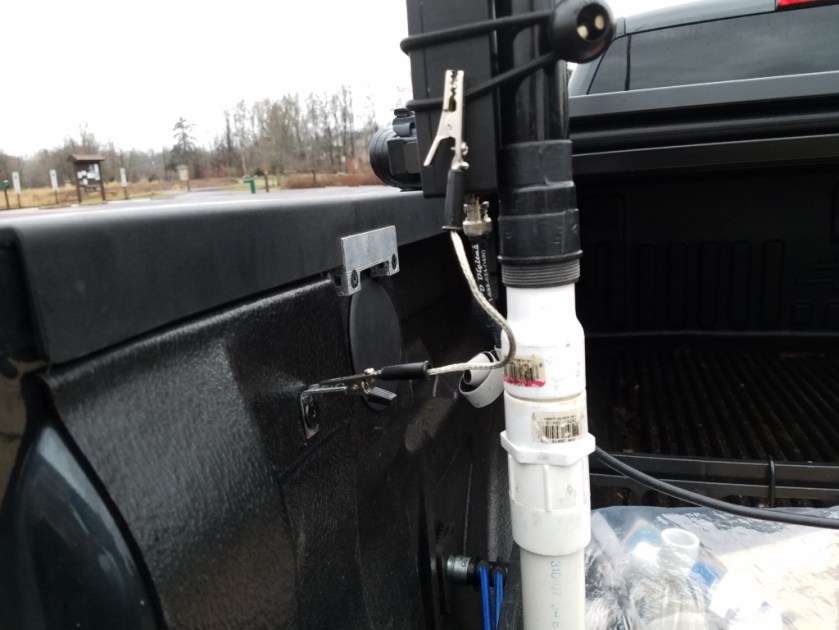
Since the last time I used the 19-foot vertical in the truck, I found a way to ground the antenna to the body of the truck. It was a simple matter of backing out one of the screws that hold the bed liner in place and using it to attach a small L bracket. This now provides a convenient spot to attach my ground lead.

Ground connection for the vertical antenna.

I was using my little MS2 straight key with the KX3 today. The bands were in pretty decent shape and the antenna seemed to be working great. I made a half-dozen SKCC contacts on 40 and 20 meters with some respectable signal reports. One SKCC’er in California called me on 20 meters but the frequency was taken over by other stations. I wasn’t able to complete the QSO but at least I was being heard on the West Coast.

Operating position in the truck

I also had some nice two-way QRP QSOs. W4UV in North Carolina had a great signal on 40M with his Ten Tec QRP rig. Jim N0UR was really pounding in from Minnesota on 20 meters. My favorite QSO of the day was with Dirk W8IQX. Dirk was running 2 watts from his FT-817 to an AlexLoop on 20 meters. If I copied correctly, he was in Florida. QRP never ceases to amaze me!

Happy Holidays to you and yours.

72, Craig WB3GCK

The Quickie Whip

This week, my ham radio activity was focused on an emergency communications exercise with my local ARES-RACES group.  I thought I’d do a post about the simple whip antenna I used with a dual-band radio.  I cobbled this  set up together a few years back and it has come in handy on several occasions.

During the exercise, I was operating indoors with easy access to our local repeaters. I was copying digital traffic using the Narrowband Emergency Messaging System (NBEMS), so a handheld radio wasn’t a good option. In this situation, a dual-band mobile radio and this little whip antenna hack were able to get the job done.

The Quickie Whip attached to my old Icom 207-H dual band radio

For the whip, I use commercially available, collapsible BNC whip antennas for the 2 meter and 440 bands.  To connect the whip to the radio, I use a UHF-Male to BNC-Female right angle adapter I picked up on eBay. To help improve the efficiency, I attach two 1/4-wave counterpoise wires, one for 2 meters (about 19 inches) and one for 440 (about 6.3 inches).

Quickie Whip Antenna components: telescopic whip antenna, PL-259 to BNC-F right-angle adapter, and the modified 9V battery clip for the counterpoise wires.

To attach the counterpoise wires, I re-purposed a 9-volt battery holder. I just drilled out one of the mounting holes and used a small bolt and nut to attach the wires. The clip is just about the perfect size to snap onto the right angle adapter.

The antennas I use came from Smiley Antenna. I have 5/8-wave whips for 2 meters and 440, along with a halfwave whip for 2 meters. Although some of the antennas are specified to handle 50 watts, I generally use them only for 10 watts or less (in the interest of RF safety). If I need to run more power, I’ll go with an antenna placed a safe distance away.

I’ve used this simple antenna arrangement in several situations in recent years. It’s become a permanent part of my emergency communications go-kit.

73, Craig WB3GCK


A “Cooler” Idea

When I was in need of a container to transport my QRP rig, my XYL came up with an inexpensive solution. The answer was as close as the nearby grocery store.

A few years ago, I was using a plastic food container to keep my little YouKits HB-1B and accessories organized and protected in transit. It had enough room for the radio, a Li-Ion battery, keyer, paddles, K1 tuner, earphones, my clipboard/paddle mount, and assorted cables and connectors. Life was good until I cracked the plastic box while out in the field for a QRP Skeeter Hunt contest. I started searching for a replacement.

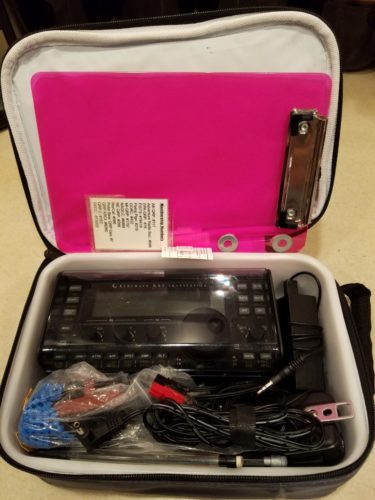
I mentioned my dilemma to my XYL. She came back into the room carrying a nifty insulated lunch box that she was using for a first-aid kit. I emptied out the first aid stuff and found that it could hold all of my radio stuff. I was particularly happy that my clipboard/paddle mount fit in there perfectly. I made a trip to the grocery store where she found the container and bought one for myself.

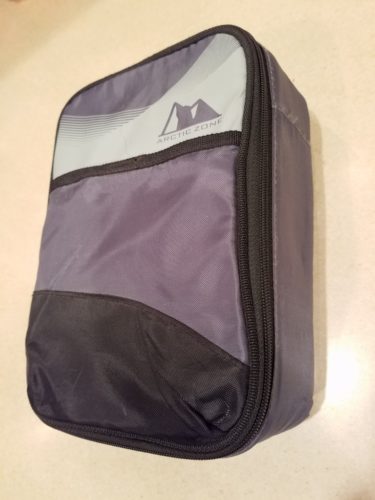
Arctic Zone Upright HardBody® Lunch Box. This one has seen years of use and now holds my KX3 and accessories.

The box my XYL found was the Upright HardBody® Lunch Box made by Arctic Zone. The outer material is padded for insulation and it has a rigid plastic liner that provides some extra protection. It also comes with an adjustable divider, which might be useful in some cases. There’s an outside pocket that I use to hold a notebook and pencil for logging. At the time, I paid less than $10 USD for it.

Last year, when I bought my KX3, I went through the same trial and error with the lunch box. I was able to get the KX3, Palm Mini paddles, MS2 straight key, microphone, earphones, clipboard and assorted cables and adapters in there. It holds everything but my LiFePO4 battery and antenna. (These items can vary from trip to trip, so this isn’t much of an inconvenience for me.)  So, off to our local KMart store I went. I bought two of the lunch boxes this time — one for the KX3 and one for a first-aid kit for in my truck.

This is the lunch box with the KX3 and accessories packed up. Out of sheer paranoia, I normally wrap the KX3 in a layer of bubble wrap for extra protection. When placed on top of everything, the clipboard provides another rigid surface for even more protection.

When I load up the KX3 box, the other items keep the radio for shifting around while in transit. Out of sheer paranoia, I put a layer of bubble wrap around the KX3. I’m not really sure that’s necessary though. When I’m ready to head out to the field, I just grab the KX3 box, my battery, and antenna of choice for the day and I’m all set.

There are certainly better, more expensive containers available. For the price, it’s hard to beat these lunch boxes. Maybe I should buy another one to hold my lunch and a couple of cold ones when I go into the field.  Hmmm…

73, Craig WB3GCK

The “Up and Outer” Antenna

[This is an updated version of a post that appears on my old website. – WB3GCK]

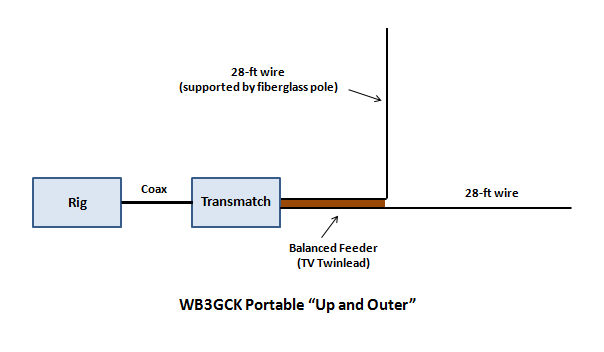
Something about the “Up and Outer” antenna has fascinated me since I first came across it in the 1974 edition of the ARRL Antenna Book. This antenna, which was once popular many years ago, is about as simple as it gets. Simply put, the Up and Outer is a dipole or doublet where one leg is vertical while the other leg is horizontal. Although it seems to be overlooked by Amateurs these days, this antenna offers some significant benefits:

  • It’s a good limited space antenna since one leg of the doublet is vertical. It only requires half of the space that a horizontal doublet would take up.
  • When fed with balanced line and used with a suitable transmatch, it’s a good multi-band antenna.
  • It combines characteristics of both verticals and horizontal wire antennas. That is, it is good for both local and DX work.
  • It’s very easy to build and erect.
The "Up & Outer" is essentially a doublet with one vertical leg and one horizontal leg.
The “Up & Outer” is essentially a doublet with one vertical leg and one horizontal leg.

First, a little background on this antenna. According to some handwritten notes from QRP Hall of Famer, C. F. Rockey W9SCH (SK), this antenna goes back to the 20s and 30s. Lew McCoy W1ICP (SK) wrote about it in the October 1960 edition of QST [1]. He didn’t use the name, “Up and Outer;” he merely referred to it as a “limited space antenna.” McCoy recommended horizontal and vertical elements of 30-feet each for operation on 80-10 meters. He also recommended using an open-wire feedline to minimize losses. Information from McCoy’s article has appeared for years in the ARRL Antenna Book. (I first saw it in my 1974 edition [2] and it was still shown in the 1997 edition [3].)

W9SCH wrote a couple of articles about this antenna for SPRAT  and appears to have coined the term, “Up and Outer.” In the first SPRAT article [4], Rock suggested using 1/4 wave elements for the lowest band and feeding it with either coax (for single band operation) or balanced line (for multi-band operation). In a follow-up article [5], Rock suggests pruning the horizontal element to equalize the current in the balanced feeder. He noted the imbalance when operating with the horizontal element close to ground. He started with 16-foot elements to cover 30-10 meters.

Another Hall of Famer, L. B. Cebik W4RNL (SK), wrote about a coax-fed version of this antenna for 10 meters [6]. Cebik built his antenna using aluminum tubing and referred to it as the “L Antenna.”

I also exchanged some correspondence years ago with Fred Bonavita K5QLF (SK), another QRP Hall of Famer and fan of the Up and Outer. He told me that W9SCH once mentioned using the copper ball from an old toilet float to top-load the vertical element of the antenna. I later came across a brief write-up by W9SCH on his Copper-Top antenna in the October 1995 edition of QRP Quarterly [7]. Using the toilet ball for top loading, Rock was able to reduce the height of his vertical element by 2-1/2 feet.

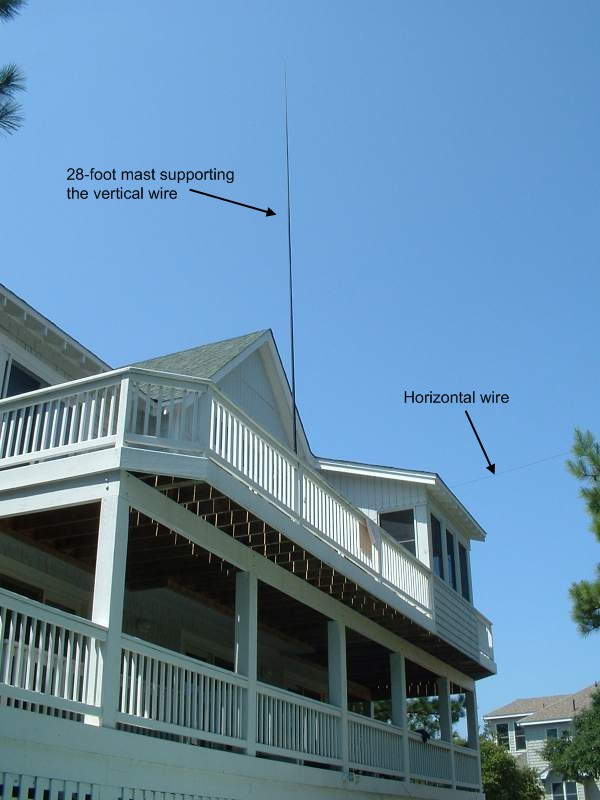
The "Up and Outer" antenna mounted on a 3rd-story deck in Corolla, North Carolina.
The “Up and Outer” antenna mounted on a 3rd-story deck in Corolla, North Carolina.

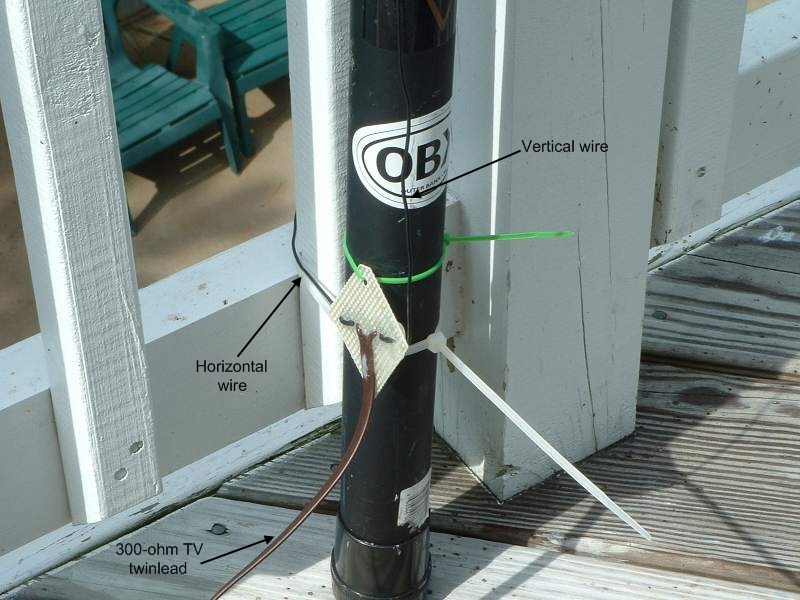
For me, the Up and Outer has turned out to be an ideal portable antenna to use while on vacation in a rented house on the Outer Banks of North Carolina. For several years I’ve used a 56-foot doublet with one wire supported by a 28-foot fiberglass telescopic mast and one 28-foot leg run horizontally. The vertical radiator is typically situated on a 3rd or 4th story wooden deck with the horizontal wire secured to a nearby tree or other support. For feedline, I use 25-feet of TV twinlead (the cheap brown stuff). Using either a homebrew Z-match tuner or an autotuner with a short run of coax to an external 4:1 balun, I’ve been able to use this antenna on 40-10 meters. Your mileage may vary. Depending on the transmatch you use, you might need to adjust the length of the feedline to get a good match on 40 meters.

"Up and Outer" feedpoint
“Up and Outer” feedpoint

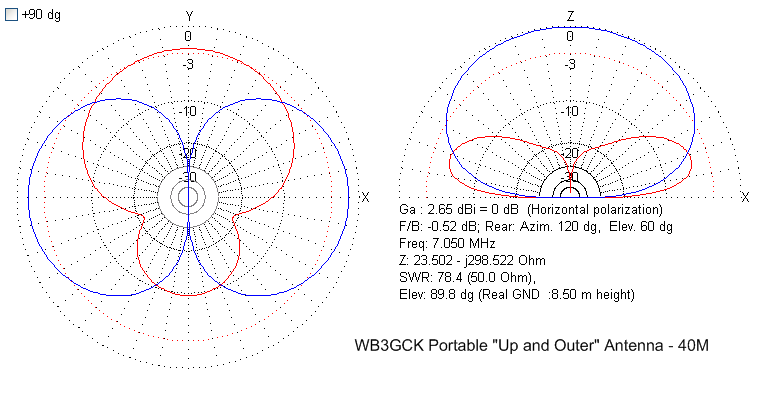
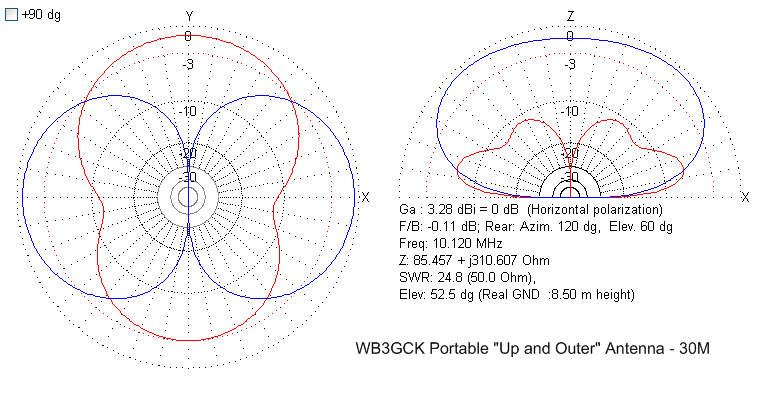
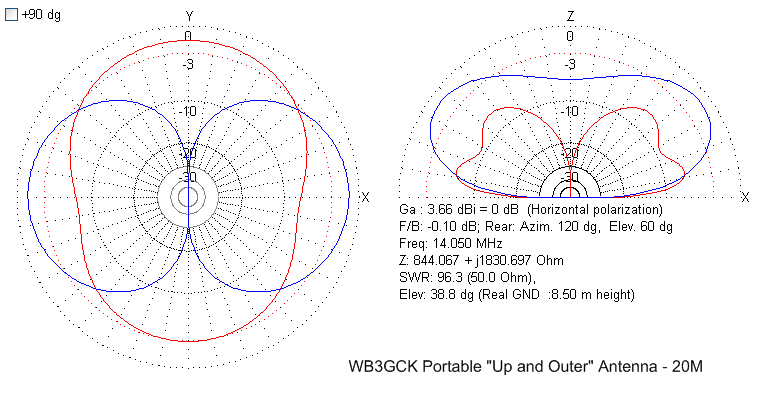
I did some quick modeling of a typical Outer Banks installation using MMANA-GL and you can clearly see the results of the combined horizontal and vertical elements. The horizontal polarity (shown in blue) shows lobes perpendicular to the axis of the horizontal wire, similar to a dipole. The vertical polarity (shown in red) shows a fairly low take-off angle and exhibits some slight directivity on 40 meters in the direction of the horizontal wire. This effect is due to the proximity to ground of the horizontal element and diminishes as you go higher in frequency. So, try to mount the Up and Outer as high above ground as you can.

"Up and Outer" 40M pattern
“Up and Outer” 40M pattern
"Up and Outer" 30M pattern
“Up and Outer” 30M pattern
"Up and Outer" 20M pattern
“Up and Outer” 20M pattern

The modeling bears out my empirical results with the antenna. My version of the Up and Outer has worked very well for both stateside contacts and DX. In particular, it has been very effective for DX contacts on 30 meters. As an added bonus, the 56-foot doublet can also be pressed into service as a normal horizontal antenna in locations where the Up and Outer configuration isn’t possible. So, it’s like getting two antennas in one. Can’t beat that.

If you are looking for a limited-space antenna, give this obscure classic a try!

73, Craig WB3GCK

References:
1. McCoy, Lewis G. “A Limited-Space Antenna.” QST October 1960: pp 23-25. (Available in the ARRL online archives)
2. “The ARRL Antenna Book.” 13th Edition, 1974. Newington, CT. pp 187-188.
3. “The ARRL Antenna Book.” 18th Edition, 1997. Newington, CT. pp 7-15, 7-16.
4. Rockey, C. F. “Up and Outer.” SPRAT Issue #67 (Summer 1991): p 18.
5. Rockey, C. F. “A Four Band Up and Outer Antenna.” SPRAT Issue #69 (Winter 1991/1992): p 16.
6. Cebik, L. B. “Whips, Tubes and Wires: Building a 10-Meter L Antenna.” QST December 1999: pp 52-54. (Available in the ARRL online archives)
7. Rockey, C.F. “The Copper-Top Antenna.” QRP Quarterly, October 1995: pp. 40-41.

© 2009-2020 Craig A. LaBarge

Jackite Pole Locking Pin

Here’s a quick little hack that might come in handy if your Jackite pole should suddenly collapse in windy conditions. It’s very easy to do and costs nothing, depending on what you have in your junk box.

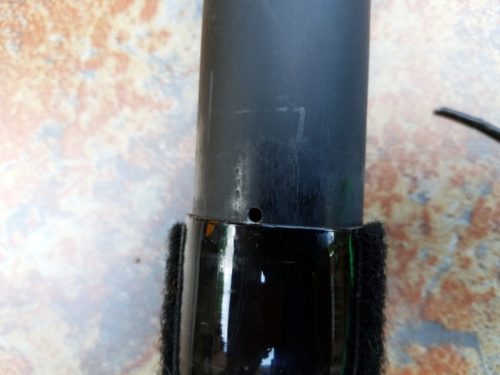
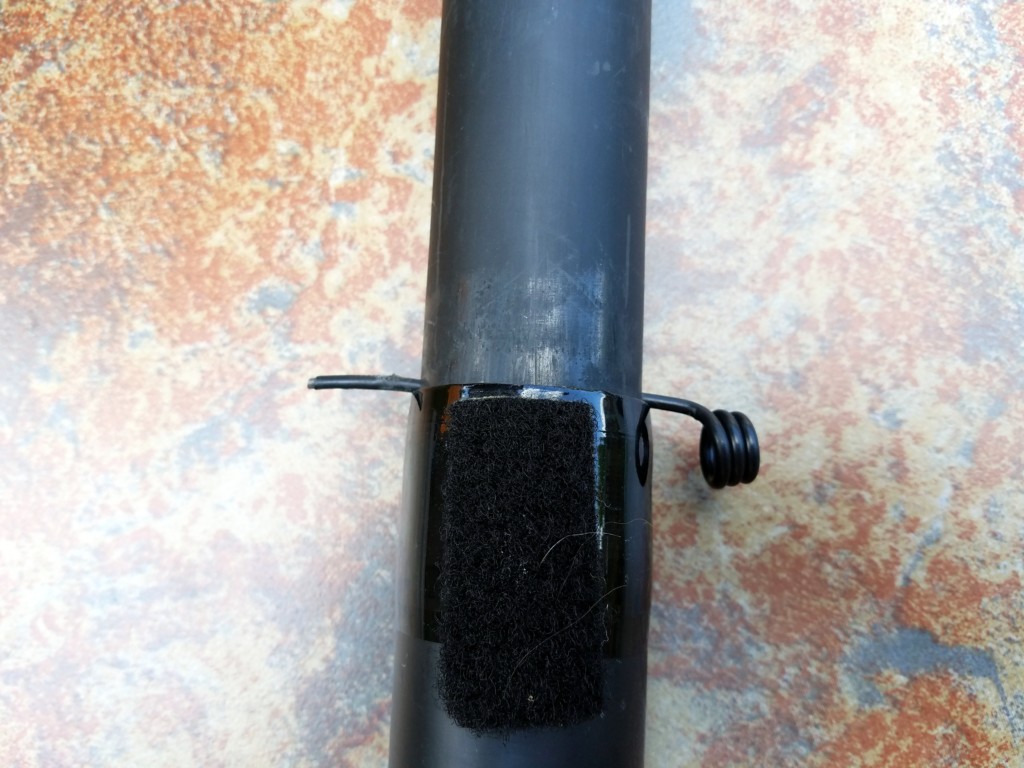
Once in a blue moon, in windy conditions, I have had my 28-foot and 31-foot Jackite poles spontaneously collapse. Usually, when it happens, it’s the second largest tube that collapses into the largest tube.  To remedy this, I drilled two 1/8-inch holes in the second largest tube right where it meets the largest tube. I drilled the two holes such that they were directly opposite each other. (See the accompanying pictures if my explanation is confusing.)

To remedy this, I drilled two 1/8-inch holes in the second largest tube right where it meets the largest tube. I drilled the two holes such that they were directly opposite each other. (See the accompanying pictures if my explanation is confusing.)

Jackite-Locking-Pin-Hole-500x375Here’s how it works. When the pole is fully extended, I just slide a pin through the two holes to prevent the pole from collapsing. For the pin, I used a hook from a bungee cord that I straightened out, using a pair of pliers. The resulting pin is just the right size and it has a nice rubberized coating on it. You could, of course, use something else (a nail, a piece of wire, etc.) for the pin.
These are the two pole sections with the locking pin inserted.

This is before (top) and after of the bungee hook I used for the locking pin.

I don’t usually use the pin, except in very windy conditions. I’ll definitely use it during my upcoming trip to the Outer Banks of North Carolina. My Jackite pole will be up for a week and facing some stiff ocean breezes.

73, Craig WB3GCK

Bike-Portable with My AlexLoop

Today was the first chance I’ve had during this long, holiday weekend to go out play radio. I’m a regular supporter of the Rails-to-Trails Conservancy, so I like to take advantage of rail trails when I can. Today, I loaded up my bike and headed down to the Chester Valley Trail. The Chester Valley Trail cuts across Chester County and connects to a large, growing network of trails in the greater Philadelphia area.

I decided to take my AlexLoop along today. I’ve never really tried carrying the AlexLoop on my bike before. While it fits comfortably in my backpack, I don’t really like to ride with a backpack on. I’ve always found that uncomfortable, especially on hot and humid days.

My bike loaded up and ready for travel. The AlexLoop structural components are in the green back. The coax radiator is in one of the pannier bags.
My bike loaded up and ready for travel. The AlexLoop structural components are in the green bag. The coax radiator is in one of the pannier bags.

Today, I arranged the three support pieces of the loop side-by-side. I used the velcro straps on the back of the tuning box to help hold the three sections together. Then I placed the sections in an over-sized nylon stuff sack. Taking care not to bend the antenna’s feed loop, I strapped the loop components and my tripod on the rear rack of my bike. I put the coax part of the loop in one of my panniers, along with my LiFePO4 battery. I put my KX3 in the other pannier bag. This turned out to be a workable solution.

This is how I arranged the AlexLoop components prior to putting them in a protective stuff sack. The velcro straps attached to the tuning box are used to help hold the pieces together.

After loading up the bike, I rode about 2.75 miles to the Exton County Park. I found a picnic table in a remote section of the park and set up the AlexLoop and KX3. I was out in an open area, so the wind was strong at times. I used a bungee cord to secure the tripod to the seat of the picnic table.

Due to some gusting winds, I used a bungee cord to secure the tripod to the bench.

I started off calling CQ on 20 meters and quickly received a call from N5GW. Gene was on vacation in Tennessee and was putting a great signal into southeastern Pennsylvania. After chatting for a bit, I signed with Gene and moved down to 30 meters. There were no takers there, so I gave 40 meters a try. N1KK gave me a call. Ken was operating QRP-portable from his summer home in Narragansett, Rhode Island. By the time Ken and I finished our QSO, the lack of shade was starting to get to me, so I packed up the bike and got back on the trail.

My setup at Exton County Park.

I rode another mile or so further before turning around and heading back to the trailhead.  I really enjoyed this trail and I’ll definitely be doing this ride again in the near future.

I was happy with the AlexLoop arrangement on the bike but I’m sure there’s room for improvement.

I’d like to wish all of my friends here in the U.S. a happy and safe Fourth of July holiday.

72, Craig WB3GCK

Mini Straight Key by KC5ILR

When I saw a Facebook post about a straight key fabricated with a 3D printer, I was intrigued.  I headed over to KC5ILR’s eBay listing to take a look and wound up buying one for $21.95 plus shipping.  (This was one of two impulse purchases I made recently.  I’ll post about the other one later.)  These keys are also available on the C.W. Morse website.

Here are the advertised specifications from the eBay listing:

Width: 1.45"
Length of Base: 2.68"
Overall Length: 4 1/8"
Weight : <1 oz.
Action: Single Max .100" gap.
Spring: Coil Chrome
Color: Black & Red
Style: Camel Back Arm
Wiring: Stranded Copper
Contacts: Solid Aluminum
Resin: Biodegradable PLA Polymer
Construction: 3D Thermal Printed
Screws: 18-8 Stainless Steel 3MM Socket Head Cap Screws
Nuts: 3MM Stainless Steel Jam Nuts

The key was promptly shipped and I received it a few days later.  Using a 3mm hex key, I was able to easily adjust the spring tension and contact spacing to my liking.  For a plastic key, it has a pretty good feel to it.  The feel is crisp and there is no side-to-side slop.  The hardware used is all quality stuff.  It doesn’t have the solid feel of a more expensive, all-metal key but I wasn’t expecting that.

C.W. Morse Straight Key by KC5ILR

Given its very light weight, I found that it needs to be attached to some kind of base to keep it steady during use.  The base of the key has two counter-sunk holes for mounting.  I’ll definitely be making up some sort of base for it in the near future.

Although this key looks like a toy, it’s actually a pretty decent straight key.  At this price, I think it would a great starter key for beginners.  If nothing else, it’s an interesting conversation piece.  I’ll probably be using it mostly for portable outings where I’m operating from a picnic table.

My trusty J-38 can rest easy; there’s no chance of it being replaced by this little, plastic key.  I am, however, looking forward to spending some time with it on the air.  Congratulations to KC5ILR and his son for coming up with this cool little key.

UPDATE (4/24/2017):

After seeing this post, Joseph KC5ILR and his boys graciously sent me one of their new, non-skid bases for my key.  Like the key, the base was produced with a 3D printer.  Although it weighs next to nothing, the new base greatly improves the stability of the key.

73, Craig WB3GCK

Save

The Splice of Shame

[Disclaimer:  Any misadventures I have had with this antenna were purely my fault and, in no way, reflect on LNR and their excellent product.]

I bought the LNR EFT-10/20/40 trail-friendly end-fed halfwave (EFHW) antenna about a year and a half ago, after seeing one at Field Day.  It’s a great, portable antenna.  It packs up small and weighs hardly anything.  I often use non-resonant antennas because I like to work a variety of bands.  However, I always carry the LNR end-fed in my pack as a backup antenna.  The EFT requires some initial pruning before use.  This is where my misadventures start.

I don’t have enough real estate at home for antenna testing.  Instead, I did the initial pruning of the antenna while setting up for the Skeeter Hunt QRP contest in August of 2015.  Trimming an inch at a time was getting a little tedious for me.  I incorrectly estimated how much I needed to cut to have the antenna favor the CW section of 40 meters.  As you might guess, I screwed up and cut off too much.  Resonance was at about 7.110 MHz and frequencies below 7.023 MHz were outside the 2:1 SWR curve.  20 and 10 meters were fine, however.  I operated in the contest with no issues.

I resolved to correct my mistake and added that task to my “job jar,” where it languished for the next year and a half.  In the meantime, the antenna was used for numerous outings, including a National Parks on the Air (NPOTA) activation of the Appalachian Trail.  I just needed to avoid the bottom end of 40 meters.

Fast-forward to this past weekend.  I finally got around to doing something about the tuning of this antenna.  I had ordered some #26 Poly-STEALTH™ wire from the good folks at Davis RF.  First, I measured the top section of the antenna (from the top of the loading coil to the end of the antenna) in its current state.  Then I cut the wire about a foot or more from the end.  Since the splice wouldn’t fit through the holes in the end insulator, I wanted to keep the splice away from it.  I did this if I would ever want to re-tune the antenna for the phone section of 40 meters.  I next spliced on a piece of Poly-STEALTH™ wire that made the overall length about 2.5 inches longer than before.  After soldering the splice and applying some shrink tubing, I was ready to give it a test in the field.

The Splice of Shame. This is the splice I had to put onto my LNR EFT-10/20/40 EFHW antenna to correct my pruning error.
The Splice of Shame

I was out in central Pennsylvania over the weekend doing some babysitting for my grandson.  As I have done at this location before, I strung the EFT-10/20/40 from a second story window to a Jackite pole strapped to the fence in the backyard.  The antenna was roughly horizontal and up about 25 feet or so.  I wanted to make sure that the range from 7.000 MHz to 7.125 MHz fell within the 2:1 SWR bandwidth.  My antenna analyzer showed that it was just a bit long.

After I lowered the antenna and cut off a half-inch, the SWR was pretty much where I wanted it.  Now it was resonant around 7.040 MHz and the 2:1 SWR bandwidth spanned 7.000 to 7.130 MHz.  On 20 meters, the SWR was less than 1.5:1 across the band.  On 10 meters, the SWR was less than 2:1 across the band.  The SWR indicator on my KX3 confirmed the results.

Final 40M SWR plot for my LNR EFT-10/20/40 antenna. The 2:1 SWR curve covers 7.000 through 7.130 MHz.

At one point, my inner obsessive-compulsive perfectionist said I could cut off another half-inch and make it better.  Fortunately, my practical side was able to resist and leave well enough alone.  As they say, perfect is the enemy of the good.  So, I declared victory and went on to make some nice CW and PSK-31 contacts with my properly tuned antenna.

The antenna works great but that splice will be a constant reminder of what happens when you rush things and try to cut corners.

72, Craig WB3GCK

The WB3GCK Downspout Antenna Revisited

[A ham friend of mine recently asked me for the details of how I use my rain gutter and downspout as an antenna.  I originally did a write-up on it in 1994.  That article found its way into several ham radio publications and newsletters.  Most of the original article is still relevant but I have made some changes in the way I feed the “antenna.”  So, here’s an updated description of my Downspout Antenna. – WB3GCK]

After years of trying to come up with a good way to get on the HF bands from my little townhouse (without attracting a lot of attention from my neighbors), I started experimenting with using my aluminum rain gutter and downspout for an antenna. The results have been surprisingly good. In fact, it has turned out to be the ultimate low-profile antenna!

The downspout has a vertical run of about 16 feet, connecting the horizontal rain gutter which is about 16 feet long across the front of the house. Including the feed wire into the shack, the total length is in the neighborhood of 42 feet; over a quarter wavelength for 40 meters and almost a half-wave for 30 meters. The house is made of brick, so the entire system is isolated from ground.

Diagram of the WB3GCK Downspout Antenna
WB3GCK Downspout Antenna

I use my downspout like a random wire antenna, using a commercial autotuner (or internal tuner, in the case of my KX3). I feed the antenna through a homebrew 1:1 unun.  I use a short run of coax between the unun and the autotuner on my operating table.  A length of #22 stranded hookup wire is used to connect the output of the unun to the downspout outside.

To connect the wire to the downspout, I first sanded the downspout and connected the wire using three sheet metal screws.  I used multiple screws to help ensure a low resistance connection.  After making the connections to the downspout, I sealed them up using an adhesive/sealant called Goop.  Goop is available at most hardware stores.

With the downspout behaving essentially like an end-fed wire, it really helps to work this type of antenna against a good ground. Fortunately, my basement operating position is only a few feet away from where the water supply pipe enters the house. I used a piece of 1/2-inch copper pipe as a ground bus between my operating position and the incoming water pipe. A tinned copper braid strap and a couple of ordinary automotive hose clamps were used to connect the bus to the water pipe. A short braid strap connects the ground stud on the unun to the copper ground bus.

For good measure, I attached counterpoise wires to the ground stud of the unun; one each for 40, 30, 20, and 15 meters. The counterpoise wires are made from garden variety stranded hookup wire cut to a quarter-wavelength. I just run these wires around the shack, hiding them under the rug. Operation on the 80 meter band has been successful using just the ground bus.

How well does it work? During the first few months of operation, I worked 49 states; all with 5 watts or less. I’ve also worked a bunch of DX stations (though I’m more of a casual rag chewer than a DX-chaser). The length of the “antenna” is somewhat short for 80 meters, but performance on that band has been a big surprise. Signal reports on 30 and 40 meters, my primary bands, have been consistently good. In fact, the downspout has been my main antenna at home for more than 20 years.

While this arrangement has served me well, it is not without an issue or two.  I find that it helps to clean up and re-do the connections at the downspout periodically.  Typically, I do this maintenance every other year or so.  Also, I have noticed that my local noise levels on 80 and 40 meters have steadily increased over the years.  I attribute this to the proliferation of electronic gadgets both in my house as well as my neighbors’ houses.  Those bands are still usable, though.

Some words of caution are in order, however, if you plan to use your rainspout as an antenna:

  1. Make sure your gutter and downspout are isolated from ground.
  2. Make sure there is solid electrical continuity between the various sections of your downspout and gutter. Mine are fastened with pop rivets (not the greatest for RF work, but they appear to be doing the job.)
  3. Watch your power. I wouldn’t recommend running a kilowatt into your rainspout. Ham radio is fun, but not worth burning down your house.
  4. Make sure people and pets won’t come in contact with the “antenna” while you’re transmitting. This isn’t too much of a problem at QRP power levels, but be careful.

So, if you find your HF antenna options are limited by either space or legal restrictions, take a look at the outside of your house. There just might be a free multi-band antenna hanging out there!

72, Craig WB3GCK