I was long overdue for some portable operation. Between family obligations, malfunctioning toilets, and a couple of snowstorms this week, opportunities were few and far between. Since I had gotten past all that, I headed out for a short activation at Marsh Creek State Park (K-1380, KFF-1380).
It was downright chilly this morning. When I left the house, the temperature was in the teens (°F). By the time I arrived at the park, the temperature had moderated to a balmy 25°F. I rolled into my favorite section of the park, and for a while, I had the place to myself.
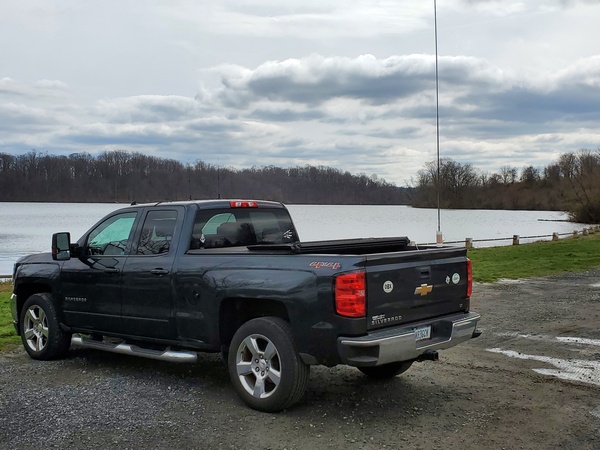
My truck all alone in the parking lot.
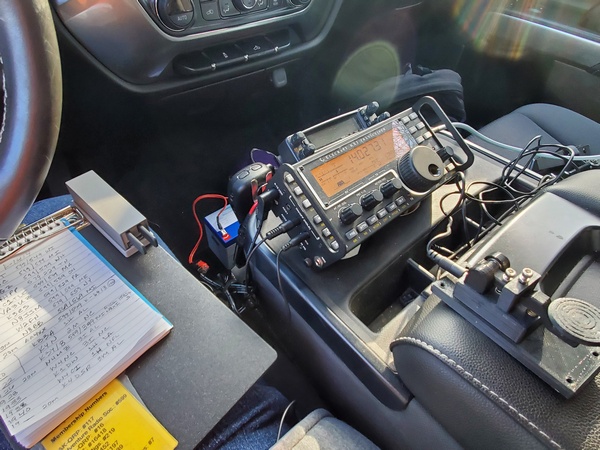
I operated from my truck using my trusty TR-35 (5 watts) and my 12-foot loaded whip. Starting out on 40M, it took all of 10 minutes to make my first 10 contacts. I made about half of my total contacts today on 40M. I spent some time on 30M, before finishing up on 17M.
Towards the end of my outing, some strong winds had kicked up, and my antenna was whipping around in the breeze. I figured it was a good time to pack up.
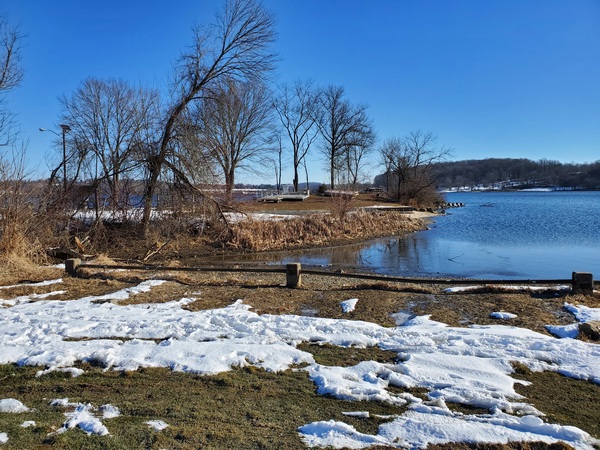
The lake in Marsh Creek State Park (K-1380, KFF-1380) with the remnants of the snow we received earlier in the week.
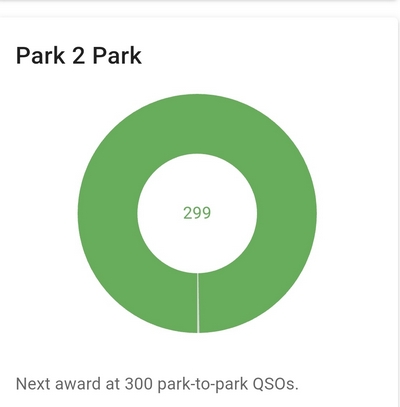
I ended up with 41 contacts in just under an hour. I didn’t have any park-to-park contacts (that I know of), but I worked nine European stations:
Slovak Republic (3)
France
Germany
Lithuania
Ukraine
Sweden
Denmark
I also worked a station in Washington State. It always amazes me when my little five-watt CW signal makes it out to the West Coast and into eastern Europe in the same session.
Hopefully, I’ll be able to get out more often in the coming months.
I mentioned in an earlier post that I bought my Elecraft AX1 antenna not long after they came out. Although I carried in my pack as a backup antenna for a few years, I never used it much. That changed last year, when I started giving it some serious use. It’s now one of my go-to options for casual, impromptu portable operation.
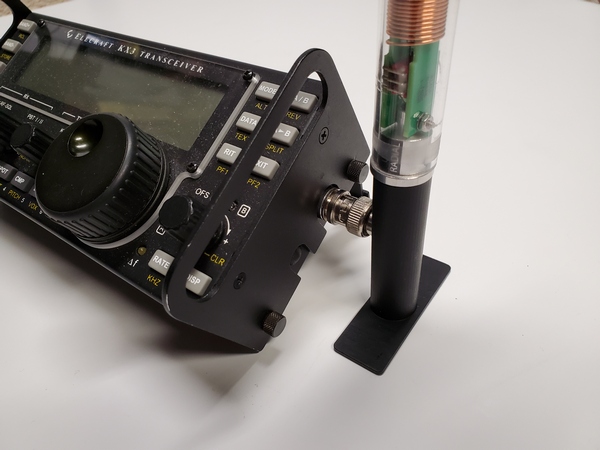
Of course I bought a few accessories for the AX1. I typically use the AXB1 Bipod with the AX1 attached directly to my KX3. While that works fine, I saw mention of an interesting alternative to the bipod, the Byonics KX3 AX1 Stand. My curiosity got the better of me, so I ordered one.
It’s a clever little 3D printed stand that weighs next to nothing. To use it, attach the BNC elbow adapter to the AX1 and set it in the stand. Scoot the stand up to the radio and connect the AX1 to the radio. That’s it!
The Byonics KX3 AX1 Stand
I set it up at home, and it seems pretty stable. The thing I like about it is that there are no adjustments. Since Byonics makes these stands for specific radios, the KX3 version won’t fit a KX2 and vice versa. That’s not a problem for me, since I don’t currently own a KX2. The Elecraft bi-pod, of course, can be adjusted to fit either radio.
I’m looking forward to trying it out in the field sometime soon.
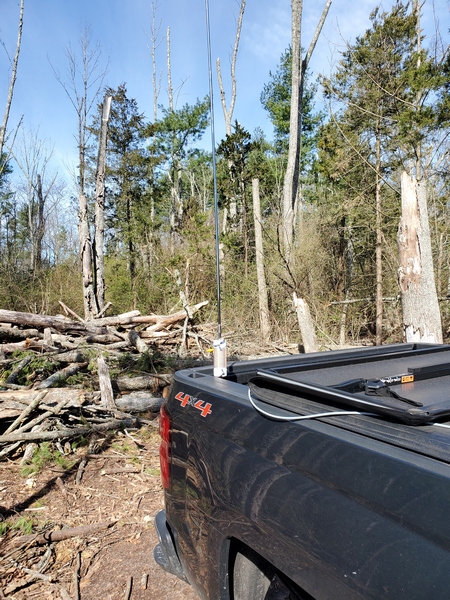
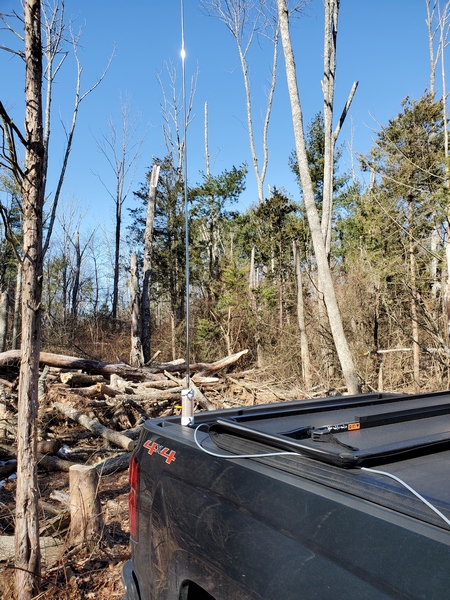
Heading out for some portable operations yesterday, I had a few objectives in mind. First, I needed to take some pictures of an antenna mount for an article I’m working on. I also wanted to do a POTA activation, while also making some Winter Field Day (WFD) contacts. Lastly, I wanted to try out an inexpensive LiFePO4 battery I recently purchased.
I planned to do all this stuff while at Ridley Creek State Park (K-1414, KFF-1414). I started off by setting up to take the pictures for the article. After getting the shots I needed, I set up to get on the air. Today, I was using my KX3 (5 watts CW) and 12-foot loaded whip. I also had a 29-foot vertical wire fed through a 9:1 unun.
My POTA/Winter Field Day setup. The straight key was pressed into service for a Straight Key Century Club contact.
I finished setting up about 10 minutes before WFD kicked off, so I started calling “CQ POTA” on 30M. By the time WFD started, I had the required 10 POTA contacts in the log. After marking myself as “QRT” on the POTA spotting page, I started “searching and pouncing” on the bands. I was hunting for WFD, POTA, or anything else that seemed interesting.
After a little under two hours, I wrapped up with 25 contacts in my log. Thirteen of them were WFD contacts. I also had a park-to-park QSO with AA4XX down in North Carolina. It’s always a pleasure to work Paul. A Straight Key Century Club contact with K3Y/8 rounded out my log.
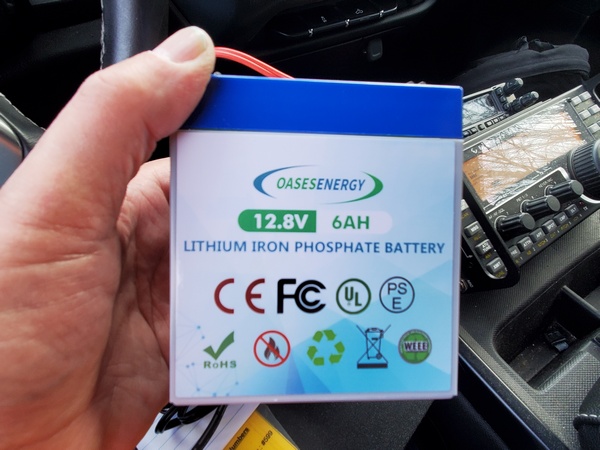
The battery I was using today was a 6 Ah LiFePO4 battery I found on Amazon for about $20 (US). My trusty Bioenno batteries are still hanging tough after more than six years of use, but I was curious to see how this cheap battery would work. It did just fine, but we’ll see how it holds up over time.
The $20 6Ah LiFePO4 battery I used for the first time today. It got the job done.
With some welcomed mild weather yesterday, this wasn’t the most wintry of Winter Field Days here in Pennsylvania. I wish I had more time for it this weekend, but life had other plans for me. Best of luck to everyone taking part in WFD.
The Boschveldt QRP Club got together for our annual Winter outing, from January 11-14, 2024. Our little group of QRPers has been getting together each January for many years. This year, we were in a cabin in French Creek State Park (POTA K-1355)
Some members stayed for four nights, while others stayed over for various portions of the weekend or just stopped in to visit. This year, the following folks attended: Ed K3YTR, Ed K3BVQ, Glen NK1N, Ed WA3WSJ, John NU3E, Walt KB3SBC, Rob KE3TI, Ron WA8YIH, W3CJW, and me WB3GCK.
Some of the group arrived on Thursday and, after settling in, got some radios and antennas set up. They followed that up by dinner at a local restaurant and a movie back at the cabin.
NU3E (left) and NK1N outside the cabin during a snow squall
John NU3E operating FT8 as W3BQC from the cabin
Glen NK1N operating CW as W3BQC from the cabin
WB3GCK at Hopewell Furnace National Historical Site (K-0834, KFF-0834)
(l-r) NK1N (on the radio), K3BVQ, and K3YTR in the cabin
Sunday’s breakfast featured NU3E’s famous waffles
By the time I arrived on Friday afternoon, NU3E and NK1N were busy activating the park using the Boschveldt Club’s callsign, W3BQC. After a lot of socializing and reminiscing, we made dinner in the cabin and ended the evening with another movie.
After breakfast on Saturday morning, I headed over to Hopewell Furnace National Historic Site (K-0834, KFF-0834) for the Parks on the Air activation. Using my TR-35 and 12-foot loaded whip, I logged 41 contacts in just under an hour. Among those, I had two park-to-park contacts with W3BQC back at the cabin.
Later that day, KB3SBC and WA3WSJ did a three-park rove, operating FT8 and FT4 using the club callsign. They activated French Creek State Park (K-1355), Hopewell Furnace NHS (K-0834), and William Penn State Forest (K-5481), which are all within minutes of each other.
On Saturday night, our group descended on a local Italian restaurant for a fantastic meal and some adult beverages. Once again we watched a movie back at the cabin before turning in for the night.
Breakfast on Sunday featured waffles and all the fixings courtesy of John NU3E. John’s waffles have been a Sunday morning tradition for us for many years. Not long after breakfast, we started receiving cell phone alerts for an impending snow squall. Sure enough, the snow came down heavily, greatly reducing visibility. Fortunately, it didn’t last too long.
After lunch, several members—me included—started packing up and heading home. A few members were staying over for one more night before vacating the cabin.
At the end of our winter gathering, W3BQC had 346 contacts in the log. Most of the contacts were from K-1355 (319) with the rest from K-0834 and K-5481. Hopefully, some of you managed to work W3BQC over the weekend.
After spending the last two winter gatherings in a freezing lodge at the Daniel Boone Homestead, the comfortable—and well-heated—cabin in French Creek was a definite step up. We unanimously decided to hold next year’s outing at French Creek.
It’s always great to spend some time catching up with my old QRP buddies. The weekend went by far too quickly, though.
According to the weatherman, we have a nor’easter heading our way. We’re supposed to get some snow, which will quickly give way to heavy rain. Not wanting to drive around in a sloppy mess, I did an early morning activation in Valley Forge National Historical Park (K-0761, KFF-0761).
I chose Valley Forge, since it’s one of the closest parks to my home. I figured if the snow got going earlier than predicted, I didn’t have too far to go to bail out.
Obligatory picture of the back of my truck. This time it’s at a trailhead in Valley Forge National Historical Park (K-0761, KFF-0761).
I rolled into a trailhead parking lot at 9am (local time) and grabbed one of the last few parking spaces available. I suppose folks wanted to get their hiking and dog walking in before the snow started.
With my current go to set up (TR-35 and 12-foot loaded whip), I was on the air in less than five minutes. I operated on 40M, 30M, and 17M today, and there was no shortage of hunters on any of those bands.
I called it quits after an hour and twenty minutes. It wasn’t because of the snow and rain; my fingers were getting cold and my sending was getting sloppy. Even in the confines of the truck, the temperature was about 45 F (7 C). I ended with 51 QSOs in the log. I had one park-to-park and seven DX contacts:
France (2)
Italy (2)
Hungary
Belgium
Ukraine
It’s snowing now as I write this. Luckily, the winter weather held off until after I got home and unloaded the truck. So far, the snow in this area isn’t amounting to much. Stay safe, if you’re in an area getting the heavier snow from this storm.
My (far) better half and I spent New Year’s Eve and New Year’s Day at home this time around. That gave me the opportunity to close out the old year and welcome the new year with a couple of POTA activations.
New Year’s Eve
For my last activation of the year. I headed up to Evansburg State Park (K-1351, KFF-1351). I normally like to start fairly early, since I rarely run into other activators at 9:30AM. Today was different.
On arrival, I pulled into one of my usual parking spots. As I started setting up, I noticed an antenna off in the distance. I walked over and found RC KC3HRV getting ready to start his activation. After chatting for a bit, I drove to another spot a little further down the road to avoid interfering with him. Hopefully, my 5-watt CW signal didn’t cause problems for his SSB operation.
KC3HRV getting ready to activate Evansburg State Park (K-1351)
I used my usual setup: Penntek TR-35 (5 watts, CW) and my 12-ft whip and homebrew loading coil combination. Starting off on 40M, I logged my first 10 contacts in 15 minutes. Among those contacts was my ARES-RACES colleague, Frank N3FLL. I had given Frank a heads-up via the local repeater during my drive to the park.
After 30 minutes, I switched to 17M, a band I haven’t used much lately. That turned out to be a good choice. I had 10 European contacts today: Germany (3), Italy (3), France (2), England, and Slovak Republic.
I stopped after an hour with 41 contacts in my log. There were no park-to-park contacts I know of. It looks like WM4P in Florida was my last QSO for 2023.
New Year’s Day
I kicked off 2024 with a return visit to Ridley Creek State Park (K-1414, KFF-1414). My strategy was to start off as POTA activation, marking myself as “QRT” on the spotting page after making 10 contacts. Then, I planned to switch to my straight key to make some Straight Key Night (SKN) contacts. (Spoiler Alert: That didn’t happen.)
Ridley Creek State Park (K-1414, KFF-1414) on New Year’s Day
Using the same equipment set up as the day before, I started off on 40M. My first QSO of 2024 was with W8CAR in Ohio. The hunters were out in full force; it only took me nine minutes to log my first ten. My friend, Frank N3FLL, was one of them once again. There was so much POTA activity, I forgot all about my SKN plans. After the activity on 40M slowed down, I bounced back and forth between 30M and 17M.
After an hour and a half, I had 65 QSOs in my log, including five park-to-park contacts. The 17M band didn’t seem as strong as the day before, but I still worked six European stations: France (2), Italy (2), Germany, and Slovak Republic.
Radio-wise, 2024 is off to a pretty good start for me. I hope you all have an great year as well.
With my Christmas shopping done, I had some free time yesterday. So, I got in a quick POTA activation before the Christmas holiday festivities kicked in. I drove over to Marsh Creek State Park (K-1380, KFF-1380) and operated from my usual spot near the West Boat Launch area.
WB3GCK at Marsh Creek State Park (K-1380, KFF-1380)
I used my usual Penntek TR-35 (5 watts CW) and 12-foot whip, and got on the air within minutes of my arrival. Things got off to a fast start on 40M. I made my first 10 contacts in about 9 minutes. The 30M band was also going strong.
When I switched to 20M, I encountered some intense pile-ups. I was beginning to think someone spotted my callsign incorrectly and people thought I was a rare DX station or something. Although it was tough trying to pull callsigns out of the din, I appreciate all the hunters who were out there yesterday.
After an hour and 10 minutes, I shut down and packed up. I ended up with 55 contacts, including two park-to-park contacts. I also worked 10 European stations: Finland, Sweden (2), Italy (2), France (3), and Germany (2).
So now, I’m looking forward to getting together with my family on Christmas day. I want to wish you and yours the very happiest of holidays.
Back in 2020, I started fooling around with digital voice modes. I don’t really use them a lot, but there are a couple of DMR nets I like to check into each week. I recently started using the WPSD software instead of the Pi-Star software I had been using on my two hotspots. Just for the heck of it, I wanted to try upgrading the old Raspberry Pi Zero board on one of them to something more capable.
According to the documentation, WPSD was never written for single core processors, like the old Pi Zero W board in my hotspot. The developer recommends a Pi Zero 2 W or better. While it will work on a single core Pi, it runs slower—I can attest to that. I also noticed that CPU utilization was well over 100% at times. With its quad core processor, the Raspberry Pi Zero 2 W is supposed to be five times faster than its single core predecessor. So, I was hoping to see some general performance improvements and faster boot-ups after this upgrade.
In the interest of full disclosure, I’m no Raspberry Pi expert—far from it. I had to do some online research before launching into this. It looked simple enough; the Pi Zero 2 W board is a drop-in replacement for the original Pi Zero board, so it seemed simple enough.
I bought a Pi Zero 2 W board on Amazon for about $28 (US). The board didn’t have the header pins installed, so I bought some. I bought a box of 40-pin headers for less than $10 (US). I now have more of them than I’ll use in my lifetime.
I took advantage of a rainy Sunday to do the upgrade. First, I needed to install headers on each end of the Raspberry Pi’s GPIO area. The two headers had two rows of five pins each. With the help of an Xacto knife, I snapped the pieces I needed from one of the (many) 40-pin headers I now own. With my aging eyes, I needed to use a lighted magnifying glass to do the soldering. To avoid melting the plastic, I allowed some cooling time after I soldered each pin.
The new Pi Zero 2 W board installed in the hotspot case. The two headers I soldered in are towards the front.
The MMDVM board installed on top of the Raspberry Pi board.
The is the fully-assembled hotspot. This pink section to the right is a piece of paper I used to cover some overly-bright LEDs.
From there, it was a simple task to disassemble the hotspot, swap boards, and put it back together. I estimate that the hardware part of the upgrade took all of about 20 minutes.
I had previously burned the WPSD image on a new Micro SD card, so it was ready to go. When I inserted the card and powered up, the hotspot booted up in a minute or two. After importing a backup WPSD configuration file and doing a couple of tweaks, the hotspot came to life. Success!
The performance improvements were immediately obvious. The dashboard and configuration web pages were much more responsive, and the CPU load typically stays under 20%. It’s been running for a week now, and it’s been rock-solid. Since this upgrade went so smoothly, I went ahead and upgraded my other hotspot. That one was just as easy and is also working great.
For you Raspberry Pi power users out there, this is pretty trivial stuff. Yeah, I guess it is. But it was an easy and fun little project, and I learned a bit about Raspberry Pi boards in the process.
I’ve been a little under the weather this week, but I squeezed in a long overdue POTA activation this morning. Although I had a successful activation, I had to contend with some annoying QRM.
I took a ride down to Ridley Creek State Park (K-1414, KFF-1414), one of my favorite nearby parks. I went with my usual setup: TR-35 (5 watts CW) and 12-foot whip with my homebrew loading coil.
WB3GCK at Ridley Creek State Park (K-1414, KFF-1414)
I had a great start on 40M, logging my first 10 contacts in 12 minutes. Four contacts later, a loud digital signal popped up on my frequency wiping me out. I moved up to 20M and had to tune around for a while until I found an empty spot. Although the band was producing contacts for me, it seemed like I was operating on the “international tune-up frequency” or something. At one point I had to stop for an extended “tuner-upper.” After what seemed like an eternity, he finally unkeyed. After that, I heard someone call him a “lid” (in CW, of course). Fortunately, things were more civilized on the 17M and 30M bands.
When I wrapped up, I had 43 contacts in my log, including Finland, Italy, and two stations in France.
Despite the occasional QRM, it wasn’t a bad morning.