Today I did something I don’t think I have done before: a single-band activation. Normally, I spend time on several bands. Today, however, I wanted to see how my 17-ft whip would perform mounted directly to the antenna mount on my truck (sans loading coil).
I drove down to Ridley Creek State Park (US-1414, KFF-1414) this morning and set up in one of the picnic areas. After mounting the antenna, I broke out my antenna analyzer. Since the fully extended whip is approximately a quarter-wave on 20M, I wasn’t surprised by the SWR readings. With 15 feet of RG-8X coax attached, the SWR was a flat 1.45 across the band. So I fired up my Penntek TR-35 (5 watts, CW) and hung out on 20M for the next hour.
My 17-foot whip mounted on my truck at Ridley Creek State Park (US-1414, KFF-1414)
When I checked the band conditions, I saw the geomagnetic field was “unsettled.” Solar wackiness notwithstanding, I logged my first 10 contacts in about 12 minutes. European signals weren’t very strong this morning, but I still managed three DX contacts: two from Italy and one from France. An hour’s effort produced 26 contacts, including four park-to-park contacts.
I’m planning to dust off a 25 year old 20M QRP rig and use it for a future activation. This antenna configuration might come into play for that. Stay tuned…
This is a large event, with distance options ranging from 11 to 100 miles. Because the event covers such a wide area, CCAR needed to provide radio operators at five rest stops and aboard eight support vehicles. The support vehicles are equipped with APRS trackers, allowing the net control operators to track their locations around the course.
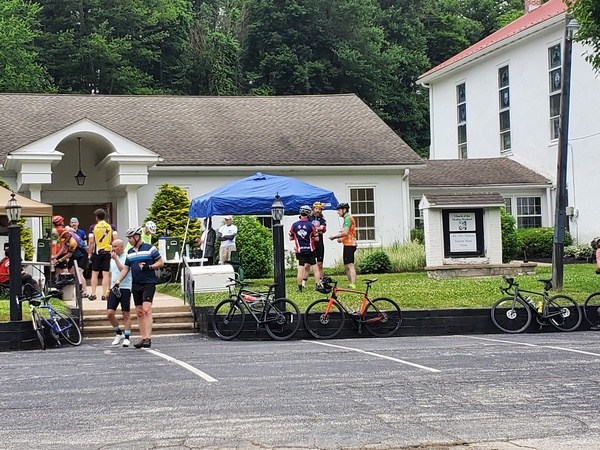
French Creek Iron Tour participants taking a break at the Yellow Springs rest stop
My part in the event was pretty straight-forward. I was once again stationed at a rest stop in historic Yellow Springs, Pennsylvania. Because CCAR has an extensive linked repeater infrastructure, an HT was all I needed for communications.
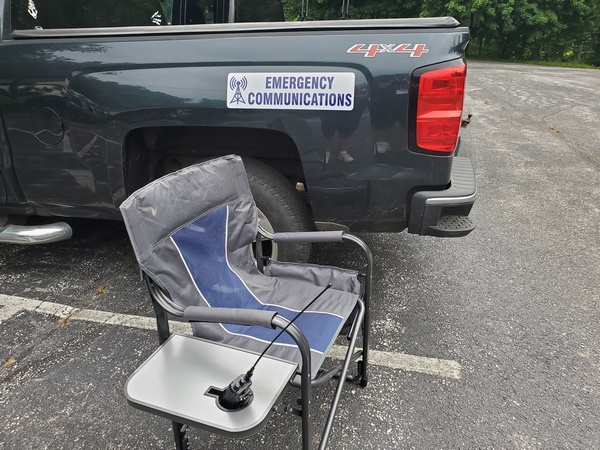
My minimalist setup for the French Creek Iron Tour cycling event
Fortunately, there were no serious issues to handle. A few riders rolled into the rest stop needing bicycle repairs, and some riders required transportation back to the start/finish line at the Kimberton Fairgrounds.
This is always a fun event, and the folks from the sponsoring organization are always a pleasure to work with.
I went back to Marsh Creek State Park (US-1380, KFF-1380) for a quick activation this morning, and things got off to an interesting start. After setting up my trusty Penntek TR-35 (5 watts, CW) and 12-foot loaded whip, things just didn’t seem right. My SWR on 40M was high, and even my Elecraft T1 antenna tuner couldn’t get it lower than 3:1.
I started checking cables and connections, but everything looked OK. Heck, it’s not a very complicated antenna, so there isn’t much that can go wrong. When I got out of the truck to change to another antenna, I noticed my 12-foot whip looked a little shorter than usual. I took the whip off and immediately found the problem. In my haste to get set up this morning, I neglected to extend the top section of the telescoping whip. Doh! Once I pulled the top section out and re-installed the whip, all was right with the world again.
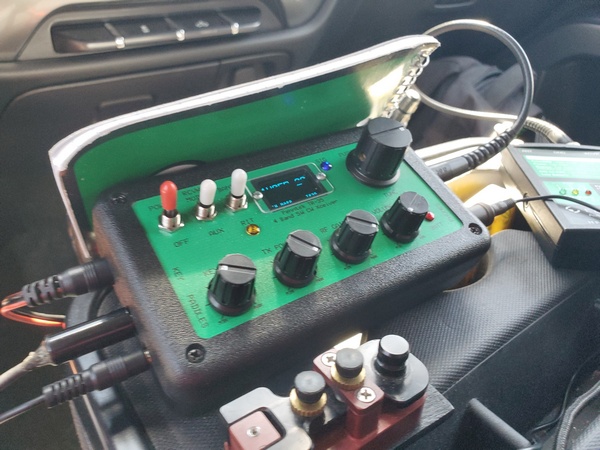
Using a notepad as an impromptu sun shield for my Penntek TR-35
Despite getting off to a slow start, my results weren’t too bad (by my standards). I finished with 36 contacts, including one known park-to-park contact. I had one DX contact with IW2NXI.
I finished my activation just in the nick of time. An hour after I got home, there was a major geomagnetic storm in progress. Timing is everything.
I almost talked myself out of this activation today. We had a long day yesterday at a family function with about four hours of driving, so my initial inclination was to take it easy today. In the end, the POTA urge was too great to deny, and I’m glad I went.
I drove over to Valley Forge National Historical Park (US-0761, KFF-0761), which is just a couple of miles down the road. It had been about five months since my last visit, so I was overdue for an activation here.
Using my Penntek TR-35 (5 watts, CW) and 12-foot loaded whip, I started out on 40M. The signals were surprisingly strong this morning. My activation kicked off with a park-to-park contact with N1BS up in Rhode Island.
My location in Valley Forge NHP (US-0761, KFF-0761)
Forty and 20M produced most of my contacts this morning. I ended up with 39 contacts with 6 park-to-park QSOs. I had four DX QSOs: two with Italian stations, and two with SM4BNZ in Sweden on 20M and 17M.
I also had a nice park-to-park contact with fellow QRPer, AA4XX. It had been a while since our last QSO, so it was good to hear Paul on the air this morning.
After about 90 minutes of operating, the bands seemed to dry up, so I packed up and made the short drive back home.
In the end, it was a fun morning, so I’m glad I went.
Since I’m slowly sneaking up on POTA “Repeater Offender” status (20 activations) at Marsh Creek State Park (US-1380, KFF-1380), I made a quick trip back there this morning. Unlike the rainy weather I encountered last time, it was a beautiful, clear morning.
Since it was a weekday, the parking lot at the Western Launch area was pretty empty. When I got out of the truck to set up my antenna, I noticed a large heron. Last time, he was patrolling the shallow, marshy area near my parking spot. Today, he was proudly standing on the dock, surveying his domain. I snapped a couple of pictures of him and continued setting up.
The resident heron surveying his domain at Marsh Creek State Park (US-1380, KFF-1380)
I went with my usual setup: my Penntek TR-35 (5 watts, CW) and my 12-foot loaded whip. Starting on 40M, it took all of 12 minutes to make my first 10 contacts.
I had some errands to run, so I kept it short. In a little more than an hour, I logged 22 contacts. There weren’t any park-to-park contacts, but I did log four European stations (Italy, Sweden, Czech Republic, and Slovak Republic) on 17M.
The heron eventually flew off. Like the heron, I took off, too—for home, that is.
Over the course of the long Memorial Day weekend, I got in two short activations. As expected, there was a lot of activity going on at the parks. Parks in this area get a little busy on holiday weekends.
Ridley Creek State Park (US-1414, KFF-1414)
I rolled into Ridley Creek State Park early on Saturday morning. Even at 0900 local time, the park was fairly crowded. I was going to operate from a picnic table, but given the number of people there, I decided against that. Between the hikers, dog walkers, mountain bikers, and folks setting up for picnics, it was a busy place.
Using my Penntek TR-35 (5 watts, CW) and 12-foot base-loaded whip, I logged 27 contacts. Most of the contacts were on 40M and 30M, with just one on 17M. No DX today, but I had three park-to-park contacts. After about 90 minutes, I packed up and headed home.
Norristown Farm State Park (US-4363, KFF-4363)
On Monday, I had another early activation, this time at Norristown Farm State Park. As I expected, there were quite a few people at this park taking advantage of the holiday.
This activation was almost a carbon copy of Saturday’s. I used my TR-35 and 12-foot loaded whip, and once again, I made 27 contacts with three park-to-park QSOs. Like the last activation, 40M and 30M were the most productive bands for me.
This time, though, I worked two European stations (Italy and Sweden) on 17M. These were my first DX contacts in more than a month, so I was glad to be out of my slump.
I hope everyone had a happy and safe holiday weekend. Be sure to take time to honor those who paid the ultimate price for the freedoms we enjoy.
I was first bitten by the parks bug, taking part in ARRL’s National Parks on the Air (NPOTA) program in 2016. When NPOTA ended, I started activating parks under the World Wide Flora & Fauna (WWFF) program. When Parks on the Air (POTA) came along, I started submitting my logs to both programs—and still do.
Since POTA and WWFF are separately administered, there are some significant differences between the two programs. One notable difference involves the park designators. In some cases the park numbers are the same, but often they’re different. For example, the designator for PA 246 State Game Land is KFF-5862 in WWFF and US-8941 in POTA. Sometimes a park will be in one program but not the other.
Fortunately, Al Zelna N3KAE has provided an online tool that makes it easy for “dual activators” to cross-reference the WWFF and POTA park designators in the U.S. and Canada. Visit the CQ Parks.net website to check it out.
If you aren’t familiar with WWFF, it’s the original Amateur Radio parks program. In its current form, WWFF dates back to 2012, but it has roots going back to about 2008. While POTA has seen tremendous growth since its inception, WWFF is still very popular in Europe and other parts of the world. When band conditions are good, a spot on the WWFF site or a DX cluster will often generate a European pile-up. It sure is fun having a bunch of DX stations chasing my little QRP station.
Lately, most weekends have been rainy around here. The forecast for tomorrow is much better than the rain today. Unfortunately, family obligations gave me no choice than to activate today.
I headed over to Marsh Creek State Park (US-1380, KFF-1380) early this morning, to avoid heavier rain later in the day. Despite the lousy weather, there were a lot of cars in the parking lot.
A rainy morning on Marsh Creek Reservoir
The rig today was my usual Penntek TR-35 (5 watts, CW) and my 12-foot loaded whip. As is my usual practice, I started on 40M. The band predictions forecasted poor daytime conditions on 40M, but that wasn’t my experience. Although some of the signal reports I received were lower than usual, I logged my first 10 contacts in about 13 minutes. My first contact was in Georgia, so that’s not too bad for 40M. The 30M band also seemed to be in decent shape.
When I moved up to 20M, I found some annoying broadband noise across the band. I’ve never encountered that here before, so I was wondering if there was a hybrid vehicle or something in the parking lot. I skipped 20M and moved up to 17M. The band was nearly devoid of activity, and 15 minutes of CQing failed to produce a single contact. While I was CQing, though, I passed the time by watching a large heron wading by. I went back to 40M to finish up.
This Heron was walking through the shallows looking for breakfast
My final tally was 32 contacts, three of which were park-to-park. I didn’t have any DX contacts this morning, but there were some highlights:
I had park-to-park contacts with KD8IE on two bands.
I worked my friend Frank N3FLL. I talked to Frank on a local repeater on my way to the park and gave him a heads-up. He found me on 40M.
I worked Al N3KAE on 40M. Al is the Regional Coordinator who uploads my WWFF logs for me. It was great to add him to the log.
Ready for the rain, with my patented coil protector (aka grocery store plastic bag) and some pipe insulation to seal the window opening
My setup withstood the rain pretty well this morning. I used a piece of pipe insulation on the passenger side window, where I fed the coax through. The fit could have been better, but it kept the rain out. Once again, I used a plastic bag to protect my homebrew coil. When I took the antenna down, I used a chamois cloth to dry the whip as I collapsed it. That worked pretty well.
Pipe insulation sealing the window where the coax enters. The fit wasn’t great, but it was good enough.
Hopefully, we’ll have a rain-free weekend one of these days.
I had another rare opportunity to activate a park on a weekday. After all the solar wackiness over the weekend, I checked the band conditions before I got started. The numbers looked better, but I still expected to encounter some flakey band conditions.
Band conditions this morning
I rolled into Ridley Creek State Park (US-1414, KFF-1414) and started setting up. Once again, I used my 17-foot MFJ-1979 whip and homebrew loading coil. Thinking I would need all the help I could get, I went with the longer whip. The rig was my Penntek TR-35 (5 watts, CW).
Using the MFJ-1979 17-ft whip with my homebrew loading coil
About a minute after spotting myself, I received a call on 40M from another activator. Another hunter called about a minute later. I was off to a good start, right? Not so fast! After those two calls, things really slowed down.
I split my time between 40M, 30M, and 20M, and it took me about 45 minutes to make my first 10 contacts. In fact, I thought number 10 would never happen.
An hour’s effort produced 15 contacts with 3 park-to-park contacts. Sadly, there were no DX contacts to be had. Happy to have salvaged the activation, I packed up and headed home.
Back in December, Becky Schoenfeld W1BXY, Editorial Director for ARRL’s On the Air magazine, asked me if I would be interested in writing a detailed set of step-by-step instructions for my Drive-on Portable Antenna Support. Naturally, I said I would.
I submitted my manuscript, along with an all-new set of pictures. The article was published in the current issue (May/June 2024) of On the Air (pages 20-22).
If you’re interested, have a look. ARRL members have access On the Air as part of their membership.