I wasn’t planning to activate a park today, but my (far) better half suggested I might want to. I have some medical procedures coming up and a bunch of other obligations, so I probably won’t have many opportunities in April. It had been a while since I last activated Marsh Creek State Park (US-1380, KFF-1380), so I tossed my radio gear in the truck and headed out.
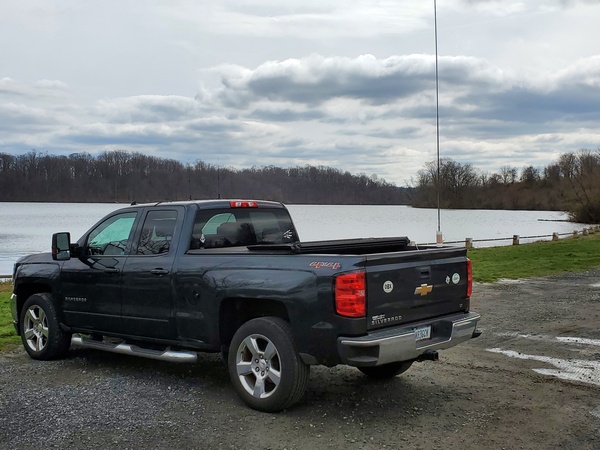
For a holiday, there was a fair number of people in the park. I pulled into a spot overlooking the lake and started setting up. Once again, I used my Penntek TR-35 (5 watts CW) and my 12-foot loaded whip.
One of my favorite spots in Marsh Creek State Park (US-1380, KFF-1380)
I spent an hour operating on 40M and 20M, and the hunters were out in full force. Although band conditions have been better, Craig sure was a busy boy. I ended up with 52 contacts. With the QRN, it was tough copying some of the DX stations. Despite that, I still logged nine of them:
St. Maarten
France (2)
Slovak Republic
Italy
Sweden (2)
Finland (2)
Hopefully, I’ll be able to get back out there in a few weeks.
We have some family coming in, and I had some errands to run to get ready for them. Before I got started with all that, I drove to Evansburg State Park (US-1351, KFF-1351) to squeeze in a short activation.
I went with a usual setup: my TR-35 (5 watts, CW) and 12-foot loaded whip. Although I was off to an early start, it didn’t take long to make my first 10 contacts on the 40M band. The 30M band was less productive, but it produced a handful of contacts.
WB3GCK at Evansburg State Park (US-1351, KFF-1351)
I spent the rest of my time up on 17M. I spotted myself on the WWFF spotting page, and the European WWFF hunters did not disappoint. They contributed seven DX QSOs to my log:
Poland
Belgium (2)
Finland (2)
Germany
Italy
There were a few other notable highlights. I worked NL7V in Alaska (17M), and I also received a call from Thomas K4SWL from QRPer.com (30M). Right before I pulled the plug, I saw on the POTA spotting page that fellow Polar Bear QRPer, Michael VE3WMB was on 40M. I ended my activation with a Polar Bear park-to-park QSO with Michael. My activation wrapped up with 37 contacts, including six park-to-park QSOs.
And now it’s back to the holiday preparations, I’d like to wish all those who celebrate a very happy Easter.
My (far) better half and I spent the weekend puppy sitting at my daughter’s house in central Pennsylvania. There are some POTA entities in the area, so I planned to get in an activation while we were there. We drove out in my (far) better half’s car, so I couldn’t use my usual setup.
Thanks to the work I did before I retired, I have a tendency to plan for every contingency. I started thinking about antennas for every scenario I might encounter. Since I have a lot of antenna options, my packing list quickly grew to ridiculous proportions. In the end, I resisted the urge to over-plan and kept things simple.
For this trip, I took my Elecraft AX1 antenna. With this antenna, I could go “picnic table portable” or use a window mount on the (far) better half’s car. For the rig, I went with my KX3, so I could use 20M, 17M, and 15M.
Early Saturday morning, I threw my backpack into my (far) better half’s car and drove up to Boyd Big Tree State Preserve (K-4356, KFF-4356). My last activation at this park was back in 2022. Coincidently, I was puppy sitting on that trip, too.
The parking lot was pretty crowded when I rolled in, but I found a spot with a little room around it. It only took a minute or two to set up the AX1 on the window mount. The car is pretty small, so I had to experiment a little to find a spot on the center console to accommodate the KX3.
It was a little cramped inside my (far) better half’s car, but certainly workable.
My goal for the day was to make at least 14 contacts to reach the required 44 contacts at this park for World Wide Flora and Fauna (WWFF). (I had 30 contacts on my previous activation.) Of course, I would have been happy just to make the 10 contacts required for POTA. But, once again, I underestimated the effectiveness of the AX1.
My AX1 and window mount on my (far) better half’s car
Running five watts of CW on 20M and 17M, a steady stream of hunters kept me busy. It only took about 20 minutes to make the 14 contacts I was looking for. The last time someone activated this park was back in November, and there have been very few CW activations. So, this was probably a new one for a lot of hunters.
DX-wise, I had one of my better outings. I had 14 DX contacts with the following countries:
Sweden (2)
Finland (4)
Italy (3)
France
Poland
Germany
Slovak Republic (2)
I worked OH2LIO on both 20M and 17M. Although not DX, I was pleased to log a contact with a California hunter. My little QRP signal really seemed to be getting around.
After slightly over an hour, I had 37 contacts, including four park-to-park contacts. Not too bad for five watts and a 45-inch whip.
I’m glad I went with this simple setup. That little AX1 never ceases to amaze me.
The weather prognosticators said we’re under a Wind Advisory from midday today through tomorrow. In the best interest of my antenna, I got an early start this morning to avoid confronting the forecasted 45 MPH wind gusts.
Instead of doing a normal POTA or WWFF activation, I headed down to Ridley Creek State Park (K-1414, KFF-1414) to take part in the Straight Key Century Club (SKCC) Weekend Sprintathon (WES) contest. I haven’t been very active in the WES contests of late, so I focused my attention on that.
I used my usual Penntek TR-35 transceiver (5 watts CW) and my 12-foot loaded whip antenna. I also used my little American Morse MS2 straight key. The MS2 is an unusual-looking key, but I’ve really grown to love it over the years. I did some earlier posts on the MS2 and the magnetic base I built for it.
My little MS2 straight key attached to my clipboard with a homebrew magnetic base I made for it
Most of my operation today was on 40M. I split my time between calling CQ and search-and-pounce. The WES contests are rather laid back, compared to a typical POTA activation. The WES QSOs come at a much slower pace. I didn’t log my 10th contact until about 45 minutes in.
As I was making my tenth contact, it started raining. So, I grabbed a plastic bag and went back to wrap up my loading coil. It was only a passing shower, so I removed the antenna’s “raincoat” a short while later.
The “raincoat” I fashioned to protect my loading coil from the rain
I ended up this morning with 15 contacts in my log. Thirteen were with SKCC stations, and two were POTA park-to-park contacts. I also worked KS1KCC, the SKCC club station in Michigan, on both 40M and 20M.
This was a fun change of pace today, and I added a few new SKCC numbers to my log.
Today was a day of sunny weather sandwiched between a rainy day yesterday and a week of mostly rainy days coming up. So, I took advantage of it and headed over the Norristown Farm State Park (K-4363, KFF-4363) for an early morning activation.
I operated today from a parking lot near the picnic pavilions. This area is a little lower in elevation than some other parts of the park, but I always seem to do well there. This spot also has the advantages of being less crowded and having nearby “facilities.”
WB3GCK at Norristown Farm State Park (K-4363, KFF-4363)
I used my usual “stationary-mobile” setup, with my Penntek TR-35 (5W CW) and 12-foot loaded whip. Although the bands seemed a little weak, the hunters were out in full force. Starting out of 40M, I had 10 contacts in the first eight minutes. After an hour and ten minutes, I had 48 QSOs in my log with two park-to-park contacts.
Among my contacts today was one with fellow QRPer, W2LJ. It’s always nice to hear Larry. I also had a DX contact with SM4BNZ. Initially, I copied his callsign incorrectly (placing him in Italy). Fortunately, he called back, and I got my log squared away.
I had some other things I needed to do today, so I was glad I could sneak in a quick activation this morning.


 WB3GCK QRP Amateur Radio