Of Blind Squirrels and QRP Contests

There’s an old saying that goes: “Even a blind squirrel finds a nut once in a while.” I think that was the case for me 23 years ago.

As I was submitting my meager entry for last week’s QRP to the Field (QTTF) Contest, it made me think back to the very first QTTF contest in April of 1995. I’ve never considered myself a serious contester; not by a long stretch. Somehow, though, I actually placed 1st overall in the NorCal QRP Club’s inaugural QTTF.  I actually did it with a most unlikely setup, too.

My 1st place certificate from the first-ever running of the QRP to the Field Contest in 1995

A local ham, Rolf N3LA (SK), graciously allowed me to operate my modest QRP station from his rural property. I operated from my truck with my antenna supported by one of Rolf’s trees.

My antenna was simply a 40M inverted vee that I made from #22 stranded hook-up wire. I fed it with about 30-feet of RG-174 coax. The center of the antenna was only about 12 to 15 feet high. One end was tied off to a bush about 4 feet off the ground. The other end ran into a fenced-in area that was home to a ram with a bad attitude.  I had to wait until the ram was otherwise pre-occupied to tie-off that end of the antenna. That end was only a foot or two off the ground.

My rig was a Small Wonder Labs SW-40 running 950mW. This was from the first batch of kits offered by Dave Benson’s (K3SWL) former company. I was also using a keyer built from an old NorCal kit, which used the classic Curtis keyer chip. I used a set of paddles that I had cobbled together from stuff in my junk box. The whole station was powered by a 7 A-H gel cell battery that was almost as big as the rest of the equipment combined.

Some of the equipment I used for the QTTF Contest in 1995. The SW-40 and NorCal Keyer are packaged in LMB enclosures. My "Junkbox Paddles" are on the right. I made a lot of QSOs with this setup in years past.
Some of the equipment I used for the QTTF Contest in 1995. The SW-40 and NorCal Keyer are packaged in LMB enclosures. My “Junkbox Paddles” are on the right. I made a lot of QSOs with this setup in years past.

Over the course the afternoon, I worked a steady stream of QRPers. I was in QRP heaven. Even Rolf, who was monitoring from inside his house, was amazed at the number of contacts I was producing with less than a watt.

QRP to the Field 1995 - WB3GCK (950mW)
40M CW
-----
1615 K4XY VA
1641 WA9MTO MD
1646 KG8FL OH
1653 KI2L MA
1655 VE3VAW ONT
1659 W2RPH NJ 1W
1701 K2SJB NY
1706 VY2MP PEI
1710 N1OZL MA
1715 VY2MP PEI (DUPE)
1723 WQ1T NH
1728 VE3FRF ONT
1740 KC1FB CT
1743 W3TS PA 1W
1745 AC4WC VA 4W
1749 K1PUG CT 1W
1807 WK8S MI
1810 WA8IBT OH
1827 N7ANT VA
1836 W3EEK PA
1840 W2TFL NY
1841 VE3UWL ONT
1844 KB8GAE OH
1848 AA3GN PA
1851 K2MV NJ
1855 WA0JTL MI
1858 WB8EEL MA
1903 N4JEO VA
1905 NO1E NH
1913 AA2PF NY
1915 K4XY VA (DUPE)
1917 N2CX NJ
1929 AA2NL NJ
1930 AA4YZ/8 OH
2038 W2QUV NY 5W
2048 KD4PUP VA
2050 KT3A PA <1W
2054 KA4GVA VA
2056 W03B MD 250mW
2101 W8MVN OH 4W
2117 AA2WJ NY
2129 KZ4D VA 2W
2137 WA8LCZ MI
2139 AA1EX NH
2141 WQ1F VT 4W
2144 KC1FB CT (DUPE)
2146 K2JT NJ
2204 K0JPL MO
2209 KA3WTF PA 5W

I specifically remember a couple of the contacts.  I worked Joe N2CX, who was testing a new antenna over in New Jersey.  Joe later mentioned that QSO in an article about his antenna in QRP Quarterly. I also remember working Ernie W8MVN (SK) in Ohio. Back in the day, Ernie ran a pair of phased, full-wave 40M delta loops on top of a 60-foot tower. He called me with an ear-splitting QRP signal that had me scrambling for the RF gain control on my rig. I think my ears are still ringing from his incredibly loud signal.

Even though I only operated on one band with my 950mW rig, I managed to log 46 contacts (plus a few dupes) that day. With my QRPp multiplier, I ended up in first place out of a field of 50 stations.

I haven’t done that well in a QRP field contest since.  (I did, however, place 2nd in the New England QRP Club’s QRP Afield contest using the same equipment later that year.) Rather than skill or prowess as a contester, I have always attributed my win to a combination of great propagation and lots of plain old dumb luck.

If your callsign is in the log above, thank you for helping this blind squirrel find a nut!

72, Craig WB3GCK
My QTTF 2018 Tale of Woe

Boy, if I thought last year’s QRP to the Field (QTTF) contest was rough, this year was even worse. Solar wackiness and high local noise levels teamed up and made for a miserable day.

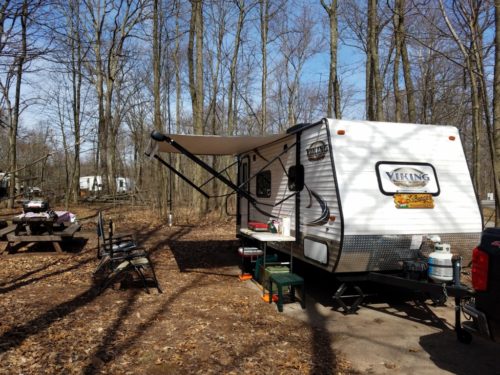
My (far) better half and I spent our first camping trip of the year at nearby French Creek State Park here in southeastern Pennsylvania. We were in a campsite that we have used many times over the years. Radio-wise, I used my 29.5-foot vertical and 9:1 unun. Since we were having an unusually chilly and windy April day, I wimped out and operated from inside our little travel trailer.

My mobile QRP shack at French Creek State Park. My antenna is in the background near the trees.

In between some beginning-of-the-season maintenance tasks on the trailer, I planned to get on the radio for some QTTF fun. Sadly, there wasn’t much fun to be had. Reportedly, there was a G2-level geomagnetic storm on Friday with effects that appeared to last through the weekend. I haven’t seen the bands that bad in a while. To make matters worse, our little trailer had some larger RVs for neighbors this weekend and all of their electrical doo-dads were causing some horrendous noise levels on the bands. The 40M band was the worst with near-constant S9 noise levels.

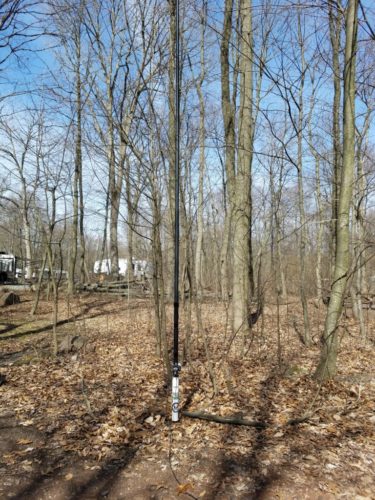
My vertical antenna out behind the trailer

My high noise levels and weak signals on the bands made for a frustrating day. My contacts were few and far between. A few times, I just had to walk away from the rig and do something else. At the end of the day, I had worked only 2 other QTTF stations and 2 International Marconi Day (IMD) special event stations.

My apologies to those who tried to work me and to those who suffered through my requests for repeats.  I hope things go better next year.

72, Craig WB3GCK

Ron Polityka WB3AAL (SK)

I heard the sad news this morning that Ron Polityka WB3AAL passed away on March 30th. Ron was an avid QRPer who was well-known throughout the QRP community. Ron was known for his portable operations, particularly from the Appalachian Trail.

Ron and I go back about 25 years or so. Back in the early 90s, I was contacted by Ron, who was starting up the Eastern Pennsylvania QRP Club. My first meeting with Ron was at a local hamfest and I became an active EPA-QRP member after that.

Ron WB3AAL operating CW at the EPA-QRP Field Day in 2006

Over the years, I participated in many EPA-QRP Field Days with Ron. I also camped out with Ron a few times for various QRP field contests. I spent an interesting weekend with Ron aboard the Lightship Chesapeake (LV-116) in Baltimore’s Inner Harbor in 2003. We activated the Chesapeake for a Lighthouse/Lightship Week event.

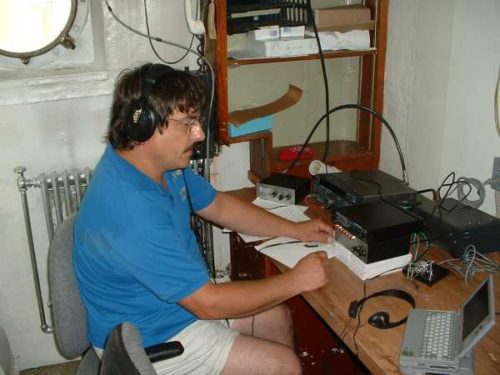
WB3AAL aboard the Lightship Chesapeake (LV-116) in 2003

Ron was one of the founding members of the Polar Bear QRP Club. I was fortunate enough to take part in one of the very early Polar Bear Moonlight Madness Events with Ron and others at Pulpit Rock on the Appalachian Trail.

In recent years, I only had occasional contact with Ron. So, I was stunned to learn of his passing at the young age of 58. Ron touched the lives of many in the QRP Community and his presence will be missed.

RIP and 72, Ron.

de WB3GCK

Falmouth Boat Launch

On the last day of a week-long trip to Central Pennsylvania to see my new granddaughter, I took a quick side trip to scout out the trailhead for the Northwest Lancaster County River Trail. This trail is on the list of trails I want to explore by bike this year. While I was out there I did a little QRP-portable operating (of course).

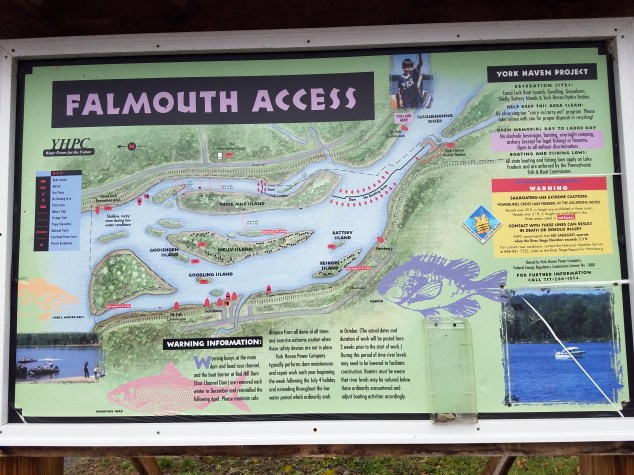
The Northwest Lancaster County River Trail is a 14-mile trail that ends at the Falmouth Boat Launch near Bainbridge, PA. From my parking spot at the boat launch, I had a wide view of the scenic Susquehanna River. This spot is just a couple miles downstream from the infamous Three Mile Island Nuclear Generating Station.

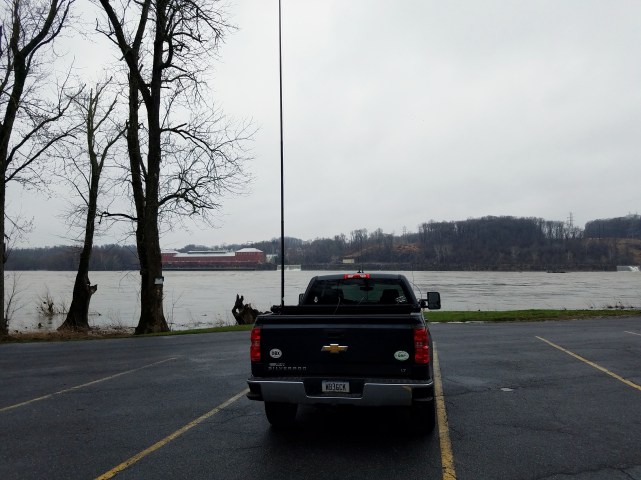
My parking spot at the Falmouth Boat Launch on the Susquehanna River.

Since it was a dreary, rainy day (but better than the snow we had yesterday), I set up my 19-ft Vertical on the back of the truck and operated my KX3 from the cab of the truck. With Three Mile Island up the river and another power plant directly across the river, I thought it would be a noisy location. As it turned out, it was surprisingly quiet. My only issue today was some heavy, weather-related QRN on 40M.

Falmouth Boat Launch information board

I’m only 1 contact away from reaching the SKCC Tribune x 5 award, so I once again focused on making SKCC contacts. Being a Tuesday afternoon, there wasn’t a whole lot of SKCC activity. I still made some interesting SKCC contacts, though. I worked two mobile stations from Ohio on 40 meters, WJ8Y and KD8ZM. KD8ZM was operating while driving. I was impressed! I also worked Hal K7SAX in Oregon. Hal’s signal was so strong, I had to quickly reach for the volume control on the KX3. Hal gave me a 569 and said I had an “amazing signal for QRP.” That was very nice to hear from a West Coast station.

It started raining heavily again, so I quickly took down the antenna and packed up. I ended up with 6 SKCC contacts but, unfortunately, none of them counted towards my Tx5 award. The quest for that final contact goes on.

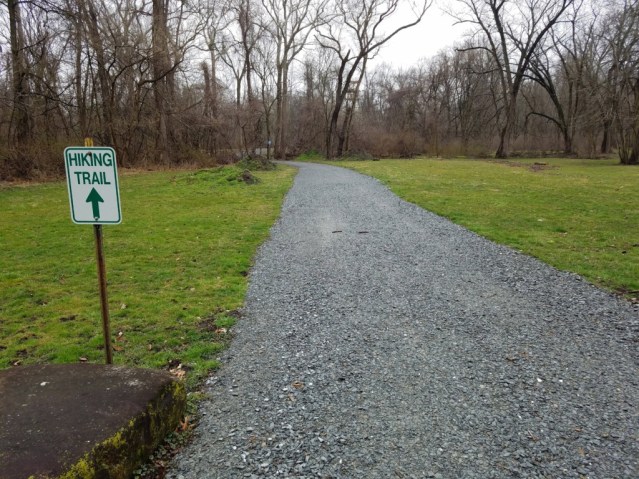
The northern end of the Northwest Lancaster County River Trail

I’m looking forward to bringing my bike along on a future visit and exploring the trail along the river. I’m sure there will be some QRP-portable operating from somewhere along the trail.

73, Craig WB3GCK

Quick End Insulator

Here’s another quick hack that took longer to write up than to actually build. I recently built a portable vertical antenna using some #26 Stealth Wire. I needed some sort of end insulator that would facilitate pruning the wire to resonance. Here’s my quick and dirty solution.

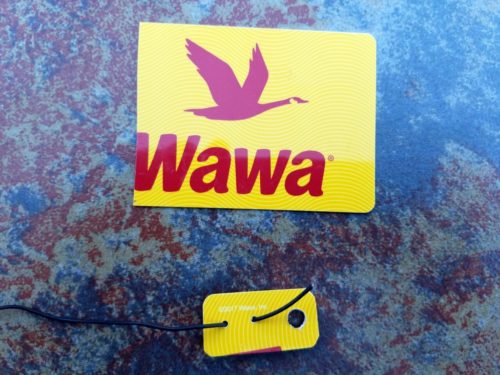
Using scissors, I cut a piece of plastic from a used up gift card I had in my wallet. The piece I cut is about 1 inch by 0.5 inches. Then, I drilled 3 holes in it. Two of the holes were just slightly larger than the #26 Stealth Wire (The Wireman Product #534). These holes hold the wire in place. I drilled a larger hole for attaching to a light line or, in my case, a small clip at the top of my telescopic pole. I also rounded off the corners a bit.

The end insulator and the gift card from which it was cut. (Disclaimer: I have no financial interest in the Wawa company, except that I have consumed untold quantities of their coffee over the years.)

So far, this is working out well for my portable vertical antenna. If I was using heavier gauge wire, I would definitely use something more substantial than the gift card. I also wouldn’t use it for a permanent installation. But for an ultralight antenna that is only used for portable excursions, it’s perfect.

If I ever need to replace it, I have enough of the original gift card left to make a bunch more!

72, Craig WB3GCK