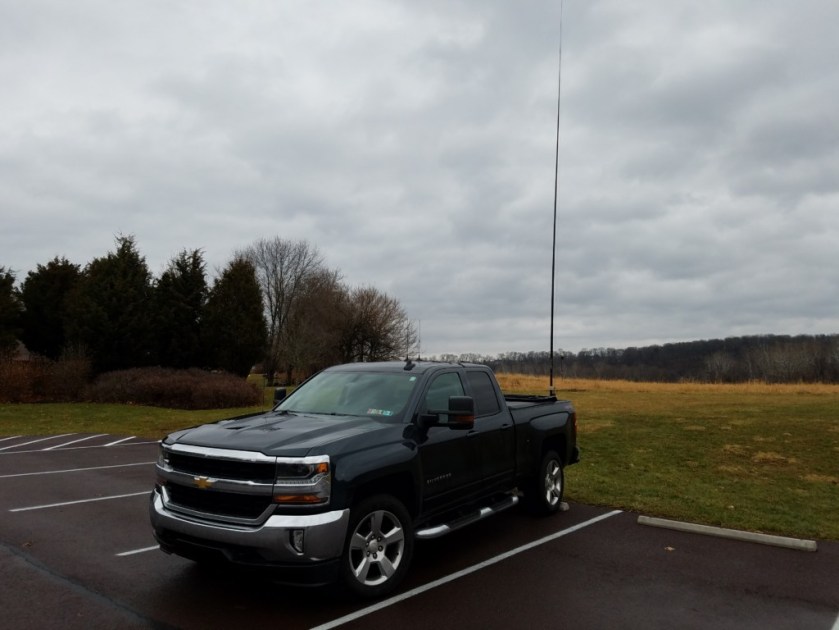
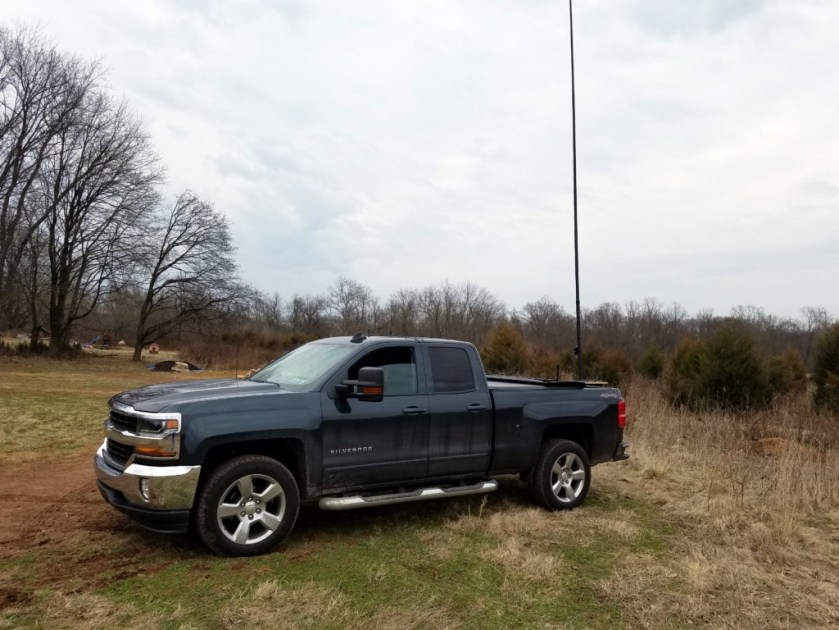
I wanted to get out and do a little QRP-portable before all the holiday festivities get started. I hadn’t operated from Black Rock Sanctuary in a while, so I headed over there. It was dreary and drizzly today, so it was a good day to operate from the truck and give my homebrew 19-foot vertical another workout.
The vertical antenna in use at Black Rock Sanctuary
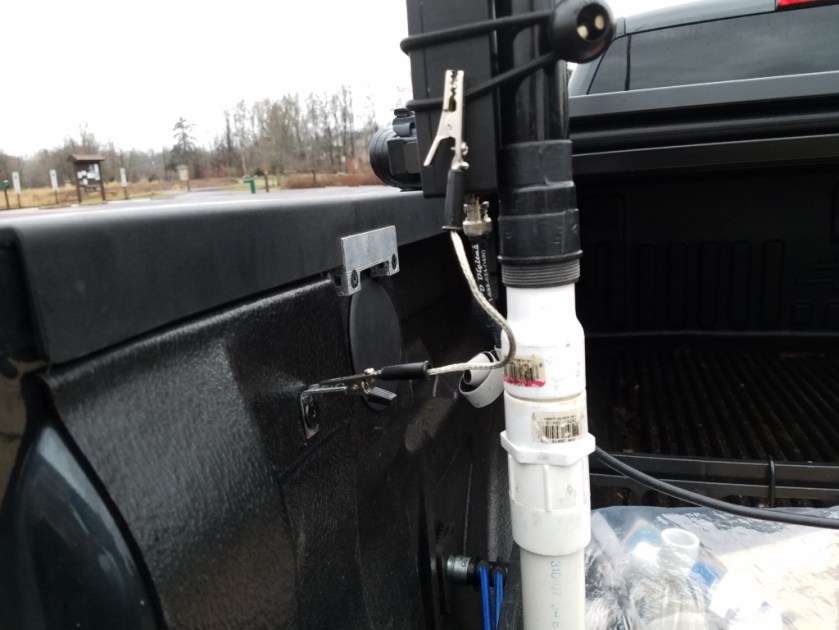
Since the last time I used the 19-foot vertical in the truck, I found a way to ground the antenna to the body of the truck. It was a simple matter of backing out one of the screws that hold the bed liner in place and using it to attach a small L bracket. This now provides a convenient spot to attach my ground lead.
Ground connection for the vertical antenna.
I was using my little MS2 straight key with the KX3 today. The bands were in pretty decent shape and the antenna seemed to be working great. I made a half-dozen SKCC contacts on 40 and 20 meters with some respectable signal reports. One SKCC’er in California called me on 20 meters but the frequency was taken over by other stations. I wasn’t able to complete the QSO but at least I was being heard on the West Coast.
Operating position in the truck
I also had some nice two-way QRP QSOs. W4UV in North Carolina had a great signal on 40M with his Ten Tec QRP rig. Jim N0UR was really pounding in from Minnesota on 20 meters. My favorite QSO of the day was with Dirk W8IQX. Dirk was running 2 watts from his FT-817 to an AlexLoop on 20 meters. If I copied correctly, he was in Florida. QRP never ceases to amaze me!
[This is an updated version of a post that appears on my old website. – WB3GCK]
I do quite a bit of my QRP operating from portable locations. I like to use simple wire antennas but, truth be told, I really dislike spending my limited operating time trying to get antenna wires up into trees. Also, when activating parks for Parks on the Air (POTA), I often operate from the cab of my truck and need an antenna that is self-contained and quick to deploy. This set up fits the bill.
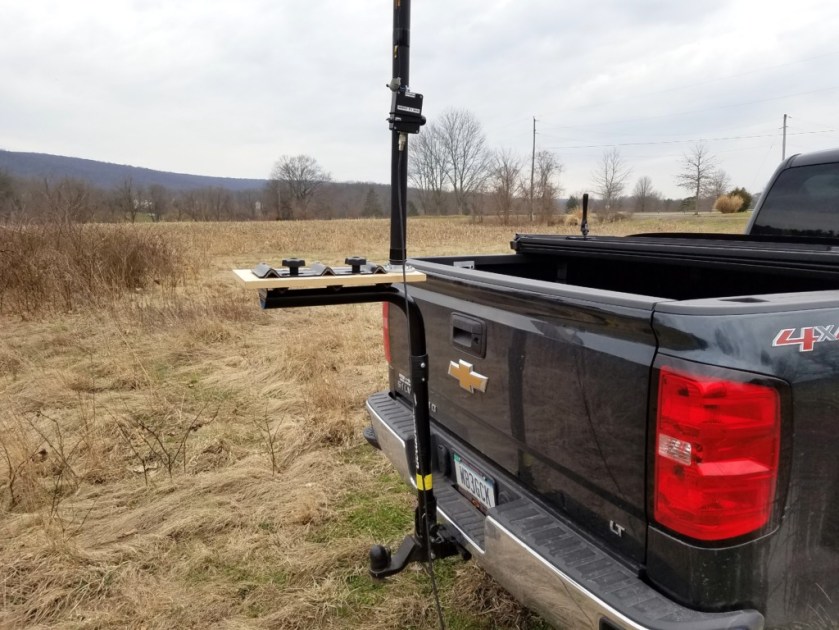
What I did was modify my homebrew roll-on mast support so I could use my hitch-mounted bicycle rack to support it. This only required the drilling of two holes in the roll-on mount. Figure 1 shows the roll-on mount clamped into the bike rack. In this case, I was supporting a 31-foot Jackite pole. After extending the pole and removing the bottom cap, I just lower the pole onto the 1-1/4 inch pipe. That’s all there is to it.
Bike Rack Antenna Mount. A 9:1 unun is attached to the Jackite pole with a bungee cord.
By selecting the right size of pipe, I can use this technique to support a variety of masts. For example, I’ve used this type of mount to support two 5-foot sections of TV antenna mast. I used this configuration to support a 1.2 GHz yagi for DStar digital communications during an ARES-RACES drill years back.
The Bike Rack Vertical in use
When operating QRP-portable, I often use a vertical antenna made from a 30-foot piece of hook-up wire and fed through a homebrew 9:1 unun with an 18-foot length of RG-8x coax. The unun is just attached to the 31-foot Jackite pole using some small bungee cords. No radials are used, which gives this set-up virtually a zero footprint. You can find more information on this configuration on the EARCHI website. I’ve successfully used this antenna in the field over the past few years. It’s a bit of a compromise, as antennas go, but it has always served me well. The extra height using the bike rack mount seems to help performance a bit. (Although I can’t quantify that, I’m sure the extra height doesn’t hurt.) With the internal antenna tuner in my KX3, I can work all bands from 40 through 10 meters. Heck, I’ve even used it on 80 meters a bunch of times.
I used this particular antenna configuration countless times in recent years. It was my “go to” antenna for NPOTA activations. Within 5 minutes of arrival, I can be on the air. When it’s time to leave, tear down is just as fast. Now, that’s what I’m talkin’ about!
Earlier this year, I built a lightweight, 19-foot vertical. Intended for tripod or ground mounting, I did the initial tuning and pruning of the vertical in that configuration. Today, I thought I’d see if it would work mounted on my pickup truck.
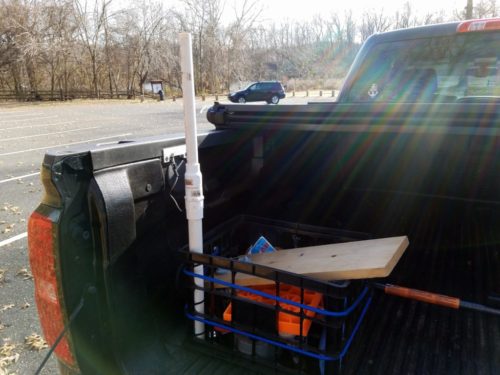
I have this plastic crate that I keep in the bed of the pickup truck. I use it to hold parts for my drive-on antenna mount, along with some tools and miscellaneous “stuff.” I hold the crate in place using bungee cords attached to a cargo bar that spans the width of the bed. I decided to make use of the crate as a quick and dirty antenna mount.
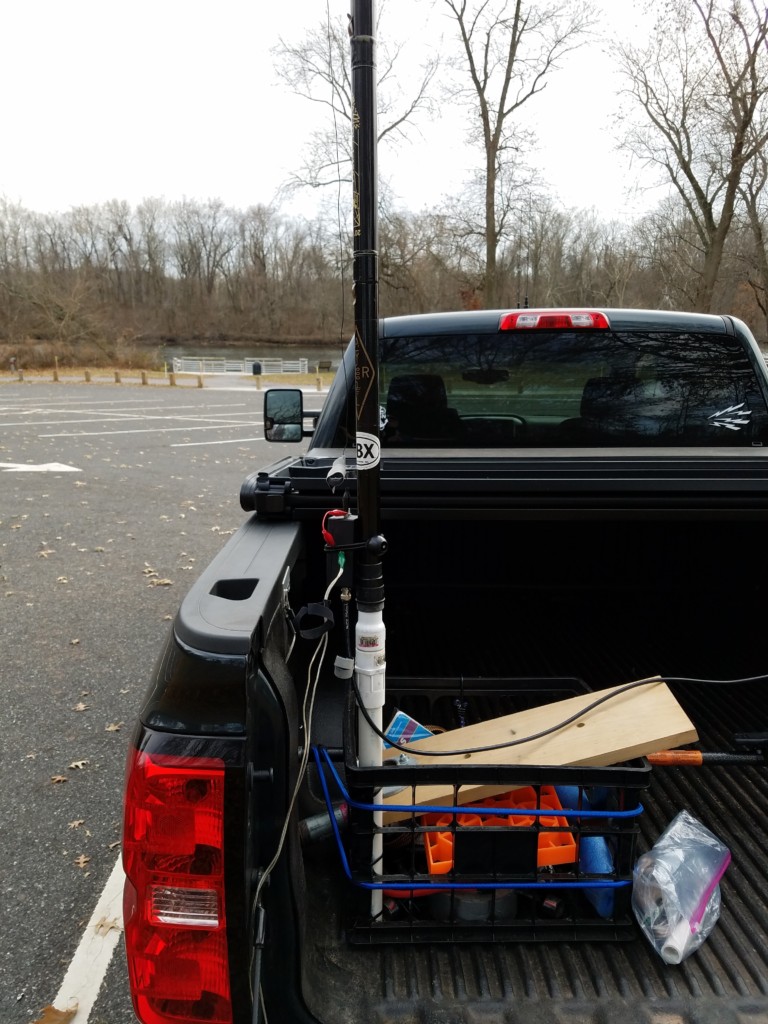
I took some 1-inch PVC pipe with a female threaded coupler from a previous antenna project and attached it to an inside corner of the crate with heavy-duty zip ties. I kept this part short enough to fit underneath the tonneau cover when traveling. To mount my 20-foot Black Widow pole, I used a 1-inch PVC male coupler and a reducer to go down to a 3/4-inch PVC pipe. The 3/4-inch PVC pipe fits nicely up inside the Black Widow pole. I went with the Black Widow pole rather than the lighter weight pole I normally use with this antenna since I already had all the PVC parts I needed to mount it.
My makeshift mount. The PVC mount is attached to the plastic crate, while the crate is attached to a cargo bar using bungee cords. The random junk I store in the crate keeps things stable.
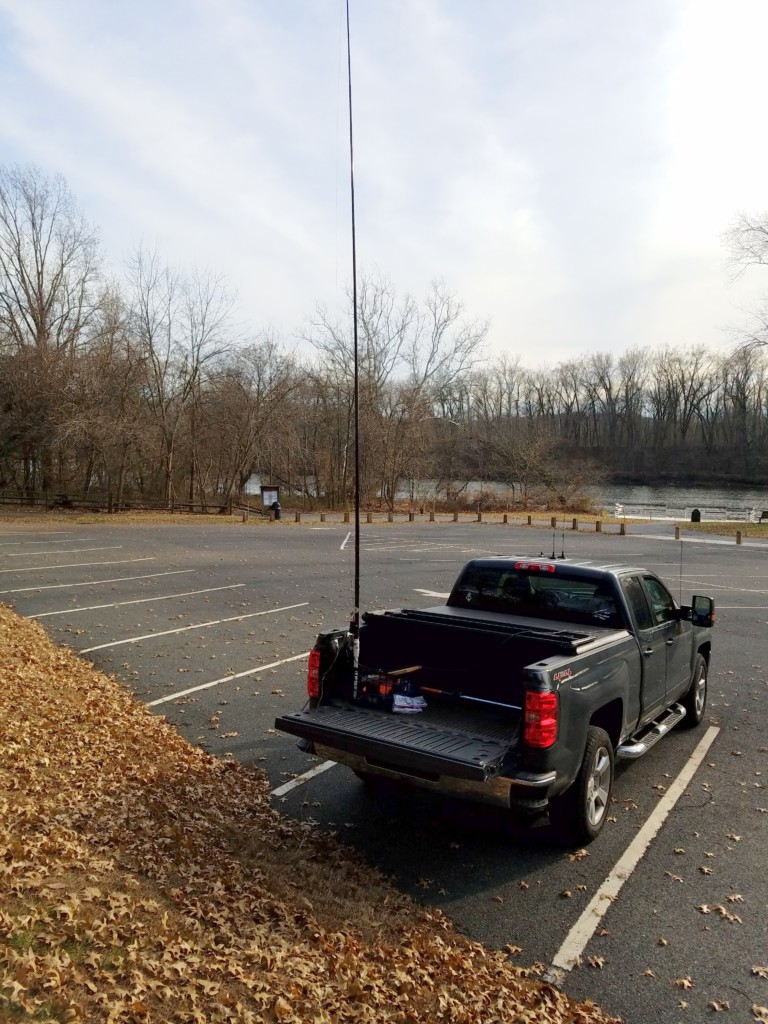
I headed out to a local park today to give it a try. It only took a few minutes to get it set up. From the antenna, I ran some RG-8x coax through a window and into the cab of the truck. I connected the antenna ground to the body of the truck using a short piece of braid to a metal plate used to latch the tonneau cover closed.
The Black Widow pole installed on my makeshift mount.
I fired up my antenna analyzer and the SWR was off the charts. On closer inspection, I found the plate I was using for my ground wasn’t actually attached to the body of the truck. Instead, I connected two radials and ran them off the back of the truck. This time the SWR on 40 and 30 was much better. The resonant frequencies in this configuration were higher than when ground-mounted but my KX3’s internal tuner easily handled the minor mismatches.
I started out on 20 meters where this antenna operates as a random wire. I heard N5PHT doing a Parks on the Air (POTA) activation (KFF-3023) down in Texas. I gave him a call and exchanged reports. Moving down the band, I worked XE1XR in Mexico. So, the antenna seemed to be working fine. I checked 30 meters but it was devoid of activity.
The 19-ft vertical in operation.
Down on 40 meters, I had a nice ragchew with Bernard VE9BEL. Bernard was operating a club station (VE9CRM) in New Brunswick, Canada. He gave me a 599 and said I was “booming” into New Brunswick. Not bad for 5 watts into a 19-foot loaded vertical. I last worked Bernard a few years ago from Mt. Misery in Valley Forge National Park. We had strong signals both ways on that day, too.
So, it looks like this antenna is usable from the truck. I still need to find a way to connect the ground to the body of the truck. If possible, I’d like to avoid drilling holes in my new truck. This antenna is a little easier to deploy than my usual “Bike Rack Vertical.” The downside is I have to exit the truck to change bands. Life is a series of trade-offs, I guess.


 WB3GCK QRP Amateur Radio