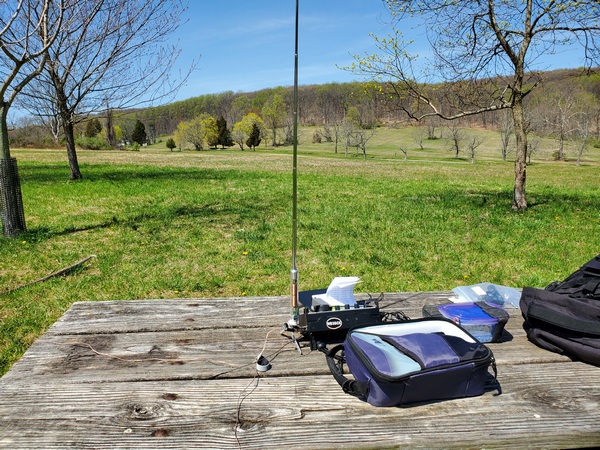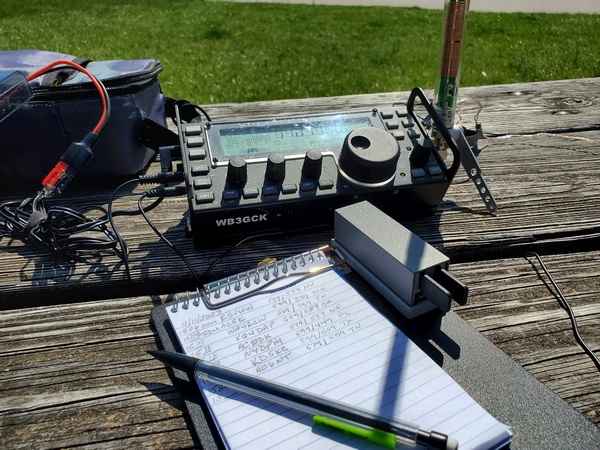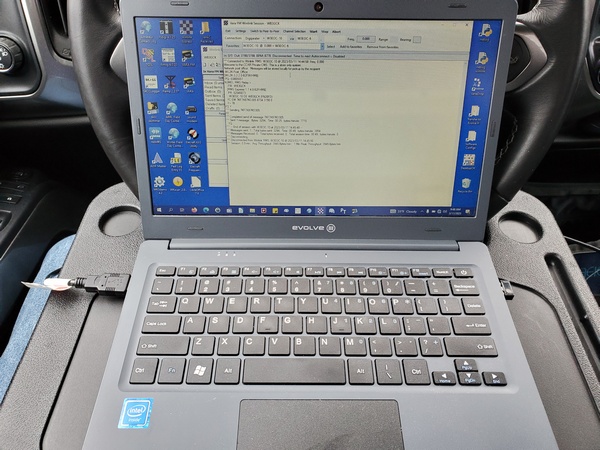
Traditionally, the day after the Thanksgiving holiday here in the U.S. is the start of the Christmas shopping season. People flock to the stores looking for bargains. This time of year is typically when stores start turning a profit (operating in the black), hence the name “Black Friday.” Wanting to avoid all of that craziness, I went a different way and headed out to a nearby park for a POTA activation.
For a variety of reasons, I haven’t been on the air much this month. I was overdue for some QRP-portable operating, so I headed to nearby Evansburg State Park (K-1351, KFF-1351). It was rainy here in southeastern Pennsylvania this morning. When I arrived at the park, I was the only one there for a while.
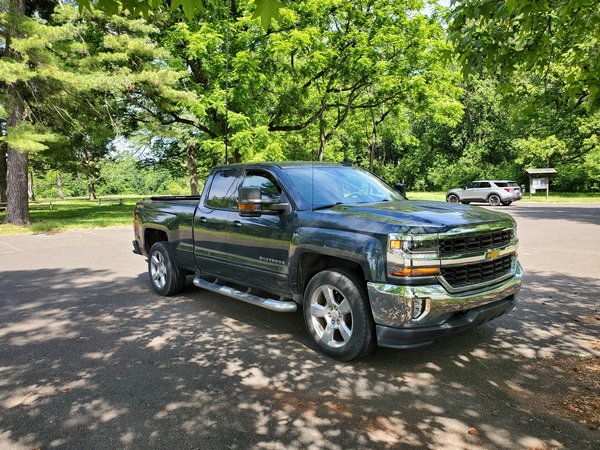
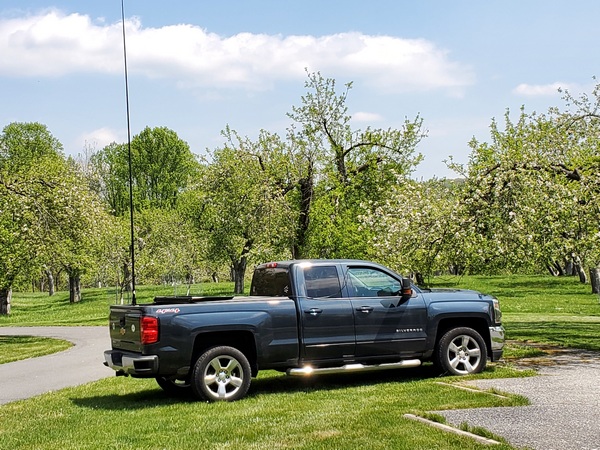
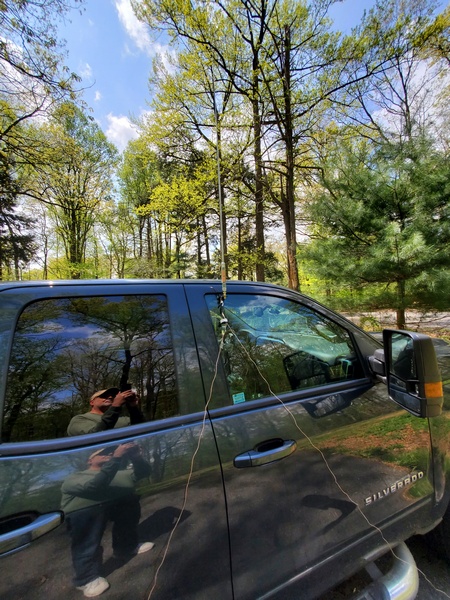
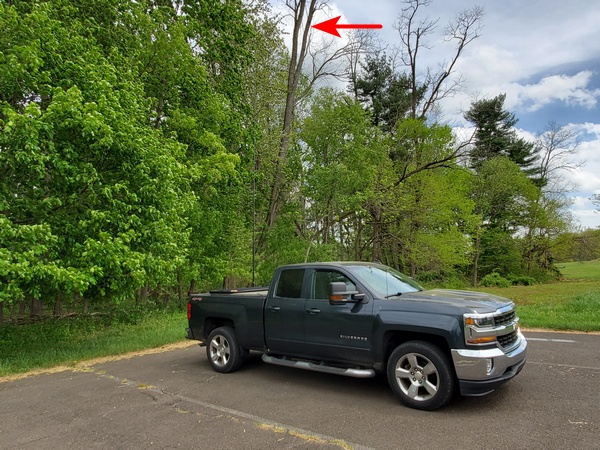
WB3GCK at Evansburg State Park (K-1351) on a damp and dreary morning
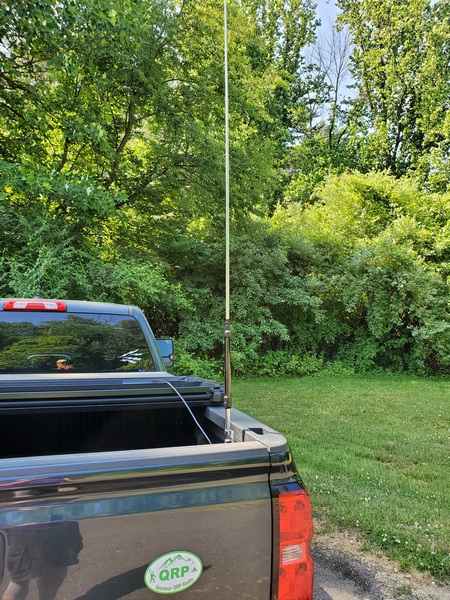
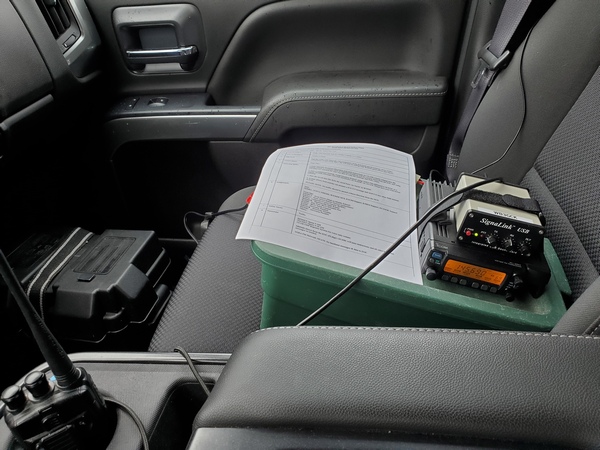
I set up my TR-35 (5 watts) inside the truck and installed my trusty 19-foot vertical on the back. The hunters quickly showed up after I spotted myself. I had my required ten contacts in about ten minutes. After I had logged 16 contacts on 40M, a station came on frequency and started CQing. I figured that was a good time to check some other bands.
The organized chaos inside my truck
Up on 20M, the signals didn’t seem as strong. Nevertheless, I picked up 15 more contacts. I made four more contacts on 17M before pulling the plug.
After a little more than an hour, I ended up with 36 contacts. Among those were four park-to-park contacts. I also logged four DX contacts: DL1AX (on two bands), SP6GNJ, and F4ILH.
It felt great to be back out activating. Hopefully, I can get back out again over the weekend.
I had a rare free day today. The only thing on my agenda was to drive out to see my grand-kids in central Pennsylvania. I made a last-minute decision to activate a park on the way there.
Just minutes before I left the house, I looked at the map of parks on the POTA website and selected Swatara State Park (K-1426/KFF-1426). I’d never been there, so I took a quick look at a map of the park and spotted a trailhead with restrooms. So, I put the address for the Trout Run Trailhead in my GPS and took off.
I rolled into the parking lot about 90 minutes later. Except for a park maintenance truck, I was the only one there. I quickly set up and got busy. The rig today was my TR-35 (5 watts) and my trusty 19-foot vertical.
WB3GCK all alone in the Trout Run trailhead parking lot at Swatara State Park
The cell coverage was great, so I easily spotted myself. A minute or two later, the hunters came calling. I spent most of my time on 40M, but I also made contacts on 30M and 20M.
After about 90 minutes, I had 54 CW contacts in the log. Among those were six park-to-park QSOs and one DX contact (CU3AA).
Swatara State Park is another park worth further exploration. There aren’t many amenities, but there are lots of trails. It appears to be a popular spot for mountain biking.
Trail signs at Swatara State Park. The Appalachian Trail runs through the park, but I wasn’t close enough for a “two-fer.”
There was a trailhead for the Appalachian Trail just down the road from where I was. If I hadn’t been so hasty with my planning, I could have gone there and activated a “two-fer.” Maybe next time.
Normally, my (far) better half and I do a lot of camping in French Creek State Park (K-1355/KFF-1355). This year, because of medical and other issues, we didn’t take the QRP Camper out at all. In fact, it’s been about a year since our last camping trip there. So, I paid a visit to French Creek this morning for a long-overdue POTA activation.
Virtually all of my activations in this park have been from campsites. This morning, though, I operated from a parking lot near a picnic area and boat launch. I operated from my truck, using my TR-35 (around 5 watts) and my 19-foot homebrew vertical.
Hopewell Lake in French Creek State Park (K-1355/KFF-1355)
My cell coverage wasn’t very good, so I had trouble spotting myself. Fortunately, the Wi-Fi in my truck uses a different carrier and allowed me to get my spot posted. Almost immediately, the hunters started calling.
After an hour, I had 36 in the log, including two park-to-park contacts. I also worked Germany and Poland on 17M.
Hopefully, we’ll be getting back to camping at French Creek again next year. In the meantime, I’ll be doing some more activations here for sure.
I haven’t activated a park recently, so I made a point to get out today. This weekend is the Parks on the Air Fall Support Your Parks weekend. What better time to activate?
I made a last-minute decision to head back to the western boat launch area in Marsh Creek State Park (K-1380, KFF-1380), a site I’ve been to a few times in the past year. Looking at the surrounding terrain, you would think this is a terrible location. It’s down at water level near the lake, and you have to descend a large hill to get down there. Despite the terrain, I’ve always had good luck from there. Today was no exception. Not to mention there’s a beautiful view of the lake.
WB3GCK at Marsh Creek State Park (K-1380)
Using my TR-35 and my 19-foot vertical, I started out on 40M. Initially, I had a little trouble spotting myself. Even before I was spotted, a station in New York stumbled upon me and got things started. Eventually, my spot went through, and things really picked up. I made 28 contacts on 40M in the first 45 minutes. Up on 30M, I picked up 11 more contacts.
Before I left, I checked 17M, and I’m glad I did. I was getting some very strong Reverse Beacon Network (RBN) spots from Europe. In short order; I had three contacts, with the last two being SP6GNJ and CU3AA. Happily, my puny five-watt signal was making the trip across the pond.
Support Your Parks Weekend Activator Award
I ended up with 42 contacts, including two park-to-park QSOs, and the two DX contacts. Right after I uploaded my log, I received a certificate for activating a park during Support Your Parks weekend. I made a few contacts as a hunter yesterday, so I also received a hunter certificate.
I was long overdue for some portable QRP, so I went out twice over the weekend. As a bonus, we had some beautiful Fall weather here in southeastern Pennsylvania.
The bands, especially 20M, were in good shape, and I made a half-dozen SKCC contacts. There were a lot of Parks on the Air (POTA) activators, so I spent most of my time hunting them. The Pennsylvania QSO Party was also going on, and I logged a few of them, too.
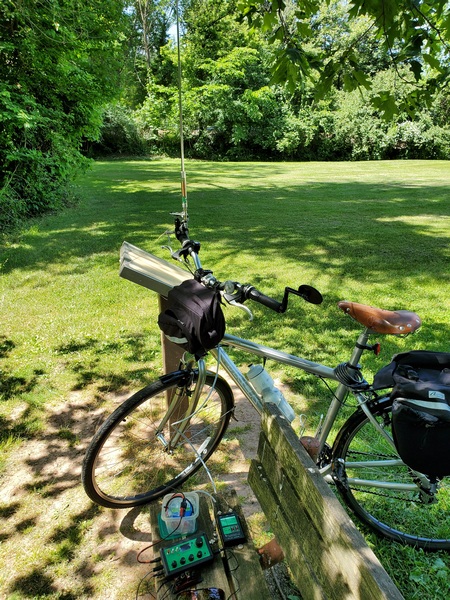
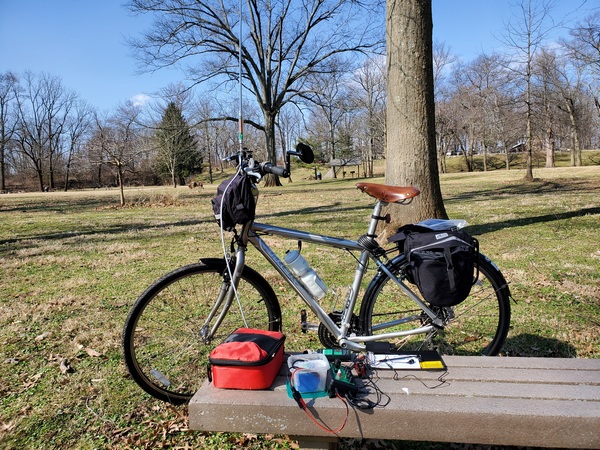
On Sunday, I went for a bike ride on the Schuylkill River Trail and stopped in a park for a little radio time. This time I used my newly acquired (tr)uSDX with my ground-mounted 19-foot vertical.
My bike-portable setup on Sunday
The bench I was sitting on was getting full sun from time to time, which made reading the radio’s display a challenge. There were some loud signals on 20M that seemed to overload the radio’s front end. I could have used some attenuation, but, not being able to read the display clearly, I didn’t attempt to navigate the menus. (Note to self: Stay in the shade next time.) Despite these challenges, I logged three SKCC stations receiving good signal reports from each of them.
Nothing really exciting this weekend, but it was great to get back out portable again.
I took advantage of the decent weather yesterday and went for a bike ride along the Schuylkill River Trail and the Perkiomen Trail. Along the way, I stopped in a local park to make a few contacts in the Straight Key Century Club’s Weekend Sprintathon (WES) contest.
When I arrived at the trailhead, it was nearly full. Fortunately, I grabbed one of the last remaining parking spaces. After loading up my radio gear, I hopped on the bike and took off down the trail. As the trailhead parking situation would suggest, the trail was getting lots of use from walkers and cyclists.
WB3GCK taking a radio break along the Perkiomen Trail
I didn’t hear much contest activity, but I seemed to have a pipeline to Prince Edward Island in Canada. I made SKCC contacts with the special event station, VC3Y/VY2, on both 40M and 20M. I also worked VA3DXQ/VY2 who was doing a POTA activation. KS9KCC was booming in from Indiana, but they didn’t seem to hear my five-watt signal. (Later in the day, I logged KS9KCC from home on 40M.) After making seven contacts, I packed up and continued on my ride.
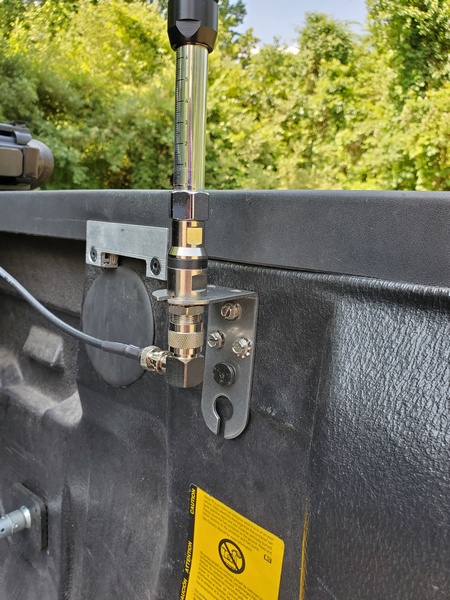
My homebrew 19-foot vertical and ground mount
It’s a good thing I went for my ride yesterday. The weather today is raining and dismal.
Also, on the 21st anniversary of the 9/11, please take time to remember those lost in that tragedy.
After a long drive home from North Carolina yesterday, we were still unpacking from our vacation and getting caught up on things today. I couldn’t pass up the annual Skeeter Hunt QRP contest, so I snuck out to make a few contacts. Besides, I was issued a single-digit skeeter number (#7) this year, so I couldn’t let that go to waste.
I drove a few miles over to Valley Forge National Historical Park, hoping to catch enough skeeters for a valid POTA activation (K-0761). The area I was in was busy with folks enjoying their picnics, so I parked my truck well away from them.
I didn’t plan to stay long, so I operated from the truck. I used my Penntek TR-35 and my trusty homebrew vertical. That turned out to be a wise move, since the truck provided some shade and an occasional cross-breeze through the windows.
Yours truly operating in the 2022 Skeeter Hunt QRP contest
When I turned on the rig, the 40M band was buzzing with QRP skeeters, and I made most of my contacts there. Conditions, at times, seemed pretty good; I worked stations in WI, MO, and GA on 40M from here in southeastern PA. After running out of new ones on 40M, I moved up to 20M and picked up a few there.
At the end of my 1.5 hour session, I had worked 16 skeeters, one non-skeeter QRPer. There were other skeeters operating from POTA entities; I had at least four park-to-park contacts I know of.
The Skeeter Hunt is always a good time. I’m glad I could take part, even if just for a part of the contest. A big shout-out to Larry W2LJ for organizing this fun event.
We arrived on Saturday, after a long drive from southeastern Pennsylvania. After unloading and getting organized in the house we rented in Corolla for the week, I went outside and set up an antenna.
Currituck Sound, as seen from my antenna.
For the past two years at this house, I used a 29-foot vertical fed through a 9:1 unun. During both trips, I struggled with noise issues. I had a couple of antenna options I wanted to try this year.
This time around, I went with a Rybakov-type antenna. I strapped a 28-foot Jackite pole to the railing of the 3rd floor deck. I used a 26-foot vertical wire fed through my recently built weather-resistant 4:1 unun. My 26-foot counterpoise wire ran out to the side of the antenna and down the side of the deck stairs. It was a weird configuration, for sure. I ran 25 feet of RG-8X coax down to the second floor, where I could operate in the shade—in the morning, at least.
My Rybakov vertical configuration. The red line shows how I ran the counterpoise wire. Despite this weird-looking setup, it worked pretty well.
I didn’t test the antenna until early Sunday morning, and my KX3’s tuner matched it on every band from 40M through 10M. The noise levels on 40M and 20M were down around S2, a dramatic improvement over previous years and completely workable. The higher bands were dead quiet.
My antenna feedpoint. I used my weather-resistant 4:1 to create a Rybakov-type vertical.
My first contact was an interesting one. Fellow Boschveldt members, Glen NK1N and Rob KE3TI, were on an overnight backpacking trip on the Appalachian Trail in Pennsylvania. I sent Glen NK1N a text message to let him know I was on the air, and we connected on 40M. We chatted for a bit and exchanged SKCC numbers. Conditions were rough in the beginning but, towards the end of our contact, our signals improved.
Before quitting, I logged 10 SKCC Weekend Sprintathon (WES) contacts. There were bonus points for using a homebrew key, so I used a straight key I cobbled together a few years ago. I also worked Greg WA3GM, who was doing a POTA activation at a park near to my home in Pennsylvania. So, my jury-rigged Rybakov seemed to get out OK.
The homebrew straight key I used during the SKCC Weekend Sprintathon (WES).
Monday morning, I got set up on the deck to make a few contacts. I noticed the antenna was acting up a bit on the 40M band. The KX3’s tuner showed it found a 1:1 match, but the SWR went up when I transmitted. I had no issues with the other bands, just 40M. It seemed like I was getting some RF on the coax shield, so I added a common mode choke at the transceiver and changed to a shorter length of coax. That cleared up the issue. I’m guessing there was some interaction between the antenna’s counterpoise and the coax on 40M. Even before I resolved the antenna issue, I logged a half-dozen contacts.
My radio setup on the 2nd story deck of the rental house.
With six adults, four grand-kids, and two grand-dogs, there was always something going on in the house. However, I managed to get on the air for about an hour each morning after breakfast to make a few contacts.
Thursday evening was busy. I kept track of Winlink check-ins for an ARES-RACES net back home. Using DMR, I checked into another ARES-RACES net in Pennsylvania. When I’m down here, I always like to check into the Outer Banks Area Wide Net. Then, it was out to the dock to join my grand-kids for some crabbing.
As I was finishing up breakfast on Friday, I got a text message from my friend, Frank N3FLL, asking if I was on the air. I quickly moved my radio out to the deck and had a nice QSO with him. I also worked a few POTA activators including Greg WA3GM. I worked Greg on the first day, so it was only fitting that I work him on the last day, too. After that, it was time to take down the antenna and pack up the radios.
I didn’t spend as much time on the air as in previous years, but I worked some fellow SKCC members, chased a few POTA activators, and had a couple of nice ragchews. All in all, it was a great vacation with excellent weather. I’m already looking forward to next year.
I recently came across a product on Etsy that caught my eye. It’s a 3D printed project box with an integrated antenna wire winder. I couldn’t resist, so I ordered one.
The box will accommodate a T-130 toroid, and the snap-on lid comes with a gasket. There is a pre-drilled hole for a BNC-F panel mount connector, and there are marks to guide drilling for the output and ground connectors of your choice. You can choose from two colors: orange or green. The vendor states that it is “UV and weather resistant.”
I like the idea of having a box to enclose the balun or transformer. My preference for portable antennas is to avoid exposed components or circuit boards.
I used mine to build a 4:1 unun for portable use in a Rybakov configuration. The unun consists of 19 bifilar turns of #24 solid hookup wire on a T130-2 toroid. You can find plans for winding the unun here and other places on the Internet. For the output and ground connections, I used #10-24×3/4″ stainless steel machine screws, along with some nuts, flat washers, and lock washers.
Inside view of the 4:1 unun. I used double-sided foam mounting tape to secure the toroid. I also use a small piece of packing foam (not shown) between the lid and the toroid for added stability.
To go along with the completed unun, I prepared two 26-foot wires; one for the radiator and one for a counterpoise. I finished up by attaching a length of 2.5mm bungee cord. This cord keeps everything together for travel. I have also used it to secure the box to a vertical support, e.g., fiberglass mast, fence post, etc.
The 4:1 unun deployed in a Rybakov vertical configuration with a 26-foot radiator and a 26-foot counterpoise
In the field, this Rybakov antenna worked as well as others I have built over the years. I tested it using my Penntek TR-35 and Elecraft T1 tuner with 18 feet of coax. It tuned up easily on 40, 30, 20, and 17 meters, and I made a couple of QSOs while testing. The integrated winder made it easy to deploy and take down.
The 4:1 unun packed up for travel
I have a feeling another one of these boxes is in my future. Maybe a 9:1 unun next time?
I logged into the POTA.app site this morning and noticed that I had 99 park-to-park QSOs, just one away from the next award level. With my vacation coming up, I probably won’t be able to activate a park for another couple of weeks. My obsessive nature couldn’t take looking at that 99 number all that time, so I set out today to rectify that.
I started the day just one away from the next POTA Park-to-Park award. Of course, I had to go out and get a few more.
I drove down to Valley Forge National Historical Park (K-0761/KFF-0761) this morning for a quick activation. We’re still under a heat advisory, so I got there early to avoid the worst of it. On arrival, I found a shady spot and parked my truck.
I set up a camping chair and small table in the shade and used my 19-foot vertical on the back of my truck. My rig today was my Penntek TR-35 at 5 watts.
My setup behind my truck at Valley Forge National Historical Park (K-0761/KFF-0761)
The CW hunters were out in force early today. It took all of 15 minutes to make my first ten contacts. Operating for exactly an hour, I finished with 25 QSOs in my log. Best of all, five were park-to-park QSOs, so I had more than enough to put me over the top.
With my mission accomplished, I can stop fixating on that pesky “99.”