The weather prognosticators were forecasting snow and rain to start Saturday afternoon. So, I headed out for a quick activation before the weather nastiness arrived. I hadn’t activated French Creek State Park (US-1355, KFF-1355) in quite some time, so I packed up my radio gear and headed out.
The place was nearly empty when I arrived. I parked near the boat launch at Hopewell Lake today and was set up a few minutes later. My rig today was my KX3 (5W, CW), along with my usual 12-foot whip and homebrew loading coil.
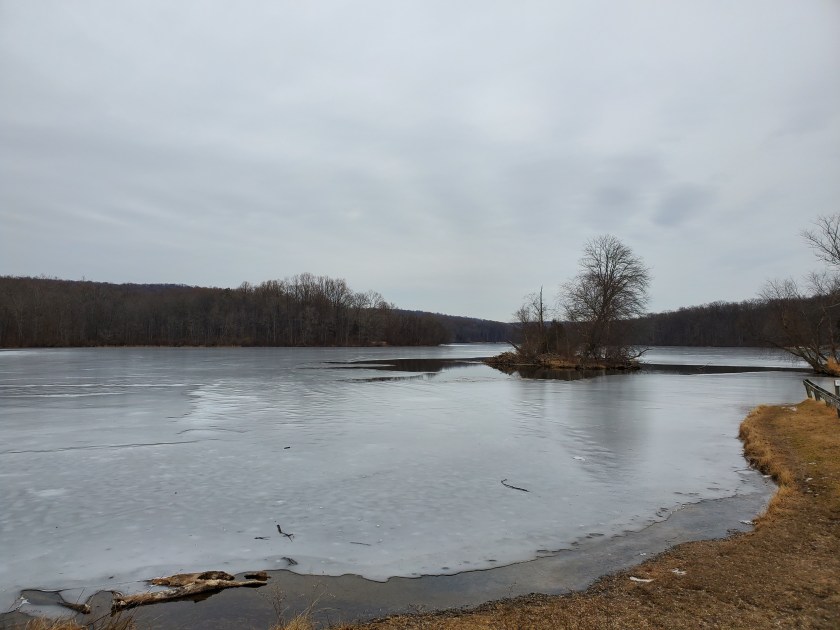
A partially-frozen Hopewell Lake in French Creek State Park (US-1355, KFF-1355)
There were several things working against me this morning. We were in the midst of a minor geomagnetic storm, and there was a good deal of static presumably from the impending weather. There was also a DX contest going, so some bands were loaded with contesters. I stayed mostly on the WARC bands, to avoid the contest mayhem.
The most concerning thing was that the ATU in my KX3 was a little finicky finding a match on some of the higher bands. I’m not sure if it’s a faulty connection or if something is going on. Regardless, I got a good enough match to continue operating.
I started out on 40M, and despite the band conditions, it only took about 12 minutes to log my first 10 contacts. When things slowed down, I moved to 30M for a while, followed by 17M and 12M. After making a couple of DX contacts on 12M, the KX3 decided it didn’t like the antenna and folded back to three watts. That was a little over an hour after I started, so I decided that was a good time to pack up and head home.
I ended up with 33 contacts with two known park-to-parks. The 17 and 12 meter bands produced five European contacts: F5MQU, OH1MM, F1BLL, SM4BNZ, and IK4IDF. A special tip of the hat to N0TOP in Missouri who worked me on three bands this morning.
So despite all the wackiness going on, it was a good morning. I have a little equipment troubleshooting to do, though.
We had a real pot-pourri of winter weather overnight here in southeastern Pennsylvania. It was a combination of snow, sleet, and freezing rain. Despite some residual ice on the roads, I went over to Valley Forge National Historical Park (US-0761, KFF-0761) this morning for a quick activation.
Before I could go anywhere, I had to scrape a thick layer of ice off my windshield. The temperature was slightly above the freezing mark, so it came off easier than I expected. The roads in my neighborhood were covered, but the main roads were mostly clear.
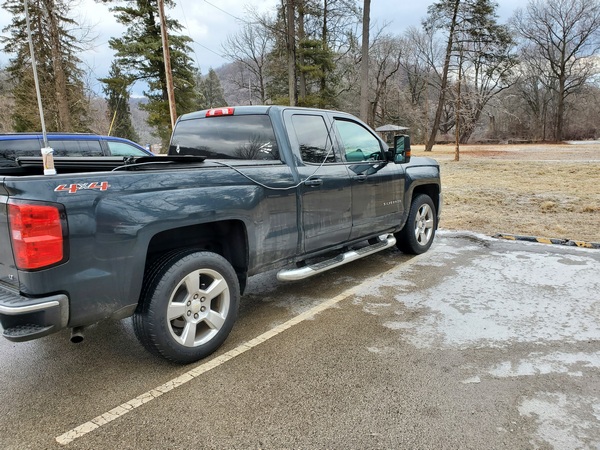
When I got to the parking lot in Valley Forge, it looked like it had been recently salted. The parking spaces were still ice-covered, and my truck was completely surrounded by it. Needless to say, I had to tread carefully around the truck.
By the end of my activation in Valley Forge, much of the ice had melted off.
I used my little Penntek TR-35 (5 watts, CW) and 12-foot loaded whip. This has been my go-to setup of late. I started off on 40M, making three Straight Key Century Club (SKCC) contacts in the monthly Weekend Sprintathon (WES) contest. I switched to my paddles and started calling, “CQ POTA.” Activity on the 40M band was a bit slow for me; it took about 20 minutes to make my first 10 contacts. Fortunately, there was more activity on 20M and 17M.
After about an hour and 15 minutes, I had 47 contacts in my log. The European WWFF hunters were out in full force, especially the German stations. I had 13 DX contacts:
Germany (8)
Slovak Republic (2)
Italy
France
Poland
I also worked three West Coast stations (two in California and one in Washington), so all in all it was a good morning. By the time I started packing up, the sun was out and much of the ice in the parking lot was gone. Happily, the drive home was uneventful.
Now it’s time to settle in, over-eat, and watch the Super Bowl.
My (far) better half and I spent the weekend in Central Pennsylvania watching the grandkids, while our second harmonic and her husband were off celebrating their anniversary. Of course, I took some radio gear along to do some QRP-portable operating while I was out there.
I had a brief window of opportunity on Saturday morning, so I drove to the Falmouth Access boat launch along the Susquehanna River to activate the Captain John Smith National Historic Trail (US-4567). Since we used the (far) better half’s car this weekend, I used this opportunity to try out my Gabil GRA-7350TC vertical and magnetic mount on her car for the first time. I also brought along my trusty Penntek TR-35 (5 watts, CW).
The Gabil GRA-7350TC & mag mount on my (far) better half’s car, while activating the Captain John Smith National Historic Trail (US-4567)
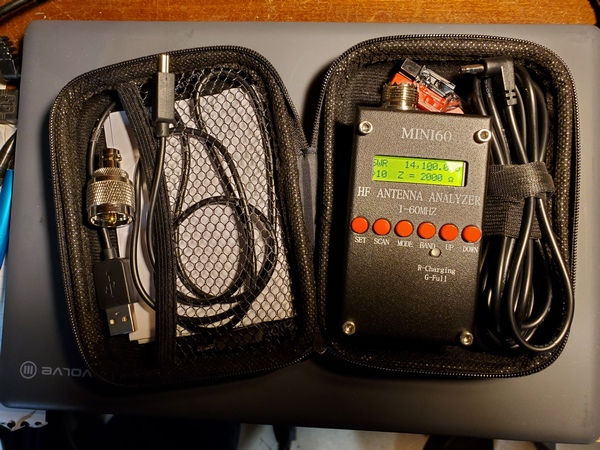
To facilitate tuning the vertical, I used a recently acquired Mini60 analyzer I bought off AliExpress. It’s cheap and a little quirky, but it’s small and its simple SWR readings got the job done. I started on 40M and got the SWR down to 1.3:1 without adding radials. That’s better than I had ever gotten on my pickup truck. I guess the roof on my XYL’s little SUV provides a better ground plane than my truck.
The Mini60 Antenna Analyzer. I found a case on Temu just the right size to hold the Mini60 and some accessories.
Band conditions were generally lousy, and there was some horrendous local noise in 40M and 20M. I didn’t experience any noise issues the last time I activated from here. Despite all that, I managed to scrape together 17 contacts in about 35 minutes, including one with F4ILH on 17M. Also, thanks to W5KEB for working me on two bands. (My apologies to a couple of hunters I couldn’t pull out of the crazy noise in 40M and 20M.)
Even though the bands weren’t too hot, I was pleased with the performance of the Gabil antenna. It’s another good antenna option when I’m using my (far) better half’s car (or any car, for that matter).
Back in 2017 I built my 19-foot wire vertical, which was my go-to portable antenna for about 4 or 5 years. The concept was simple: It functions as a base-loaded resonant vertical on 40M & 30M and as a random wire on 20M and up. The matching unit contains a tapped toroid for 40M & 30M and is fed through a built-in 1:1 choke. It occurred to me I could do something similar with the 12-foot telescopic whip and homebrew loading coil I’ve been using on my truck of late.
My 12-foot whip setup is resonant on 40M through 17M. You’re probably thinking: “Why not just bypass the loading coil and adjust the length of the whip for 15M through 10M?” Well, being as lazy as I am, that would make band changes a little more involved than I want to deal with. I like having some “frequency agility,” and I’m not above using an ATU to achieve that.
To emulate the scheme I used for the 19-foot vertical, I just needed a choke at the input to my homebrew loading coil. (I could probably go without the choke, but I wanted to keep the coax from becoming part of the antenna.) So, I use the 12-foot whip as a base-loaded resonant vertical on 40M through 17M. For 15M through 10M, I would bypass the coil and use an ATU.
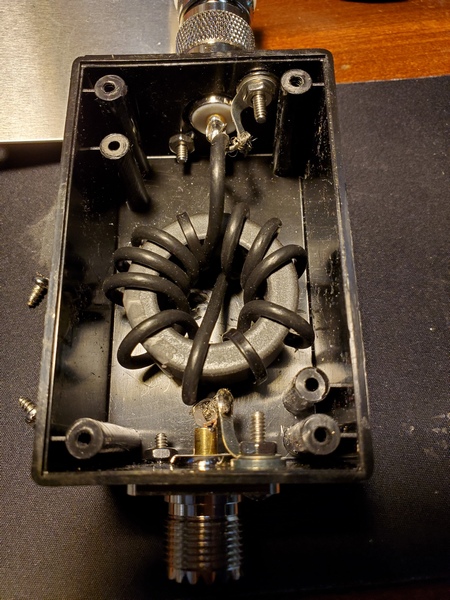
To test this out, I threw together a choke using parts I had on hand. I wound 10 turns of RG-174 on an FT-140-43 toroid. A Radio Shack project box I had in my stash of parts was the perfect size to house the toroid. (I bought it a decade or two ago, and it was still unopened in the original Radio Shack packaging.) Since I installed SO-239 connectors on each end, I had to use an adapter to connect the choke to the SO-239 on the antenna. To hold the coil in place, I wedged a piece of foam packing material between the lid and the core. The completed choke is functional, albeit a little cheesy-looking.
The choke is 10 turns of RG-174 coax on an FT140-43 toroid.
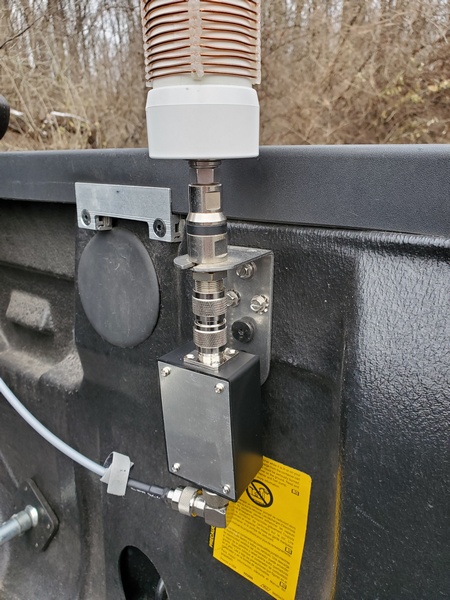
My first test using the 12-ft whip on the higher bands was a success. While activating Ridley Creek State Park (US-1414, KFF-1414), I used my KX3 (5 watts, CW) and installed the choke at the antenna feedpoint. On 40M through 17M, the loading coil functioned as it normally does. On 15M, 12M, and 10M, I bypassed the coil entirely and relied on the KX3’s internal ATU to load up the whip.
The choke installed at the antenna’s feedpoint
The KX3 easily found matches on all three bands, and my results on the air were encouraging. On 15M, I worked stations in Poland, Belgium, France, Ukraine, Germany (3), and the Slovak Republic. I made two stateside contacts on 12M. Up on 10M, I worked some more DX: Germany (2), Italy, and Czech Republic. One of the German contacts was park-to-park.
I’ve used this arrangement on a few more activations since then, including Winter Field Day. My results have been consistently good.
I haven’t done any modeling, but the 12-foot whip seems to be a pretty good length for operating like this. It’s just a little longer than a ¼-wave on 15M and a little shy of ⅜-wave on 10M. On 12M, it’s somewhere between ¼ and ½-wave; so it isn’t resonant on any of the bands of interest.
Although I was pleased with these initial results, I might do a little more tinkering with this setup. I’m toying with repackaging the choke to make it a little more weather resistant. I encountered some rain during the first activation using it. There was no damage to the choke at all, but I always have a tendency to over-engineer things—it keeps me occupied and out of trouble, I suppose.
No scientific breakthrough here. Just a lazy guy “force feeding” a fixed length whip to squeeze a few more bands out of it.
I did a modest Winter Field Day (WFD) operation this year, doing a little operating each day from a POTA/WWFF park. My aim was to make at least enough WFD contacts to complete a couple activations in the process.
Logging
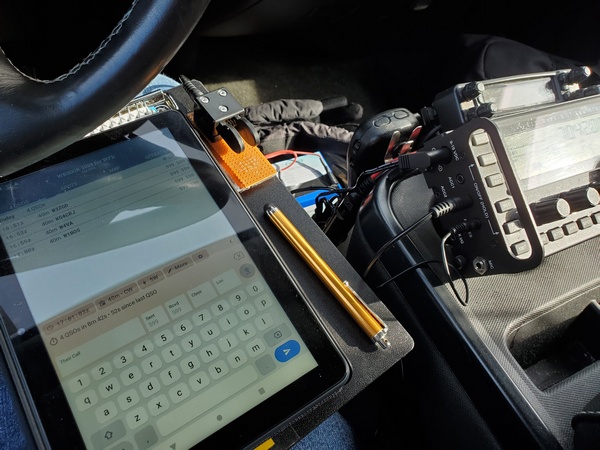
Except for ARRL Field Day, I’ve always been a diehard paper logger. For this year’s WFD, I wanted to try using my tablet for logging. Since I planned to operate mostly “search & pounce,” I figured I’d be able to adapt easily.
I’m using an Amazon Fire tablet these days. It was inexpensive and has good battery life, but ham radio applications—and applications in general—are limited in the Amazon Appstore. To get around Amazon’s limitations, I installed the Google Play application. Following some instructions I found on the Internet, it was a fairly simple process to find and install the four apps required to do that. Now I can install just about any app available through Google Play, and they run fine under Fire OS.
Using my new capabilities, I installed both the HamRS and Ham2K PoLo logging apps and did some testing. I like that the ADIF produced by HamRS uses separate fields for “Category” and “Section.” This is compatible with the N3FJP WFD logger, should I ever want to import it there. In the end, however, I opted to go with PoLo. The user interface is less busy on my tablet.
My Winter Field Day setup in the truck. It took some getting used to, but the tablet worked out pretty well for logging.
I’m very fastidious about backing up my data in the field. Since neither PoLo nor HamRS have an automatic backup function (like the N3FJP loggers have), my strategy was to periodically export the ADIF and Cabrillo files to my Dropbox account.
Day 1
On Saturday afternoon, I headed out to Marsh Creek State Park (US-1380, KFF-1380) and operated from the truck in my usual spot close to the lake. The park was busy with folks ice fishing, skating, or just walking around on the frozen lake, so the parking lot was pretty full.
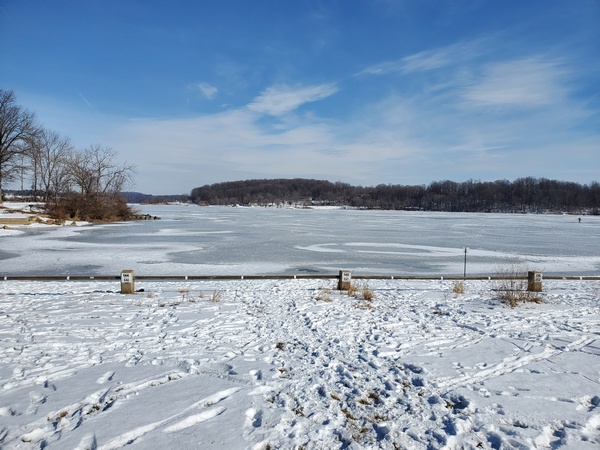
A frozen Marsh Creek Lake
I used my KX3 (5 watts) so I could access 15M and 10M. For my antenna, I used my 12-foot loaded whip fed through a 1:1 coaxial choke. (More on that setup in another post.)
This year I operated as 1M EPA, searching and pouncing for contacts. There was a ton of CW activity on 40M and 20M, so I had plenty of stations to pounce on. The 20M band, in particular, was jam-packed with CW signals. There was QRM galore. The 15M and 10M bands had less activity, so I didn’t have to fight with pile-ups to work stations.
The view from my mobile shack
Once again, my QU-21C paddles gave me problems. (The poor operator on the other end probably thought I was having a medical emergency.) I switched to my Palm Mini paddles and kept going.
Paddle problems notwithstanding, two hours of operation produced 29 Winter Field Contacts and two POTA park-to-park contacts in the log.
Day 2
On Sunday morning, I went back up to Marsh Creek to make a few more contacts. Activity was not as brisk as the day before, and it was harder finding stations I hadn’t already worked. Despite that, I worked 21 WFD stations in a little more than an hour. Most of my contacts were on 40M and 20M, with only one on 15M.
After cleaning the contacts the night before, the QU-21C paddles worked flawlessly this time out. I might need to take them apart to see what’s going on with the contacts on the DIT side.
Wrap-up
I finished up with a grand total of 50 CW WFD contacts this year. This wasn’t my best showing, but it was far from my worst. Considering the limited time spent on it, I did OK—by my standards.
Logging on the tablet worked out fine, for the most part. Operating in the “search and pounce” mode, I could easily keep up poking away with a stylus. If I was running stations in a pile-up, it would have been more difficult. I’m a pretty good touch typist, so I would probably do better using my Bluetooth keyboard with the tablet.
It was nice to actually have some winter weather here in southeastern Pennsylvania for this year’s Winter Field Day. I hope everyone who participated had a successful Winter Field Day.
I needed another mini straight key like a hole in the head. With my fascination for these things, however, I just couldn’t help myself.
The key in question came from AliExpress and cost me about $18 USD. Although it has no markings on it, it appears to be from the same manufacturer as the QU-21C paddles I bought a while back. The basic design is the same as the QU-21C, and it came with identical packaging and accessories. After modifying the magnetic base, the paddles have served me well. So I took a chance on the look-alike straight key.
My no-name mini straight key from AliExpress during a recent portable outing. The key is magnetically attached to steel strips I glued to my clipboard.
Out of the box, the straight key’s contact spacing was a little wide for my taste. Using the included Allen wrench, I adjusted the key more to my liking. For a cheap key, it has a pretty good feel to it, and it keys cleanly.
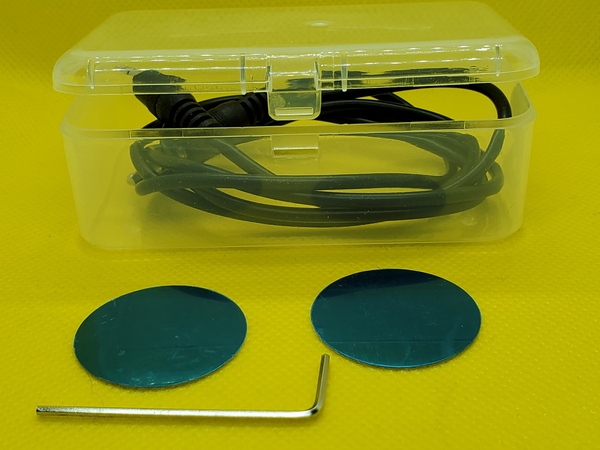
The accessories that came with the mini straight key. (Not shown is an adhesive rubber square that I attached to the bottom of the key.)
Based on my experience with the QU-21C paddles, I had some reservations about the highly polished square magnet on the bottom. However, since the motion of the straight key is the vertical plane instead of side-to-side, the magnet is less of an issue.
I used the key during a recent outing, and I had no major issues with it. I have some a couple of steel strips glued to my clipboard, and I stuck the key there. There was a little movement, but nowhere near as bad as the paddles. I just needed to make sure I didn’t get too vigorous with my keying. After I use them some more, I’ll decide if I want to modify them like I did with the paddles.
Most of the time I get what I pay for, but in this case, I think I got a decent product for the price. I let you know if my opinion changes with time.
I made another quick run over to nearby Valley Forge National Historical Park (US-0761, KFF-0761) this morning. There were a few things I wanted to do during this activation, including finishing off my first POTA Kilo Award. My last activation left me 28 QSOs shy of 1,000 contacts at Valley Forge.
I went with my usual setup: Penntek TR-35 and 12-ft loaded whip. I made a minor tweak to the antenna setup, which I wanted to test. (More on that in the future.)
Things got off to a brisk start this morning, so I quickly made the 28 QSOs I needed—and then some. After an hour on the air, I had 41 contacts in the log, with one park-to-park QSO and two German stations.
Before I packed up, I hooked up a little straight key I wanted to try out. (More on that later, as well.) I made a couple of Straight Key Century Club (SKCC) contacts with the new key, including one with K3Y/1, one of the Straight Key Month special event stations.
Earning a Kilo Award is no big deal for many activators, but I’ve been a casual activator at best. I made the first-ever POTA QSO at Valley Forge back in January 2016, so it took me nine years to get to 1,000 contacts. Actually, I wasn’t always active with the parks programs over the years; my focus shifted to other aspects of the hobby from time to time. Regardless, it’s been fun getting to this point.
My thanks to all the POTA and WWFF hunters who got me there. I appreciate each and every QSO.
We’re getting our first real taste of winter weather here in southeastern Pennsylvania. It’s been below freezing all weekend, and there’s a Winter Storm Warning in effect for Monday. So, I thought I would squeeze in a pair of activations at Valley Forge National Historical Park (US-0761, KFF-0761) this weekend before the snow gets here.
Valley Forge NHP is just a few miles from home, and I regard it as my “home park.” I’m getting close to a POTA Kilo Award here, so this was a good chance to continue inching towards that milestone. Unlike George Washington and the Continental Army in 1777-1778, I didn’t spend the winter here; I was only here a short time each day and went home to a warm house and hot coffee afterwards.
On Saturday morning, I parked in my usual spot at a popular trailhead. There were a bunch of trail runners there, so I was surprised by the number of cars there. My setup for both days included my usual Penntek TR-35 (5 watts, CW), MFJ-1977 12-foot whip, and homebrew loading coil.
The view from my “mobile shack” on Saturday at Valley Forge National Historical Park (US-0761, KFF-0761)
Over the next hour and a half, the hunters kept me busy. I operated on 40M, 20M, and 17M, with most of my contacts on 20M and 17M. When I finished up, I had 71 contacts in my log. I’m not sure, but I think that’s a personal record for me. Among those were one park-to-park and six DX contacts: France (3), Finland, Germany, and Italy. I also worked a couple of California stations.
Even though I was hunkered down in my truck, the inside temperature was only in the low 40s (F). My CW was getting a little sloppy, so I guess my old arthritic fingers were telling me it was time to wrap it up for the day.
I went back to Valley Forge again this morning (Sunday). When I arrived, it was colder than yesterday. The air temperature was 23º F (-5º C) and a wind chill of 12º F (-11º C). So, I set up my antenna in record time, to avoid getting my fingers numb. The good news is that there was more sun today, so the truck was about 10 degrees (F) warmer than yesterday.
The 40M band had RTTY contest stations all over the place, so I started out on 30M. About half of my contacts today were on 30M. The 17M band was a lot less productive than yesterday, only yielding four contacts. I found a clear frequency down on 40M, so I finished up there.
In an hour and a half, I made 50 contacts, two of which were park-to-park. I only had one DX contact today (DL8NDG). I’m still 28 contacts short of a Kilo Award, so I think one more activation should do it.
But, that activation will have to wait. Between the snow tomorrow and a medical procedure later in the week, it might be another week or two before I can get out again.
Wow! It’s hard to believe 2024 has come and gone. I wrapped up 2024 and welcomed the new year with a pair of POTA/WWFF activations.
I finished off 2024 with an early morning activation at Marsh Creek State Park (US-1380, KFF-1380). After rolling into the parking lot, I set up a 12-foot loaded whip on my truck. When I set up my Penntek TR-35 (5 watts, CW) in the cab of the truck, I ran into a snag. My trusty little radio refused to power up. After trying two other batteries without success, I spotted my problem. (Notice I said “my” problem.) I had connected my earbuds to the “Paddles” input and my paddles to the headphone jack. After correcting my faux pas, all was right with the world. Apparently the little TR-35 is smarter than me.
Marsh Creek State Park (US-1380, KFF-1380) on New Year’s Eve
As they say on TV commercials: But wait, there’s more. About 25 QSOs into my activation, my QU-21C paddles decided they only wanted to send dits occasionally. I quickly switched over to a straight key and kept plugging on. When there was a lull in the activity, I dug out my Palm Mini paddles and pressed on. (When I got home, I used some contact cleaner on the paddles, and they seem to work just fine again.)
After an hour and 15 minutes, I had 43 contacts in the log. Among those were four DX stations: F4HZR, IK4IDF, SM3NRY, and DL3HXX. My last QSO for 2024 was with K7NSW in Arizona.
My intended destination on New Year’s Day was Norristown Farm Park, since I’ve been slowly creeping up on a Repeat Offender award there. When I arrived, however, the park was closed. I quickly implemented “Plan B.” Evansburg State Park (US-1351, KFF-1351) is only about 5 miles down the road, so off I went.
I checked the propagation forecast before leaving the house. It showed a major geomagnetic storm in progress with poor conditions for all HF bands. Because of the challenging band conditions, I used a 17-ft whip with my homebrew loading coil, instead of my usual 12-foot whip. I figured I needed all the help I could get. Once again, I used my TR-35.
New Year’s Day at Evansburg State Park (US-1351, KFF-1351)
When I fired up the radio on 40M, the band was wall-to-wall with CW signals. It was hard to tell there was some geomagnetic wackiness going on. It didn’t take long for the hunters to find me. My first QSO of 2025 was with WN1E in Massachusetts. It took about 14 minutes to log my first 10 contacts. Not bad for a major storm, I suppose.
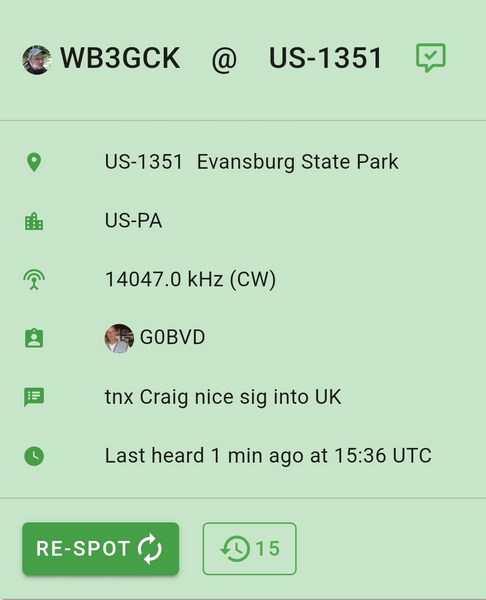
Conditions didn’t seem too bad on 20M. One difference I noted, though, was with the European hunters. Their signals had a watery, distorted sound. Despite the propagation, I had contacts with five DX stations: F1BLL, UT5PI, OZ1IPP, F4HZR, and GØBVD. An hour and 15 minutes on the air yielded 38 contacts. So, 2025 is off to a decent start.
This spot from GØBVD made my day. After all these years running QRP, it still amazes me every time I work a DX station with five watts.
I hope you all have a healthy and prosperous new year, and I look forward to hearing you on the air.
During a recent activation, my beloved MFJ 12-foot telescopic whip came apart. I’ve had it for a long time, so I was really disappointed when it broke. I specifically designed my homebrew loading coil to pair with a 12-foot whip. With this setup, I can work 40M through 17M by changing the tap on the coil. I don’t need to adjust the whip. These bands match the bands covered by my Penntek TR-35.
When the old whip broke, I salvaged the parts and tried to put it back together when I got home. No joy was to be had. However, all was not lost.
Although 12-foot telescopic whips aren’t aren’t as widely available as the ubiquitous 17-foot whip, I found one in stock at Ham Radio Outlet. After placing my order, I had the antenna on my porch 24 hours later on Christmas Eve. (I have no financial interest in HRO. I’m just a very satisfied customer.)
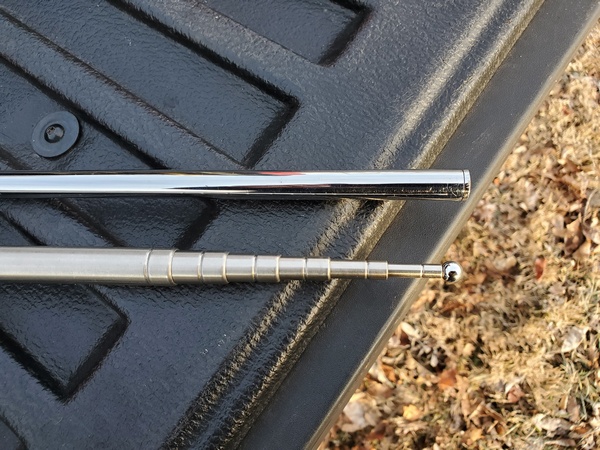
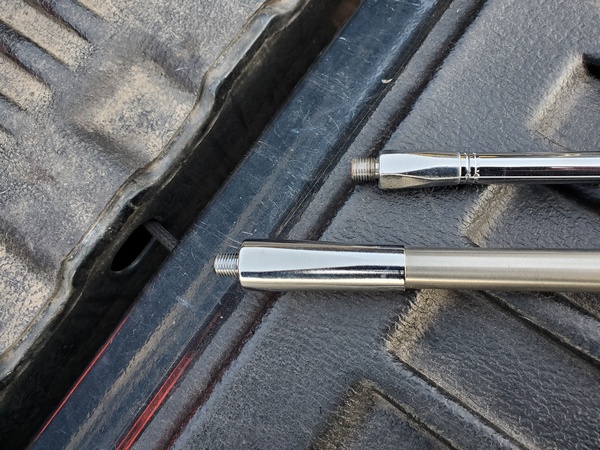
This new whip is an MFJ-1977, and it’s distinctly different from my old MFJ-1956 whip. The new whip’s construction is the first obvious difference. Additionally, the stainless steel has a less polished finish. The MFJ-1977 is also a little heavier, and its collapsed length is an inch or two longer than the older whip. In the pictures below, the older MFJ-1956 is on the top and the new MFJ-1977 is on the bottom:
The new MFJ-1977 had its maiden deployment at Norristown Farm Park (US-4363, KFF-4363). I used the antenna with my Penntek TR-35 (5 Watts) on 40M, 20M and 17M. As expected, the new antenna seemed to perform as well as its predecessor. After an hour and 10 minutes, I had 42 in the log with three DX contacts: two from France and one from Germany.
My old 12-foot whip saw heavy use, and it served me well. In the future, however, I plan to rotate whips occasionally. I extended my MFJ-1979 17-foot whip to 12 feet and marked it with a permanent marker. I did the same with my cheap 5.6M whip from AliExpress. Hopefully, having two other whips available will let me avoid beating up my 12-foot whip and extend its life.




 WB3GCK QRP Amateur Radio