CW – A Workout for Your Brain

For those of us who use it, the advantages of the CW mode are well known. It’s efficient and cuts through noise better than voice. CW is also well-suited for low-power (QRP) communications, enabling the use of modest equipment and power sources. Another important advantage is that learning and using Morse code is good for your brain. 

It should come as no surprise that ham radio demographics skew heavily towards older adults. Folks over the age of 55 make up roughly 60% to 70% of the ham radio community.1 It’s also widely known that cognitive decline often comes with age. I’ve always believed that Morse code is good exercise for your brain. In doing some research, I found that scientists have studied this, and there’s solid scientific evidence supporting my beliefs. 

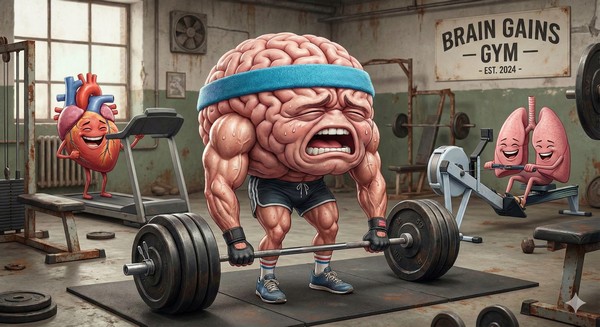
AI-generated cartoon image showing a human brain lifting weights in a gym.

Five Ways Your Brain Benefits From Morse Code

Mental Exercise There are several studies out there that show the benefits of learning and using a new skill, such as a new language or playing a musical instrument. With Morse code, you are essentially learning and using a new language, since you are translating sound patterns into letters and words. This type of activity strengthens memory and attention.2 

Promotes Neuroplasticity. There are studies that show measurable changes in CW operators’ brains related to listening and motor control. Activities like this have been shown to promote neuroplasticity, or the ability to adapt and create new pathways in the brain.3 4 I’m no neuro-scientist, but I’m told this is a good thing for your brain. 

Improved Auditory Processing. Copying Morse code by ear is all about recognizing patterns, rhythms, and differences in pitch. This can sharpen auditory discrimination and focus. It seems to me that recognizing patterns, rhythms, and pitches is pretty similar to playing a musical instrument. 

Focus and Mindfulness. Copying CW requires our complete attention and sustained concentration. This exercises your brain, not unlike playing a challenging game or solving a puzzle. 

Social Interaction. When you use Morse code to communicate with others, it keeps you socially engaged, which is increasingly important as we age. Social engagement is not limited to just Morse code; hams communicate with each other using a variety of modes. Belonging to a radio club or participating in nets also provides social interaction. During my 50-plus years in ham radio, I have had the pleasure of developing countless friendships, both on the air and in person. 

It’s Never Too Late to Start

When I was an 18-year-old sailor training to become a U.S. Navy radio operator, I soaked up Morse code like a sponge. Studies show there’s a good reason for that. Younger brains work faster, while processing speed and working memory can decline with age. That doesn’t mean we older folks should throw in the towel on learning new skills. Au contraire! Remember that neuroplasticity I mentioned earlier? Well, science shows that the ability to form new pathways and connections in the brain continues well into our twilight years.5 Contrary to the old adage, it seems you can teach an old dog new tricks.

While younger brains have their speed advantage, older adults approach learning armed with a lifetime of experiences. Because of these accumulated experiences, older folks are often better at problem solving and pattern recognition. Also, our retention and conceptual understanding are often better. We just might need more repetition and smaller chunks of information while learning something new. 

Take Your Brain to the Gym

If you don’t already use CW, consider giving it a shot. It can be challenging, but it’s certainly worth the effort. Just be patient and stick with it. I think you’ll find it’s a fun way to communicate. 

If you’re already a CW aficionado, grab that key and join me on the air for a workout!

73, Craig WB3GCK 

DIT DIT

References:
    1. Mann (N0SSC), S. (2021, April 23). There Is Youth in Ham Radio. On All Bands. https://www.onallbands.com/there-is-youth-in-ham-radio/ ↩︎
    2. Wu, R., & Jessica, C.-L. (2023, June 23). To Stay Sharp as You Age, Learn New Skills. Scientific American. https://www.scientificamerican.com/article/to-stay-sharp-as-you-age-learn-new-skills/ ↩︎
    3. Schlaffke L, Leemans A, Schweizer LM, Ocklenburg S, Schmidt-Wilcke T. Learning Morse Code Alters Microstructural Properties in the Inferior Longitudinal Fasciculus: A DTI Study. Front Hum Neurosci. 2017 Jul 26; 11:383. doi: 10.3389/fnhum.2017.00383. PMID: 28798672; PMCID: PMC5526915. https://pubmed.ncbi.nlm.nih.gov/28798672/ ↩︎
    4. Schmidt-Wilcke T, Rosengarth K, Luerding R, Bogdahn U, Greenlee MW. Distinct patterns of functional and structural neuroplasticity associated with learning Morse code. Neuroimage. 2010 Jul 1;51(3):1234-41. doi: 10.1016/j.neuroimage.2010.03.042. Epub 2010 Mar 24. PMID: 20346399. https://pubmed.ncbi.nlm.nih.gov/20346399/ ↩︎
    5. Greenwood & Parasuraman (2010). Neuronal and cognitive plasticity: A neurocognitive framework for cognitive training in older adults. Restorative Neurology and Neuroscience. https://www.frontiersin.org/journals/aging-neuroscience/articles/10.3389/fnagi.2010.00150/full ↩︎

    Ten-Year Blog-iversary

    Ten years ago today, I published my first post on this blog. Time flies when you’re having fun—and it certainly has been fun.

    I started this blog mostly for selfish reasons. It started off as a personal journal of sorts, a way of documenting my ham radio activities and projects. When I receive a QSL card or Logbook of the World confirmation, I often go back through the posts to see where I was, what equipment I was using, and how I was set up during the contact. I thought others might want to read this stuff, and apparently they do.

    Some blog posts have been consistently popular over the years. I could only pull up statistics for the last five years, but the most frequently visited posts over that period were:

    1. Revisiting the Rybakov 806 Vertical
    2. The Doublet – Revisiting a Classic Antenna
    3. A Homebrew Z-Match Transmatch
    4. Speaker Wire Half-Square Antenna
    5. U.S. Navy Morse Code Training

    I don’t make any money from this blog; there are no sponsors, affiliate links, or the like. It’s just something I have enjoyed doing. So, if you are among the hundreds of visitors each day from around the world, thank you for stopping by.

    Here’s to the next ten years!

    72, Craig WB3GCK

    Operating a QRP Classic: The Tuna Tin 2

    I learned recently that Ed Hare, W1RFI, passed away. Ed was a long-time lab engineer at ARRL. I didn’t really know him, but I had the pleasure of meeting him at a QRP gathering 25 years ago. The post below originally appeared on my old website, but I thought I’d share it over here in Ed’s memory. – WB3GCK

    During the 2000 Atlanticon QRP convention at Glen Mills, Pennsylvania, I had the distinct honor of operating a bit of QRP history. Ed Hare, W1RFI, brought the original Tuna Tin 2 transmitter and put it on the air as a special event station operating as W1FB/3.

    For those unaware of the significance, the Tuna Tin 2 was built by famed QRPer, Doug DeMaw, W1FB, and featured in QST back in the 70s [1][2]. It was stored at ARRL headquarters for many years until it mysteriously disappeared. It was later discovered by Ed Hare in a hamfest junk box 100 miles away. Ed bought it back for a dollar and has been putting this classic rig on the air on a regular basis. The fact that it still exists at all makes it a very special piece of equipment. The design has been updated over the years and QRPers still continue to build versions of this venerable classic.

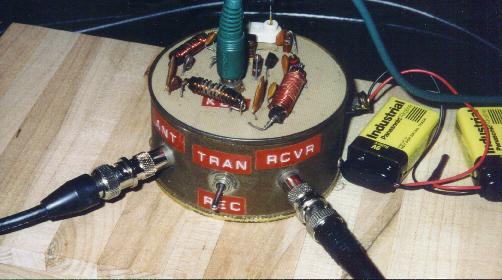
    The Tuna Tin 2 transmitter

    Technically speaking, it’s not much of a transmitter. A couple of 2N2222s in a simple, crystal-controlled circuit putting out about a half-watt or so (or about 800mW with the two 9-volt batteries shown). Using a toggle switch to switch from transmit to receive brought back memories of my Novice days. My only QSO was with another QRPer on the 4th floor of the hotel. Still, I was thrilled to be able to briefly operate this famous little transmitter. Especially, under Doug DeMaw’s callsign, W1FB. That really made it special. 

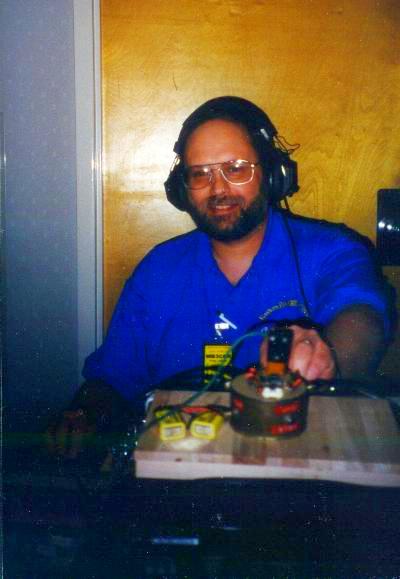
    WB3GCK operating W1FB's famous Tuna Tin 2 transmitter at Atlanticon in 2000.

    © 2000-2025 Craig A. LaBarge

    [1] DeMaw, Doug. “Build a Tuna Tin 2.” QST, May 1976, pp. 14–16. Available in the QST archives at ARRL.org.
    [2] Hare, Ed. “The Tuna Tin 2 Today.” QST, Mar. 2000, pp. 37–40. Available in the QST archives at ARRL.org.

    Of Hams and Bikes

    I received an email from Jim N4JAW last week, letting me know he was planning to mention me in an upcoming blog post. Jim is an avid cyclist and is the owner of the Ham on a Bike blog. He’s doing a series of posts highlighting other hams who incorporate cycling into ham radio activities (or vice versa), titled “I Am Not Alone. There Are Many Of Us.” 

    Jim gave me a shout-out in Part 2 of his series. I’m honored to have my meager cycling activities included among such a distinguished group of hams on bikes. There is a really impressive collection of videos and pictures in Jim’s posts.

    My park bench setup in Towpath Park
    Operating bike-portable a couple of years back

    All of this reminds me I’m long-overdue for some bike-portable operation. Now that the weather is warming up a bit, I need to get the bike out on the trails. 

    Be sure to check out Jim’s blog. He has some great stuff over there. 

    72, Craig WB3GCK

    A Half-Century of Ham Radio

    Wow! Where has the time gone? Today marks 50 years of ham radio for me. I was first licensed as WN3YSV on this date in 1974, after finishing a four-year hitch as a Navy Radioman. Over those years, I’ve made a lot of great memories. I also made a lot of great friends, both in-person and on the air. 

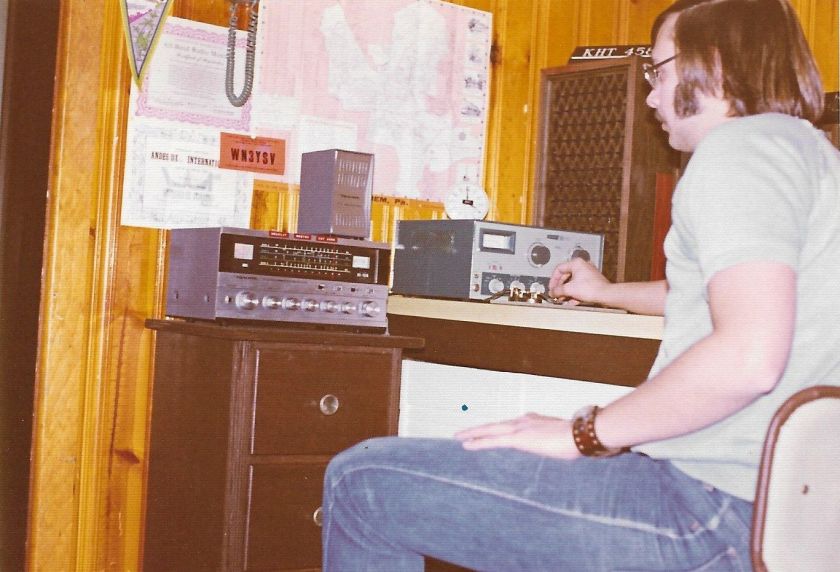
    My first station included a Heathkit DX-60 crytal-controlled transmitter and a Realistic DX-160B receiver. This picture was taken in 1975, about 8 months after leaving the Navy.
    WN3YSV (pre-WB3GCK). My first station included a Heathkit DX-60 crystal-controlled transmitter and a Realistic DX-160B receiver. This picture was taken in 1975, about 8 months after leaving the Navy.

    Thanks to the thousands and thousands of hams I’ve had the pleasure of working over the past 50 years. I look forward to many more contacts over the next 50 years!

    72, Craig WB3GCK (ex-WN3YSV)

    The Mystery of the Sticky Feet

    I’ve been powering up some of my old QRP gear to see if any of it still works. The gear has been stacked up on a shelf above my operating position for years. In testing some of this gear, I came across a curious problem.

    Last night I was rearranging some of my equipment and re-routing some coax cables. When I went to move my Oak Hills Research power meter, it was stuck to the shelf. The rubber feet on the bottom of the meter had become slightly soft and sticky. I didn’t think too much of it at the time. I just finished connecting the cables and placed it back on the shelf. 

    Today, I took my old MFJ-9030 transceiver down from the shelf and was greeted with a gooey mess. The rubber feet had completely dissolved and turned into a sticky, tar-like mess. Using a single-edged razor blade, I scraped off as much as I could from both the radio and the residue on the shelf. I used some mineral spirits to clean up as best I could. The mineral spirits worked great, but I still had sticky spots where the feet were attached to the radio. I cut some pieces of aluminum duct tape to cover those spots, and I applied four new feet from my junk box. 

    This is the underside of my 31 year old MFJ-9030 transceiver showing the black goo from the dissolved feet. The clear feet were added by me.
    This is the underside of my 31 year old MFJ-9030 transceiver showing the black goo from the dissolved feet. The clear feet were added by me.

    My theory is that the rubber (or whatever material they are) feet reacted with the finish on the shelf. I know that vinyl guitar straps and accessories can damage the lacquer finish used on some high-end guitars (like my 1973 Martin D35 acoustic), so I suspect something like that happened to my radio equipment. I built the shelf and my operating table from some repurposed shelves that were in the house when we moved in back in the late 70s. So, I have no idea what kind of finish is on them. 

    Besides the power meter I mentioned earlier, it looks like my old MFJ-941-E antenna tuner is also affected. So, I’ll have to replace the feet on those items and clean up the residue on the shelf with the mineral spirits. Needless to say, some of this equipment hasn’t been moved in years.

    This wasn’t exactly how I wanted to spend my afternoon, but I’m glad I spotted the problem.

    72, Craig WB3GCK

    Carter Craigie N3AO (SK)

    I recently learned of the passing of my old friend, Carter Craigie, N3AO. He was an avid QRPer, an excellent CW operator, and one of the nicest people I have ever met. 

    I first met Carter sometime back in the 90s, when we were members of the now-defunct Eastern Pennsylvania QRP Club (EPA-QRP). Later on, Carter and I were members of Chester County (PA) ARES-RACES. Carter served a two-year stint leading the organization as the Emergency Coordinator (EC). 

    Eventually, Carter and his wife, Kay N3KN (former ARRL President), moved to Blacksburg, Virginia. Although I rarely saw him in person after that, I had a bunch of QSOs with him over the years. He was a regular participant in QRP field contests, like the NJQRP Skeeter Hunt and Flight of the Bumblebees. He was also an active member of the Straight Key Century Club (SKCC). 

    In 1999, Carter N3AO and Ed WA3WSJ stopped stopped by my campsite in French Creek State Park (PA) to check out my new camper. L-R: WA3WSJ, WB3GCK, and N3AO.
    In 1999, Carter N3AO and Ed WA3WSJ stopped stopped by my campsite in French Creek State Park (PA) to check out my new camper. L-R: WA3WSJ, WB3GCK, and N3AO.

    Looking back through my logs brought back some memories. Carter always tried to work me when I was out camping or traveling. He seemed to know my go-to frequencies and operating habits and would always seem to find me. I remember being on a camping trip to the Thousand Islands in New York back in 1999. I turned on the radio one morning, and without touching the tuning knob, the sound of Carter calling me greeted me. We had some nice rag chews on those trips. 

    Phillies spring training in Clearwater, FL, in 2009. L-R: WB3GCK, my (far) better half, Kay N3KN, and Carter N3AO.
    I had the pleasure of running into Carter and Kay during Phillies spring training in Clearwater, Florida, in 2009. L-R: WB3GCK, my (far) better half, Kay N3KN, and Carter N3AO.

    During the year-long National Parks on the Air (NPOTA) event in 2016, I used to text Carter whenever I was out activating a park. Within minutes, I would hear Carter calling me for a contact. He would always make sure to spot me on the NPOTA Facebook page. 

    While it’s sad to know that I won’t hear Carter on the air anymore, I feel truly blessed for having known him. Rest in peace, my friend.

    72, Craig WB3GCK

    A Tool for Dual Activators

    I was first bitten by the parks bug, taking part in ARRL’s National Parks on the Air (NPOTA) program in 2016. When NPOTA ended, I started activating parks under the World Wide Flora & Fauna (WWFF) program. When Parks on the Air (POTA) came along, I started submitting my logs to both programs—and still do. 

    Since POTA and WWFF are separately administered, there are some significant differences between the two programs. One notable difference involves the park designators. In some cases the park numbers are the same, but often they’re different. For example, the designator for PA 246 State Game Land is KFF-5862 in WWFF and US-8941 in POTA. Sometimes a park will be in one program but not the other. 

    Fortunately, Al Zelna N3KAE has provided an online tool that makes it easy for “dual activators” to cross-reference the WWFF and POTA park designators in the U.S. and Canada. Visit the CQ Parks.net website to check it out. 

    Dual Parks North America

    If you aren’t familiar with WWFF, it’s the original Amateur Radio parks program. In its current form, WWFF dates back to 2012, but it has roots going back to about 2008. While POTA has seen tremendous growth since its inception, WWFF is still very popular in Europe and other parts of the world. When band conditions are good, a spot on the WWFF site or a DX cluster will often generate a European pile-up. It sure is fun having a bunch of DX stations chasing my little QRP station.

    Have fun out in the parks, however you activate!

    73 & 44, Craig WB3GCK

    Drive-on Antenna Mount Article

    Drive-on Antenna Mast Mount

    Back in December, Becky Schoenfeld W1BXY, Editorial Director for ARRL’s On the Air magazine, asked me if I would be interested in writing a detailed set of step-by-step instructions for my Drive-on Portable Antenna Support. Naturally, I said I would.

    I submitted my manuscript, along with an all-new set of pictures. The article was published in the current issue (May/June 2024) of On the Air (pages 20-22).

    If you’re interested, have a look. ARRL members have access On the Air as part of their membership.

    73, Craig WB3GCK