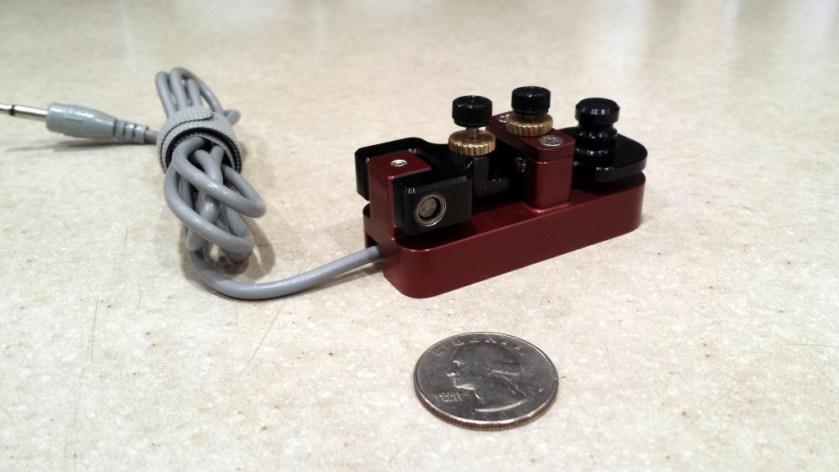
American Morse MS2 Straight Key

For many years after I first learned the code in the Navy, I was a die-hard straight key user.  Unfortunately, back in the 90s, I started to experience some wrist pain and switched to using iambic paddles.  Recently, after working one of the Straight Key Century Club (SKCC) K3Y special event stations, I was inspired to sign up with SKCC and dust off my straight keys.  Hopefully, I will be able to get my old straight key fist back in short order.

Since I do most of my operating while portable, I wanted a straight key that was easy to pack and use while sitting on the ground along some trail somewhere.  I was looking for something small that I could add some magnets to for use with my little clipboard.

After doing some research, I decided on the American Morse MS2 miniature straight key.  I built a set of Doug Hauff’s (W6AME) NorCal paddles from a kit many years ago and they are still in regular use.  Doug’s machine shop produces some precision stuff.

The kit arrived a few days after I placed my order.  Following the manual’s precautions, I emptied the parts into a baking pan.  Some of the parts are pretty small and would disappear forever if dropped on the carpet.  Even with my aging eyes, it only took about 45 minutes to assemble the kit.  (A younger person with better eyes and steadier hands could have done it faster, I’m sure.)  You need to supply your own cable and connector, so I dug an old audio patch cable out of my junk box and cut it in half.

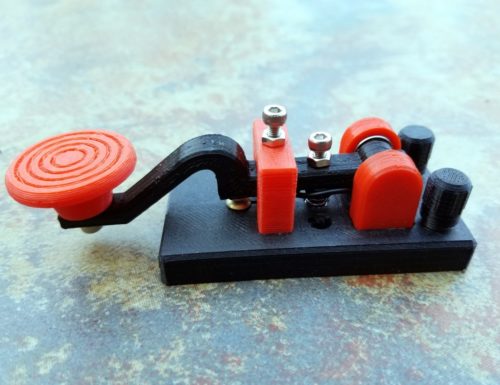
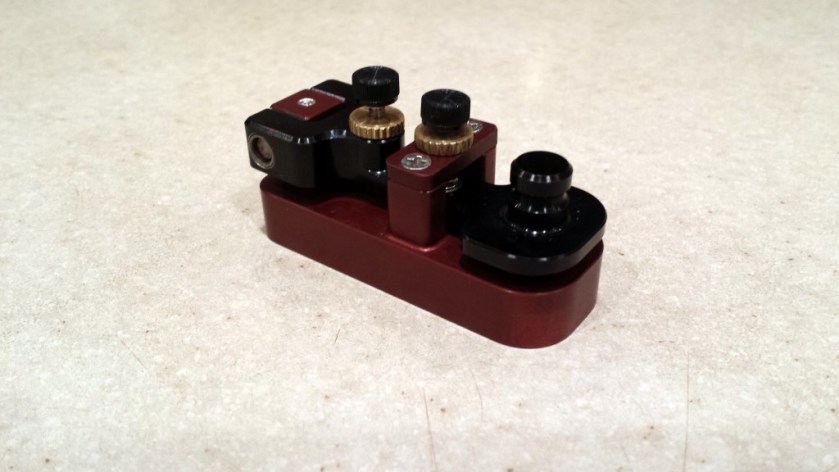
American Morse MS2 straight key after initial assembly

The key is 2 inches long by 1 inch wide and is made from machine aluminum.  The contact gap and spring tension are fully adjustable.  The key (with my cable attached) only weighs about 2.7 ounces (76 grams).

The finished MS2 straight key with cable attached. The cable is one half of an 1/8-inch diameter audio patch I had in the junk box.

After adjusting the contact spacing and the spring tension, I was surprised at how great this little key feels.  The knob is a little different from most keys, but I was able to easily adapt to it.  As expected, the overall quality of the key is outstanding.

My next project will be to attach some sort of base to it with magnets spaced to line up with the washers on the clipboard I use while portable.  More on that in another post.  I’m looking forward to making some SKCC contacts from out in the field.

72, Craig WB3GCK

Jackite Pole Repairs

As you can tell from other posts, I’m a big fan of Jackite fiberglass poles.  My 31-foot pole sees heavy use as the main component of my Pop-up Vertical antenna. I also use it a variety of other portable situations, including my Bike Rack Vertical antenna.

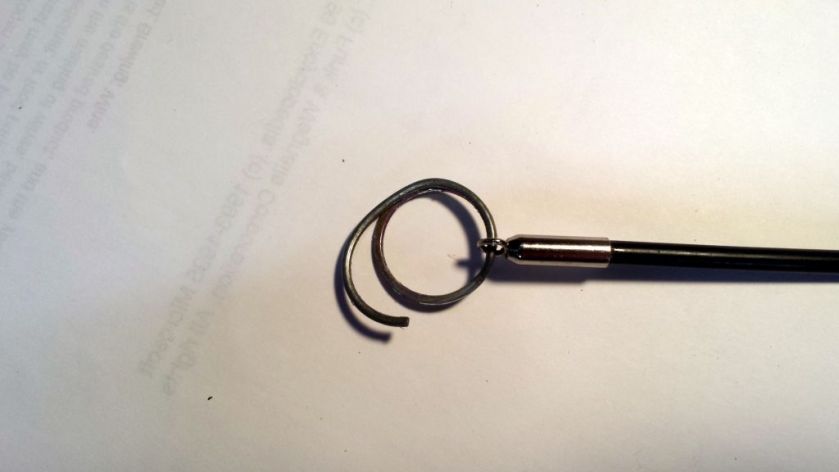
Recently, I was in a wooded area and had the pole strapped to a signpost. While packing up to leave, the tip section got stuck.  It refused to slide back into the next larger section.  I noticed that the split ring I have attached to the top eyelet (see my Jackite Hacks post) had some damage. I’m guessing it got hung up in a tree branch when I was collapsing the pole.  My downward pulling most likely caused the top two sections to become jammed.

Damaged split ring. (Click for full-size image.)
Damaged split ring. A possible clue as to how two sections of my Jackite pole became hopelessly jammed.

I have had these two sections become stuck once or twice before.  I guess I’m sometimes a bit too aggressive when I extend the sections.  Usually, a little WD-40 does the trick.  Not this time.

I worked on it when I got home and wound up cracking the tip section.  The two sections were still stuck together.  After few minutes on the Jackite website, a new tip section and the next larger section were on order.  I received a shipping notice the next day. The cost was reasonable.  It was definitely less expensive than replacing the entire pole.  A couple of days later, the parts arrived and the pole is ready to head out into the field again.

Thanks to the good folks at Jackite, I’m back in business.  I’ll try to be more careful next time.

72, Craig WB3GCK

Disclaimer:  I have no interests, financial or otherwise, in Jackite.  I’m just a happy customer.

Jackite Pole Hacks

I’m a big fan of the Jackite fiberglass poles for portable antenna supports. I have two of them have have seen a lot of use over the years. Here are a couple of quick and simple hacks that improve (in my opinion) on an already great product.

Keeping the Cap From Falling Off

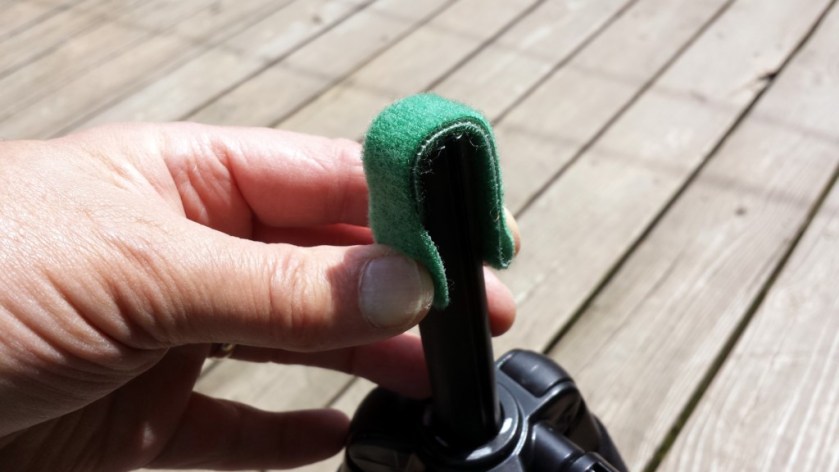
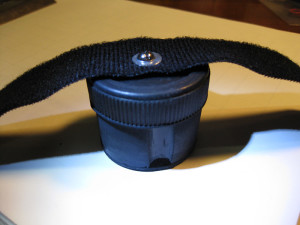
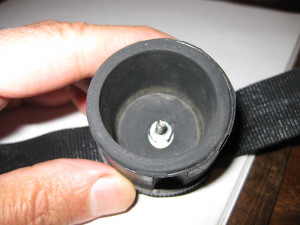
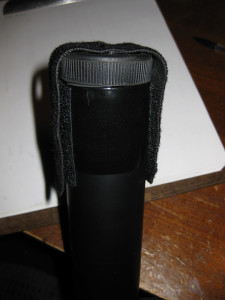
While the overall quality of Jackite’s products is excellent, there is one thing that I find annoying — the caps have a tendency to fall off when transporting the pole. To overcome this, I attached a velcro strap to the cap (Figure 1). The Velcro is something I had on hand in my junkbox. It’s about 8 inches long by 1 inch wide. I used a #4 machine screw with some flat washers, a lock washer and a nut (Figure 2). I used an awl and a small phillips screw driver to make the hole in the cap. I then attached two Velcro strips (the fuzzy part) on either side of the pole (Figure 3). When transporting the pole, just secure the Velcro straps (Figure 4) and you’re good-to-go.

Figure 1
Figure 1
Figure 2
Figure 2
Figure 3
Figure 3
Figure 4
Figure 4

Easy Extension

This quick mod might seem kinda pointless to some users. In fact, I hesitated about writing it up. Anyway, you be the judge:

Figure 5
Figure 5

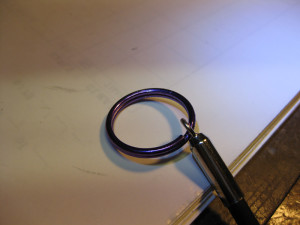
In cases when I need to bungee or strap the pole to a fixed support, I would first need to extend the top-most section first. This is because the top section sits down inside the other sections when collapsed. What I did was attach a key ring (aka split ring) to the eyelet on the top section (Figure 5). The ring I used is approximately 7/8-inch in diameter. So, I can strap the collapsed pole to a support, remove the cap, reach in and use the ring to pull the top section out (Figure 6).

Figure 6
Figure 6

Again, you might not see the value in this one, but I find it helpful.

73, Craig WB3GCK